They all look much the same, and Dyson has never made this easy. There's no model name printed on the side, the box went in the bin years ago, and "Supersonic" covers most of a decade of machines that differ in ways that matter.
It matters for a practical reason: some of these can be repaired and some can't. Not because the faults are different, but because parts for the newer models aren't available to anyone outside Dyson. Knowing which one you've got tells you whether you're looking at a repair, a warranty claim, or a replacement — before you spend money on postage finding out.
Here's how to identify yours, and what each one means.
Where the number is
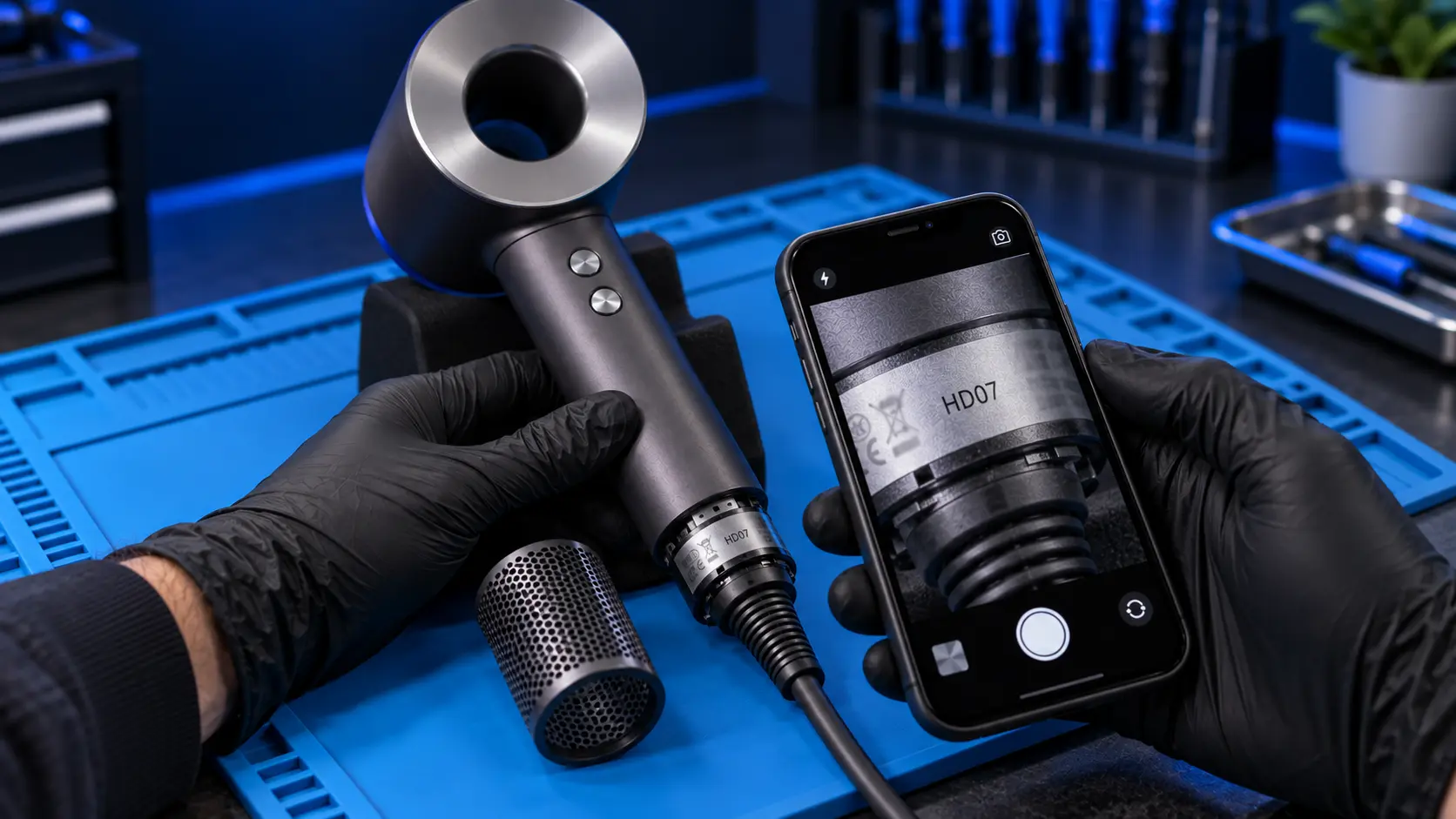
Every Supersonic carries a rating plate with the model and serial number on it. It's on the base of the handle — the flat end, where the cable comes out.
Slide the filter cage off first. It pulls down off the bottom of the handle, and on most models it comes away with a firm, straight pull. With it off, the printed information on the body underneath becomes readable.
What you're looking for is a code beginning HD followed by two digits — HD01, HD03, HD07 and so on. There'll be a longer serial number alongside it, and the electrical ratings.
The print is small and often worn, especially on older machines. Use your phone's camera and zoom in rather than squinting; it's usually easier to read on a screen than in the flesh.
If it's completely illegible, you have three other routes. The serial number is on the original box if you still have it. If you registered the machine with Dyson, it'll be on your account. And Dyson's own support can identify a machine from the serial number alone.
What each model is
HD01 — the original, launched in 2016. The one most likely to be broken by now, simply because it's had the most years. Cable failures dominate this generation. What goes wrong with an HD01.
HD03 — the long-running mainstream revision, and the one you're most likely to have. Huge numbers sold. Common HD03 faults.
HD07 — the more recent mainstream generation. More of these are still in warranty, which changes the answer to "what should I do about it". HD07 problems and what to do first.
HD02, HD04 and HD08 — lower-volume variants covering different markets and retail bundles. Fewer of them about, and they share most of their faults with the mainstream models of the same era.
HD16 — the Supersonic Nural. The newer, sensing model. Different internally from everything above it, and only partly serviceable outside Dyson. What can and can't be done on a Nural.
HD17 — the Supersonic r. The compact, flattened professional model. Visibly different from the rest as soon as you see one. Why the Supersonic r can't currently be repaired independently.
HD19 — the Supersonic Travel. The folding, dual-voltage one. Also outside what's serviceable independently, for the same reason. The HD19 situation explained.
Professional editions. Salon machines, based on the mainstream models of their generation but used vastly harder. They fail differently — more airflow restriction, more cable wear, sooner. Professional edition repairs.
Which ones I can actually repair
This is the part that saves you a wasted parcel, so I'd rather say it plainly than bury it.
HD01, HD02, HD03, HD04, HD07, HD08 and the Professional editions — full range. Cables, heating faults, airflow, cut-outs, noise, servicing. These are the machines with a genuine independent parts route, and they're the bulk of what's in circulation.
HD16 Nural — partial. There's a limited set of work I'll take on, and a larger set I won't, because the electronics and sensing are a different proposition and the parts aren't there. If you've got a Nural, check before booking rather than after.
HD17 Supersonic r and HD19 Travel — I decline these outright, and so does every other independent I'm aware of. There's no independent parts supply for them. If yours is one of these and it's faulty, Dyson is genuinely your best option, and I'd rather tell you that here than have you pay to post it, only for me to tell you the same thing.
I lose work by writing that paragraph. I'd still rather write it.
Telling them apart without the label
If the rating plate has worn away completely, a few things narrow it down:
The Supersonic r (HD17) is obvious. It's noticeably flatter and more compact than every other model, with the motor arrangement moved. If yours looks like the standard Supersonic shape, it isn't this one.
The Travel (HD19) folds. If yours doesn't fold in the middle, it isn't an HD19.
The Nural (HD16) is recent. If you bought it before 2024, it isn't one.
That leaves the mainstream generations, which look similar enough that guessing between them isn't reliable. The good news is that it matters far less — they're all repairable, and the faults overlap heavily. For a repair booking, "one of the standard Supersonics" is usually enough to get started, and I'll confirm the exact model when it arrives.
Why the generation matters for what it costs
Two reasons, and neither is about the price list.
Parts availability and age. An older machine has had more years of flexing on the cable and more hours on the bearings. That doesn't make it unrepairable — cables are entirely fixable — but it does mean a tired HD01 sometimes has a second fault behind the first one.
Whether it's worth it at all. This is the honest bit. If you've got an early machine with a failed motor, the maths sometimes says no: a used working Supersonic is £90–£115 with no warranty and no history, Dyson's refurbished one is around £250 when in stock, and new is £279.99. A cable repair on an eight-year-old machine is almost always worth doing. A major internal repair on the same machine sometimes isn't, and I'll tell you which you're looking at rather than quoting and hoping.
Common questions
Is the serial number the same as the model number?
No. The serial is unique to your machine; the model — the HD number — tells you which generation it is. They're printed together on the same plate.
Do I need the model number to book a repair?
It helps, but it isn't essential for the mainstream models. Tell me what you can see, and if there's genuine doubt I'll confirm on arrival. The exception is the newer models: if there's any chance yours is a Nural, a Supersonic r or a Travel, check before booking, because those are the ones where the answer might be that I can't help.
My machine is out of warranty. Does that change anything?
Only in where you can go. An out-of-warranty mainstream Supersonic is a perfectly normal independent repair. An out-of-warranty HD17 or HD19 is still a Dyson job, unfortunately.
The label is worn away completely. What now?
Send a photo of the machine with your enquiry. Between the shape, the attachments and the filter design I can usually place the generation, and for the mainstream models the precise number rarely changes what I do.
How long does a repair take?
The current turnaround is shown when you book. If a part needs ordering, I'll tell you as soon as I've diagnosed it and give you a realistic date.
Slide the filter cage off, photograph the base of the handle with your phone, and zoom in. That's the whole job, and it takes a minute. Once you've got the HD number, the pages above will tell you what tends to go wrong with your particular machine and what it costs to put right.
And if it turns out to be an HD17 or an HD19, I've saved you the postage — those go back to Dyson, and there's no independent route for them yet. If it's one of the mainstream models, have a look at what I charge, which is a fixed price up front rather than an estimate after you've posted it. Every repair is done by me personally, on my own bench, start to finish. Either way, note the number down somewhere now — it's a lot easier to read today than it will be in three years.
The Repair Works is an independent UK repair service, run by me, Paul — 25 years of hands-on repair experience, working by post for customers across the whole country. Not affiliated with or endorsed by Dyson.