I repair these for a living, so you'd expect this page to tell you never to get rid of one. It won't. Sometimes selling it is the right call and occasionally recycling it is, and I'd rather be the one who says so.
What I would ask is that you don't bin it, in the literal sense, and that you do one ten-second test first — because the most common reason a Supersonic ends up in a "spares or repair" listing is a fault worth £79 to fix on a machine worth a great deal more than that.
Do this before you decide anything
Switch it on, hold the dryer completely still, and flex the cable gently where it enters the handle.
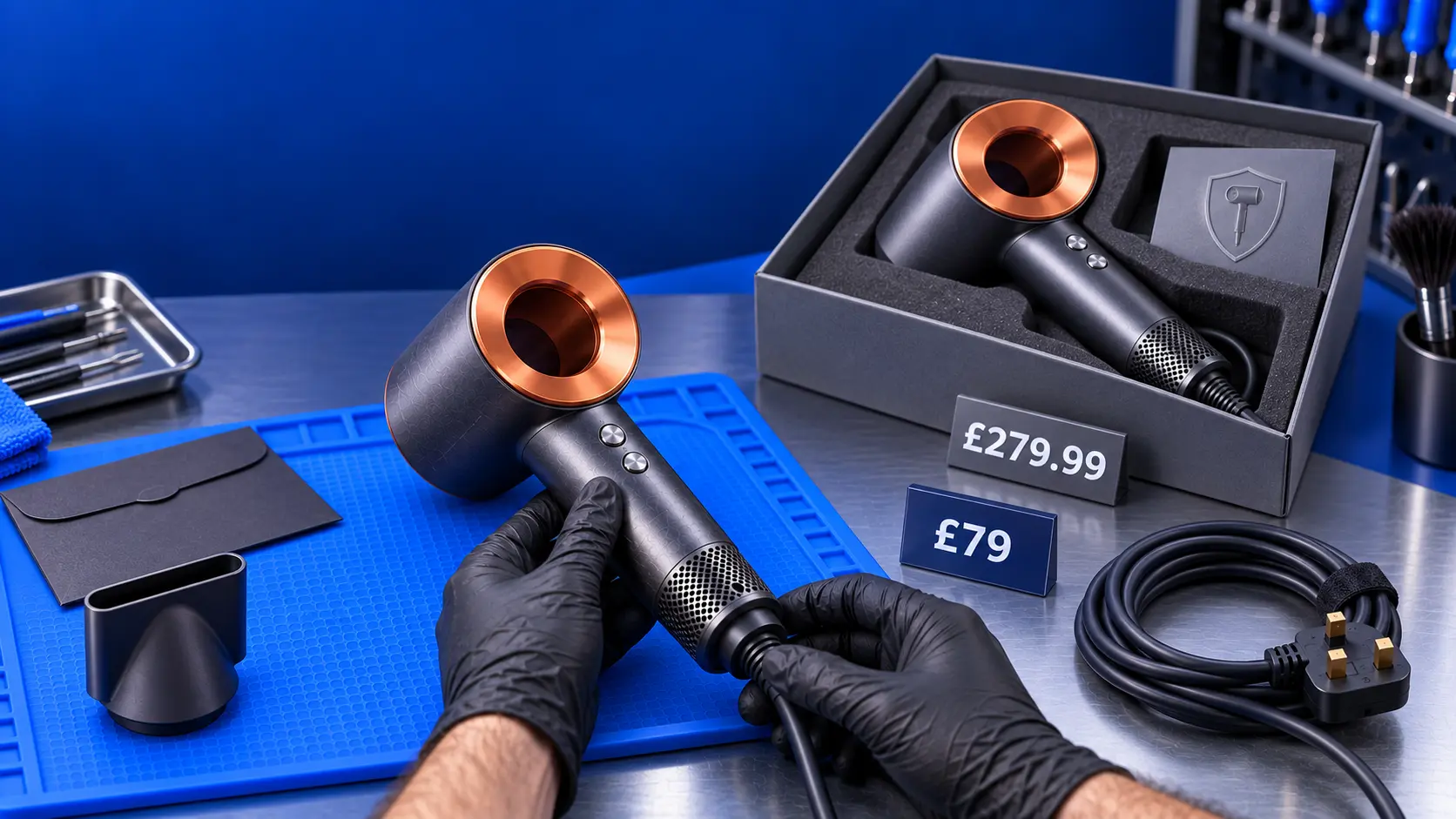
If the behaviour changes at all — cuts out, stutters, comes back to life — that's a cable. It's the most common fault on these by a wide margin, it's £79 to put right, and you'd be selling a machine with a perfectly good motor for the price of a takeaway.
That single test is the difference between a £79 repair and giving away something that cost you close to £300. It takes ten seconds and it's the only reason I'd ask you to read this page before listing anything.
What a broken one is actually worth
Three separate things give a dead Supersonic value, and most people selling one only think about the first.
The motor. This is the expensive component and it's usually the part that's still fine. Buyers who know these machines are buying the motor — everything else is cheap and replaceable. A dryer that's dead because of a cable or a board is, to the right buyer, a good motor with a solved problem.
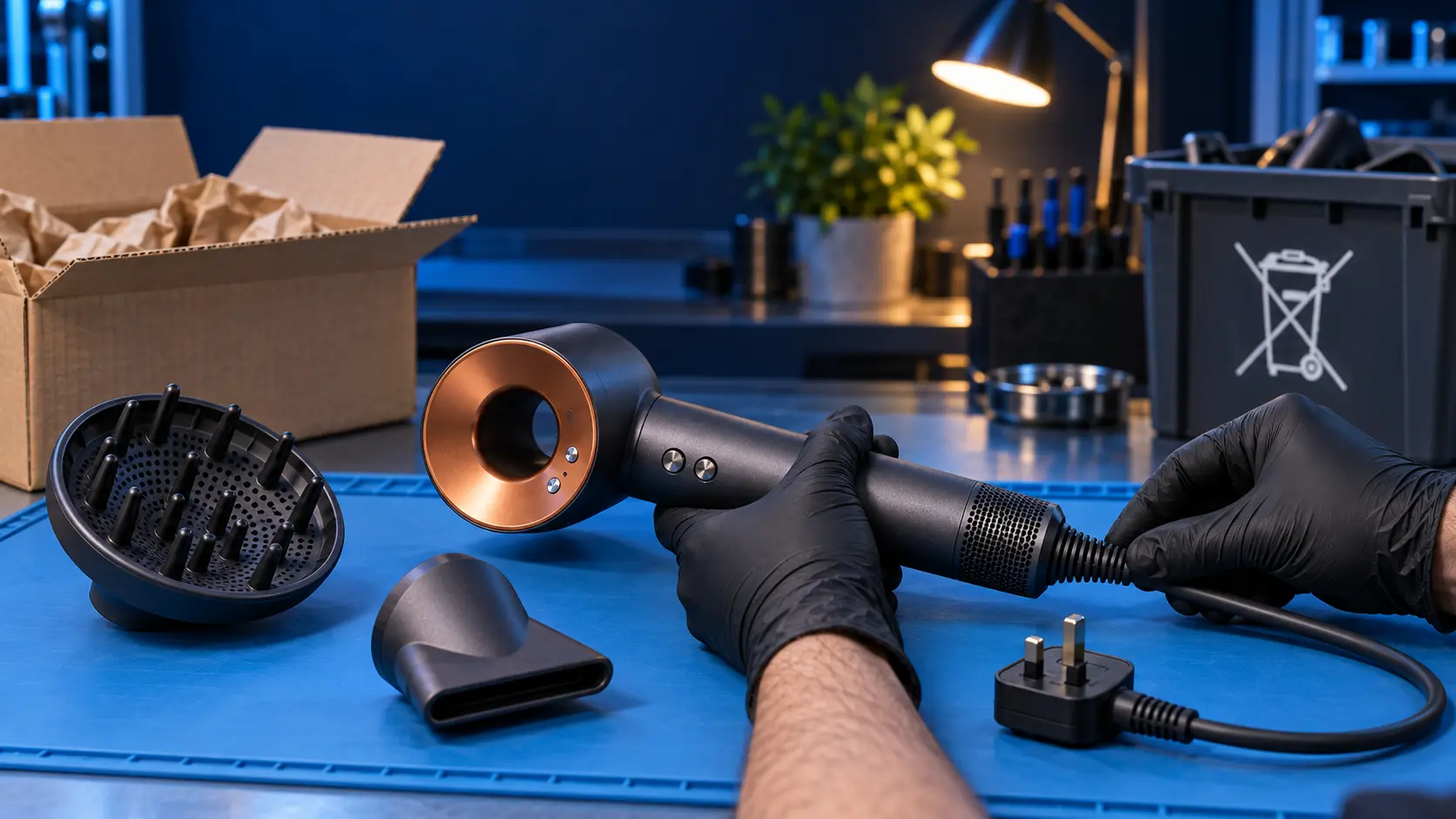
The attachments. This is the one that surprises people. Dyson's styling concentrator is £29.90 and the diffuser £34.90 — and both were out of stock when I checked in September 2026. So a broken dryer that still has its attachments carries £30–£65 of accessories that can't currently be bought new direct.
If you're getting rid of one, either keep the attachments or make a point of them in the listing. People throw them away with the dryer constantly and they're often the most sellable thing in the box.
The rest. Filter cage, housings, buttons, the case. Small money individually, but it's why parts buyers exist.
I'm deliberately not giving you an eBay figure, because "spares or repair" prices move constantly and a made-up number would be worse than none. Search completed listings for your exact model before you price it — that's the only figure that means anything.
When selling for parts is the right call
The motor has failed and it's an older machine. A failed motor on a 2016 HD01 is the one case where I'd genuinely tell you not to repair it. That's the expensive part reaching the end of a decade's service, and the money is better spent on a newer dryer. Sell it honestly as a motor fault and let someone strip it for the rest.
It's been in water. Water damage is unpredictable, and a dryer that's been submerged or soaked is one I won't quote blind. Sell or recycle it.
It's been apart before. If someone has already had a go at it, what I'd be quoting on is unknowable. Same answer.
Several things are wrong at once. One fault is a repair. Four is a decision, and the decision is often no.
You've already bought a replacement. Perfectly reasonable, and then it's just a question of getting something for it rather than nothing.
When selling is the wrong call
Anything that responds to the cable test. £79, and you keep the machine.
Cutting out, weak airflow, overheating. Almost always restriction rather than failure. A £49 service on a dryer that's never been apart frequently returns it to close to new. Selling one of those is giving away a working dryer with a dirty filter.
Buttons, cold shot, controls. Cheap faults, sound machine.
It's still in warranty. Go to Dyson — it's free, and a machine they've repaired is worth vastly more than a broken one you've sold.
How to sell it honestly
Not a moral lecture, just what actually gets you a fair price and no comeback.
Say what it does and doesn't do, specifically. "Dead, no lights" and "runs but won't heat" are different machines to a buyer and the second is worth more.
Give the model number. It's on the rating label. HD01, HD03, HD07 and so on are worth different amounts and buyers filter on it — here's how to find yours.
List it as spares or repair if that's what it is. Don't describe it as working intermittently and hope.
Say whether the attachments are included, because that's a meaningful chunk of the value.
Mention if it's been cleaned or serviced. Genuinely relevant to what someone's buying.
Never sell one you know to be electrically unsafe as working. A dryer with a damaged cable that runs "if you hold it right" should be sold as faulty and described as such. Selling it as a working appliance is not a grey area.
Please don't actually bin it
I mean this literally rather than as a repair-trade plea.
Small electrical appliances shouldn't go in your household waste in the UK — they're covered by electrical waste regulations, and there are free routes for exactly this:
Your local recycling centre takes small electricals free of charge.
Many councils collect small WEEE from the kerbside or on request.
Retailers selling electrical goods have take-back obligations, so the shop selling you the replacement will frequently take the old one.
Supermarket and high-street collection points for small electricals are increasingly common.
A Supersonic contains a high-quality motor, copper, and recoverable electronics. None of that belongs in landfill and all of it has somewhere better to go for free.
If you don't know which situation you're in
That's the honest position for most people reading this, because "it's dead" doesn't tell you whether it's a £79 cable or a finished motor.
Do the cable test first — free, ten seconds, and it settles the most likely case. If that's not it, £4.99 buys a proper diagnosis: I tell you exactly what's wrong and what it would cost, and you get the dryer back either way. If the answer is "not worth fixing", you've spent £4.99 to sell it accurately instead of guessing, and an honestly described fault fetches more than "untested, spares or repair".
And if it is worth fixing, you've saved yourself from giving away a machine with a good motor in it.
Common questions
Is it worth more repaired or sold broken?
Repaired, in nearly every case where the motor is sound — which is most of them. A working Supersonic is worth several times a broken one, and the repair costs a fraction of that gap. The full repair or replace reasoning is here.
Will you buy my broken one?
No, I don't buy or sell machines. I repair them and give them back. That way there's no question about whose interest I'm serving when I tell you what's wrong with it.
Can I part it out myself?
You can, and people do. Attachments and the filter cage sell easily. Be careful about selling electrical components as functional when you can't test them, and don't sell a cable off a machine that died of a cable fault.
Should I buy a broken one to repair?
If you know what you're doing and it comes with attachments, there are bargains. Just remember you can't know the age of the cable, and that's the part that fails.
Is a refurbished one a better bet than fixing mine?
Depends on the fault — Dyson's refurb is around £250 with a one-year guarantee, when in stock. Proper comparison here.
It's an HD17 or a Travel and it's broken. Sell it?
Neither, yet. The Travel is months old and still under Dyson's guarantee, so that's a free repair. The r has no independent parts route, which makes Dyson your only option — but it also means a broken one has almost no parts market, so selling it will get you very little.
Ten-second cable test first. If anything changes when you flex it at the handle, don't sell it — it's £79 and you keep a good motor.
If it's genuinely finished, keep the attachments, describe the fault honestly, and take it to a recycling point rather than the bin. And if you don't know which it is, £4.99 tells you before you give away something worth keeping.
The Repair Works is an independent UK repair service, run by me, Paul — 25 years of hands-on repair experience, working by post for customers across the whole country. Not affiliated with or endorsed by Dyson.