Usually yes — and I'd rather give you the rule for working it out yourself than tell you what you want to hear.
The rule is this: on a Supersonic, the motor is the expensive part and it's almost always the part that's still fine. If the fault is anything other than the motor, repair is very likely the right answer. If it's the motor, it very likely isn't.
That's it. Everything below is how to tell which one you've got, and what the numbers actually look like.
Why that rule works on these specifically
Most appliances aren't like this. On a cheap dryer the motor is the cheap bit and the whole thing is throwaway.
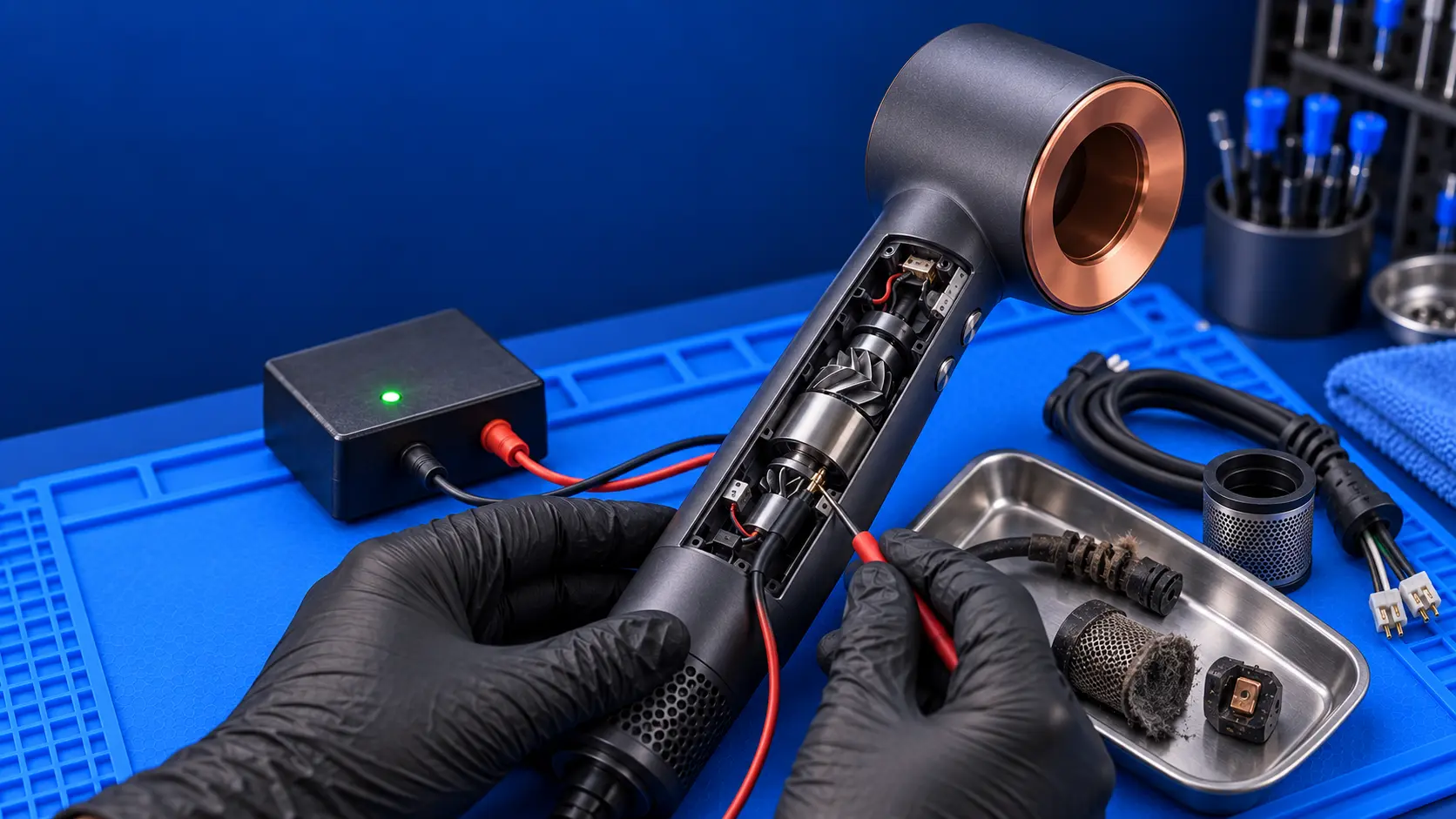
A Supersonic is the other way round. Dyson put a very high-quality motor in the handle — around 110,000 rpm — and built everything else around it. That motor routinely outlives the cable, the filter, the buttons, the attachments and the airflow path by years.
So a broken Supersonic is usually a good motor surrounded by one worn-out cheap thing. Replacing the cheap thing gets you the motor back, and the motor is most of what you paid for.
What a repair actually costs
My prices are fixed, published, and the same for everyone:
£4.99 — assessment, if you want to know before committing (taken off the repair if you go ahead)
£49 — full service and deep clean: airflow path cleaned, new inner filter, motor checked
£79 — cable replacement, or a dead unit
£85 — cutting out, including a correctly specified thermal cut-off and verified sensing
All of those include parts, return postage, PAT safety testing, and twelve months on the workmanship. No fix, no fee — if I can't repair it you get your money back less £4.99 return postage.
I publish those because most repairers won't. "Diagnostic fee plus parts, we'll let you know" is the industry standard answer and it's useless to you when you're trying to decide. The full price list is here.
What the alternatives cost right now
Prices checked September 2026 — verify before you act on them, because Dyson's pricing moves constantly.
Dyson's own refurbished Supersonic: around £250, with a one-year guarantee, when in stock. That's from Dyson's UK outlet, and stock comes and goes.
A new standard Supersonic: harder to pin down than you'd expect. Dyson's own product page was showing out of stock when I checked, and John Lewis had it as no longer available online. Whether that's a temporary gap or the standard Supersonic being retired in favour of the Nural and the newer range, I genuinely don't know. Either way, "just buy a new one" is not the simple option it was.
A used one on eBay or Facebook: cheaper, no guarantee, no service history, and no way of knowing whether the cable is three months from doing exactly what yours just did. You're buying somebody else's unresolved problem at a discount.
Set those against £79 for a cable with twelve months behind it and the arithmetic mostly answers itself. I've gone through the refurbished comparison in detail if that's the route you're weighing.
When it's clearly worth repairing
A cable fault. The most common fault on these by a wide margin, and the clearest yes. £79 against around £250 for a refurb, and you keep a motor that's good for years.
Cutting out, weak airflow, or overheating. Nearly always restriction rather than failure. A £49 service on a dryer that's never been apart often returns it to something close to new.
Buttons, cold shot, controls. Cheap faults on an otherwise sound machine.
Anything on an HD07, HD08 Origin, Nural or newer. These are recent enough that replacing them is genuinely expensive and the machines have years left.
It's a Professional edition. Salon machines get serviced rather than replaced, and the economics aren't close.
When it isn't worth it, and I'll tell you
This is the part most repair sites won't write, so here it is.
A failed motor on an HD01. Probably not. The HD01 launched in 2016, so a failed motor means a decade of service and the most expensive component in the machine has reached the end of it. At that point you're paying serious money to keep a ten-year-old dryer going, and I'd rather you spent it on a newer one.
A dryer that's been repeatedly overheating for a long time. If the protection has been tripping for a year or more, the heat has been through everything, not just the one part that failed. Sometimes that's still fixable and sometimes it's a machine with several things half-worn. I'll tell you which when I've got it open.
Water damage, or a hard drop with damage in several places. One broken thing is a repair. Four broken things is a decision.
A Supersonic r, or a Supersonic Travel. I don't repair these and I'll say so up front rather than take the parcel. The r has no independent parts supply at all; the Travel is five months old and still under Dyson's two-year guarantee, so Dyson will fix it for free. Sending either to me would be worse for you than doing nothing.
Anything still in warranty. If it's inside Dyson's two years, go to Dyson. Free beats £79 every time and I'd be daft to argue.
The one thing to check before you decide anything
Switch it on, hold the dryer completely still, and flex the cable gently where it enters the handle.
If the behaviour changes at all — cuts out, stutters, comes back — you've found it, it's a cable, and it's the cheap end of this. That single test resolves the majority of "is it worth fixing" questions in about ten seconds, and it costs nothing.
If it runs steadily and the fault is something else, a £4.99 assessment tells you what you're dealing with before you commit to anything. That's what the assessment is for — and if you decide not to proceed, you've spent £4.99 to make a properly informed decision about £280.
Common questions
What's the oldest Supersonic you'd repair?
Age isn't the deciding factor — the fault is. I'll happily put a cable on a 2016 HD01, because the motor in it is likely good for years yet. I'd hesitate over a motor replacement on the same machine.
Is a repaired Dyson as good as a new one?
For a cable or a service, functionally yes — you've got the original motor, which is the bit that matters, and a new cable or a clean airflow path is genuinely new. It won't have the newer models' features, because it isn't a newer model.
How long will it last after a repair?
Nobody can promise that honestly. What I can tell you is that these fail one part at a time rather than all at once, and that a serviced Supersonic with a new cable is typically good for years rather than months. There's twelve months of workmanship warranty behind my end of it.
What if you open it and it's not worth fixing?
Then I tell you, you don't pay a repair fee, and you get your money back less the £4.99 return postage. I'd rather lose a job than take money for a repair I don't believe in.
Should I repair it or put the money towards a Nural?
If your Supersonic needs a cable and nothing else, repair it — you'd be spending £280 to solve a £79 problem. If you actively want the newer machine for its own sake, that's a different question and it's a purchase rather than a repair decision. I'm not going to pretend a repaired HD03 is a Nural.
Is it more environmentally sound to repair?
Yes, straightforwardly. A cable is a few grams of copper and plastic against a whole appliance. That's not the main reason to do it, but it's not nothing either.
The rule again: it's the motor that's expensive and the motor is almost never the problem. Do the ten-second cable test first, and if that's not it, £4.99 buys you a real answer before you spend real money.
And if it turns out not to be worth fixing, I'll say so. That's the only way any of the rest of this is worth reading.
The Repair Works is an independent UK repair service, run by me, Paul — 25 years of hands-on repair experience, working by post for customers across the whole country. Not affiliated with or endorsed by Dyson.