Most of the time, the dryer is fine.
I get these every winter, and a decent proportion of them turn out to be a tripped breaker, a blown plug fuse, or a socket that never came back on — all of which are free to sort out and none of which need posting anywhere. So before you box anything up, work through the four checks below. They take five minutes.
If it's genuinely surge damage, you'll know by the end of them, and there's one thing about that you need to know before you contact anybody.
Check one: is the socket actually live?
Sounds obvious. Isn't always.
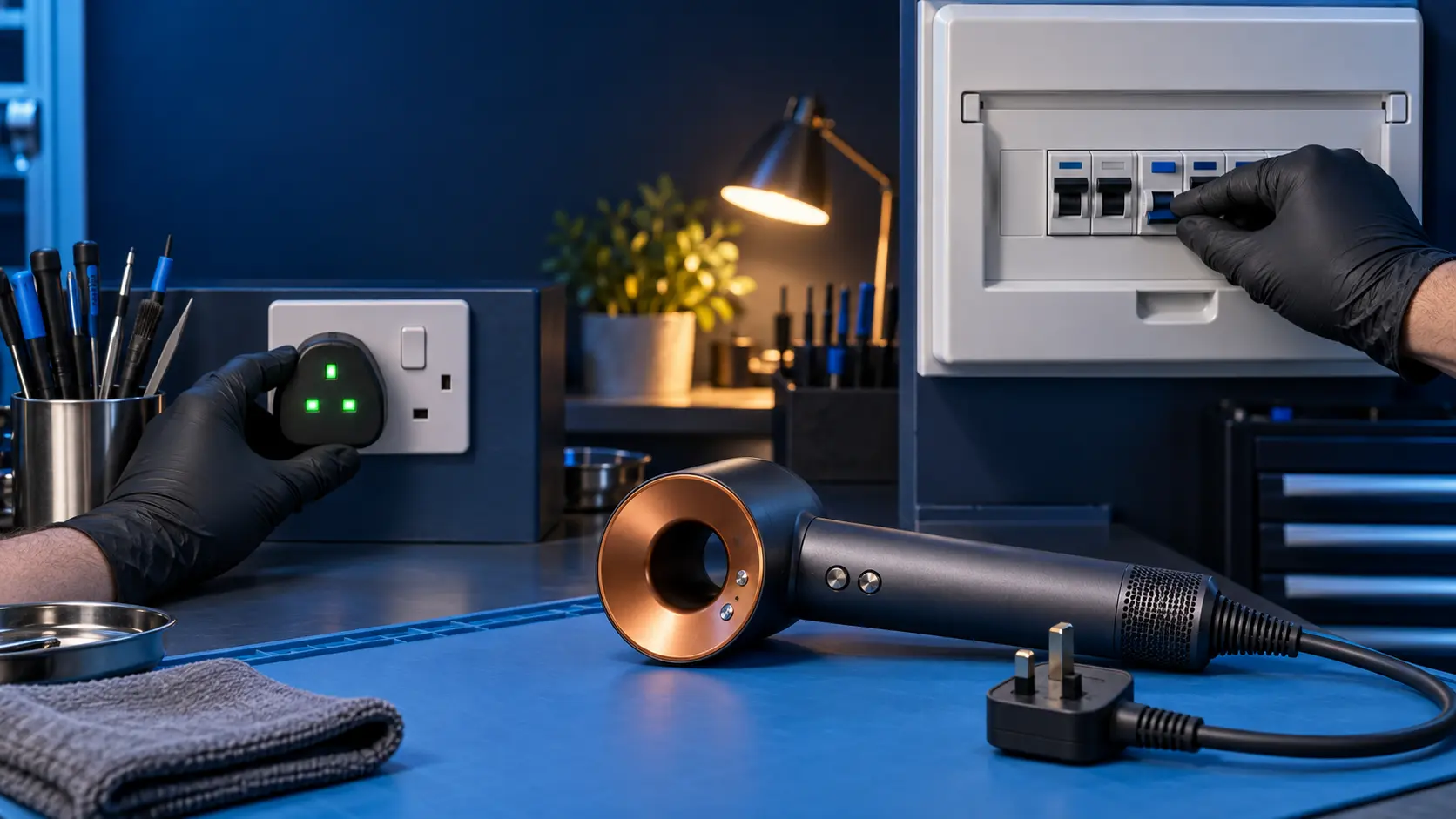
Plug something else into the same socket — a lamp, a phone charger, anything you can see working. If that doesn't work either, your dryer was never the problem.
Then do the reverse: plug the dryer into a different socket, ideally in a different room on a different circuit. If it works there, the fault is in your wiring rather than your dryer, and that's an electrician rather than a repairer.
Check two: the consumer unit
A power cut, and more particularly the moment the power comes back, quite often trips something in the consumer unit.
Go and look. You're checking two things:
The RCD — the big switch, sometimes two of them, usually with a test button. If it's down, push it firmly up.
The individual breakers. Here's the bit people miss: a tripped breaker doesn't always look obviously down. Some sit in a halfway position that reads as "on" at a glance. The reliable way to check is to push the breaker fully off first, then firmly back on. If it was half-tripped, that resets it properly.
If something trips again straight away — or trips the moment you plug the dryer in — stop. That's a genuine electrical fault and it needs an electrician, not another attempt. Don't keep resetting it.
Check three: the plug fuse
This is the single most common answer, and it's the one that costs about 50p.
UK plugs contain a fuse whose entire job is to fail so that nothing else does. A surge on power restoration is exactly the sort of event it's there for. A blown fuse means the fuse worked.
Dyson's moulded plug has a fuse carrier you can open with a small screwdriver. Swap in a new fuse of the same rating as the one you took out — don't fit a bigger one, ever; the rating is chosen to protect the appliance and its cable.
Then try it.
If the new fuse blows immediately, stop there. That's not a fuse problem, that's a fault drawing current it shouldn't. Repeatedly replacing a fuse that keeps going is silencing an alarm, and it's the one thing in this article I'd ask you not to do.
Check four: what "dead" actually means
Get specific, because it points in different directions.
No lights, no noise, nothing at all. Consistent with everything above — supply, breaker or fuse. Also consistent with a failed power supply on the board.
Lights come on but no airflow. The dryer has power and its electronics are alive. That's not a supply problem.
It runs but won't heat. Again, it has power. Different fault entirely.
Lights flash and it does nothing. Worth noting the pattern — what the lights mean.
It half-works, or works if you hold the cable a certain way. That's the cable, and the power cut is a coincidence. Stop using it.
That last one comes up more than you'd think. A cable that was already marginal often chooses a moment like this to finally give up, and people reasonably blame the power cut. Switch it on, hold the dryer still, and flex the cable where it enters the handle. Any change and you've found it.
If it is surge damage
Surges don't usually kill motors or heating elements — those are relatively robust lumps of copper and wire. What they kill is electronics, and on a Supersonic that means the control board and its power supply.
Two things suggest a genuine surge rather than a supply problem:
Something else in the house went at the same time. A router, a TV standby circuit, a microwave display. Surges rarely pick one victim.
The socket is confirmed live, the breaker is fine, a new fuse doesn't blow, and the dryer still does nothing at all.
And here's the thing to know before you contact Dyson: their guarantee explicitly excludes damage from external sources including power surges. So even if your dryer is inside its two years, surge damage isn't covered. That's in their own terms, and it's worth knowing so you're not surprised by it.
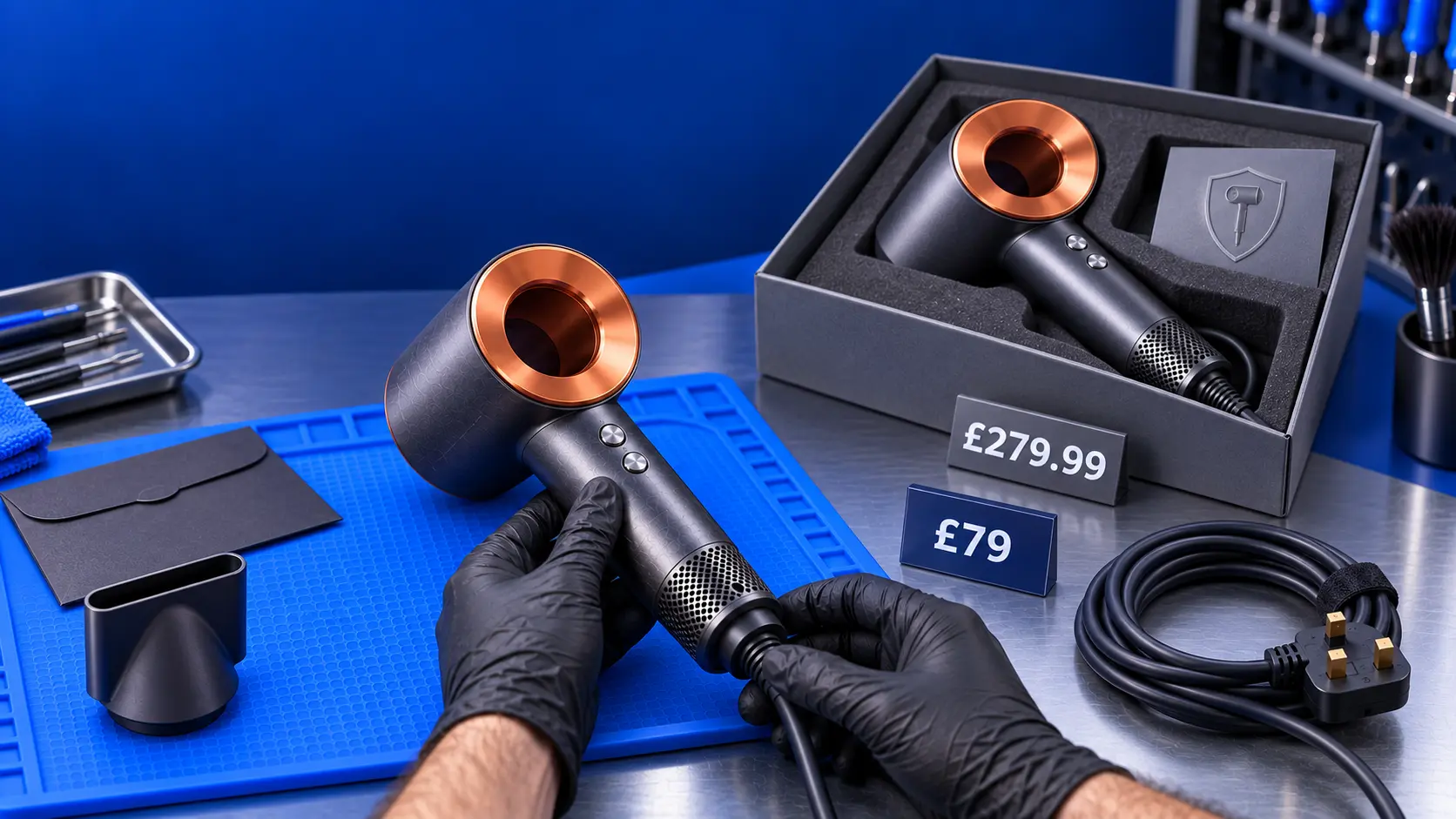
What that means practically is that a surge-damaged dryer is on you regardless of age — which puts it straight into repair-or-replace territory. A dead unit is £79 with me, fixed price, no fix, no fee. Dyson's own out-of-warranty repair is listed at £99 flat, though they ask hair care owners to check the price with them.
Is it worth checking your home insurance?
Possibly, and people forget. Some home contents policies cover damage to appliances from power surges, sometimes as an add-on rather than as standard.
Whether it's worth claiming on a £280 hair dryer depends on your excess, and for most people it won't be. But if the same surge took out several things at once, that's a different conversation and worth five minutes with your policy.
Preventing it next time
Honest answer: mostly not worth engineering around.
Unplug it when you're not using it. Which most people do anyway, and it's complete protection — an unplugged dryer cannot be surged. This is the whole answer for a hair dryer.
A surge protector is real protection if you want it, but a plug-in protected socket for a hairdryer is faintly over-engineered when unplugging achieves the same thing for nothing.
What won't help: switching it off at the wall but leaving it plugged in is much less protection than unplugging it, depending on the socket.
Common questions
Can a power cut damage a dryer that was switched off but plugged in?
Less likely than one that was running, but not impossible — a surge can reach the appliance through the socket. Unplugged is the only complete answer.
It worked fine before the cut and now does nothing. Surely that's the cut's fault?
Probably, in the sense that the cut was the trigger. But the four checks above still come first, because "the cut's fault" most often means the plug fuse rather than the dryer.
How much does surge damage cost to fix?
If it's the board, that's the expensive end. £79 is my fixed price for a dead unit and it covers what it covers; if I open it and find something that puts it beyond sensible repair, you get your money back less £4.99 return postage and I'll tell you what I found.
Should I try it a few more times just in case?
No. If a new fuse blew, or a breaker trips when you plug it in, repeated attempts can turn one failed component into several.
My whole street lost power. Does that make surge damage more or less likely?
It doesn't tell you much either way. What matters is the restoration rather than the outage — the switch-back-on is where the transient happens.
It won't turn on but there was no power cut.
Different article, same starting point. Here's the full turn-on checklist.
Socket, breaker, fuse, then work out what "dead" means. Four checks, five minutes, and most of the time one of them is the answer.
And if the new fuse blows straight away or a breaker keeps tripping — that's the point to stop, because those are the two symptoms where carrying on makes things worse.
The Repair Works is an independent UK repair service, run by me, Paul — 25 years of hands-on repair experience, working by post for customers across the whole country. Not affiliated with or endorsed by Dyson.