You press the button and nothing happens. No lights, no sound, no air. It isn't cutting out or blowing cold — it's just dead, the way it would be if it weren't plugged in at all.
Here's the part most people don't expect: a Dyson Supersonic hair dryer that's completely dead is usually a cheaper fix than one that half works. I'll explain why in a moment. First, three checks that cost nothing.
Start with the free checks
Do these in order before you conclude anything. A machine can be posted for repair when it needs none of what follows.
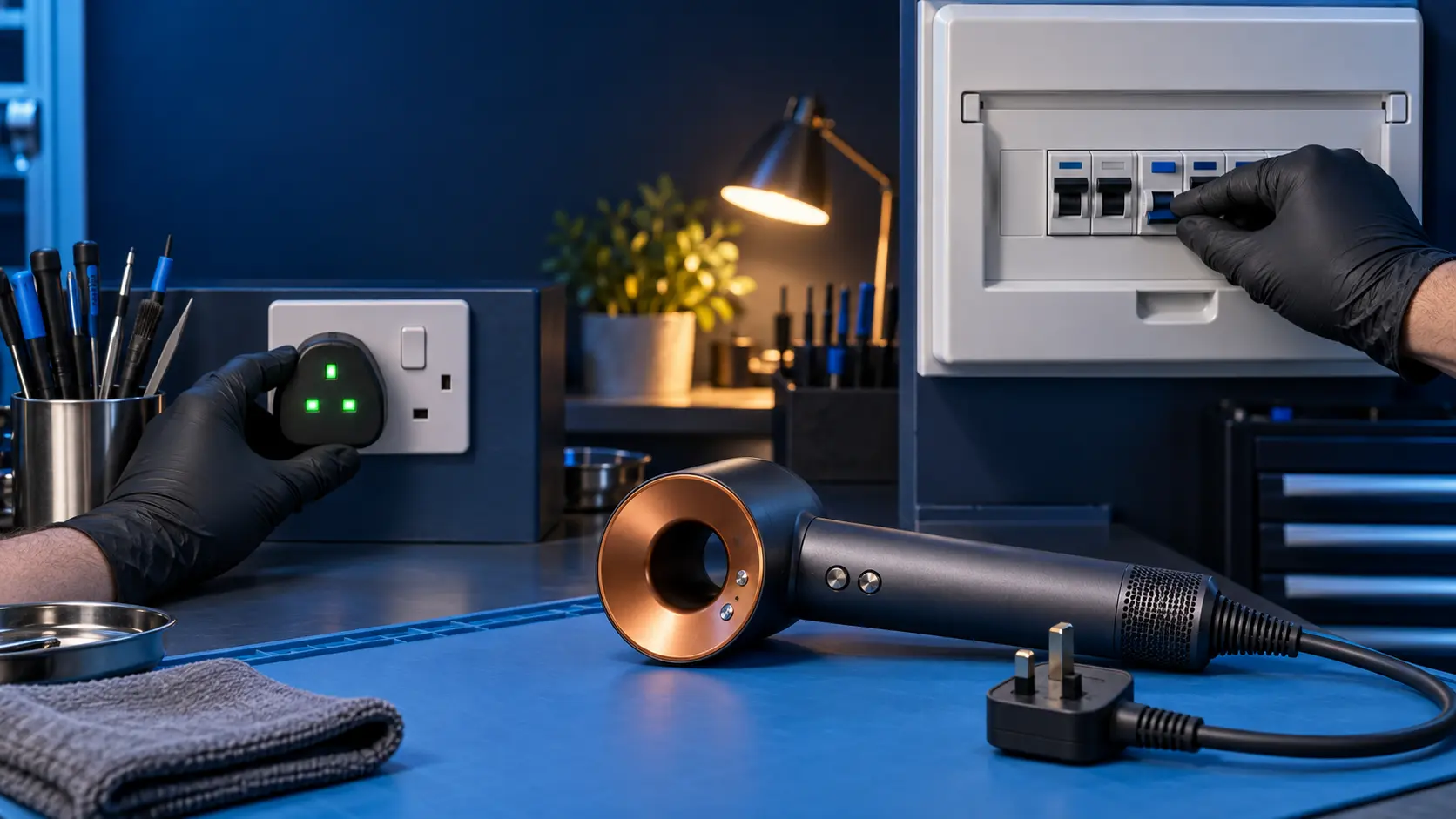
Try a different socket, in a different room. Obvious, but it catches more than you'd think — particularly if you always use the same bathroom or bedroom socket. If other things work in that socket, fine, move on. If they don't, the problem isn't your dryer.
Check your consumer unit. If a switch has tripped, something on that circuit has faulted. Reset it. If it trips again the moment you plug the dryer in, stop — that's a live electrical fault and it belongs on a bench, not in a socket.
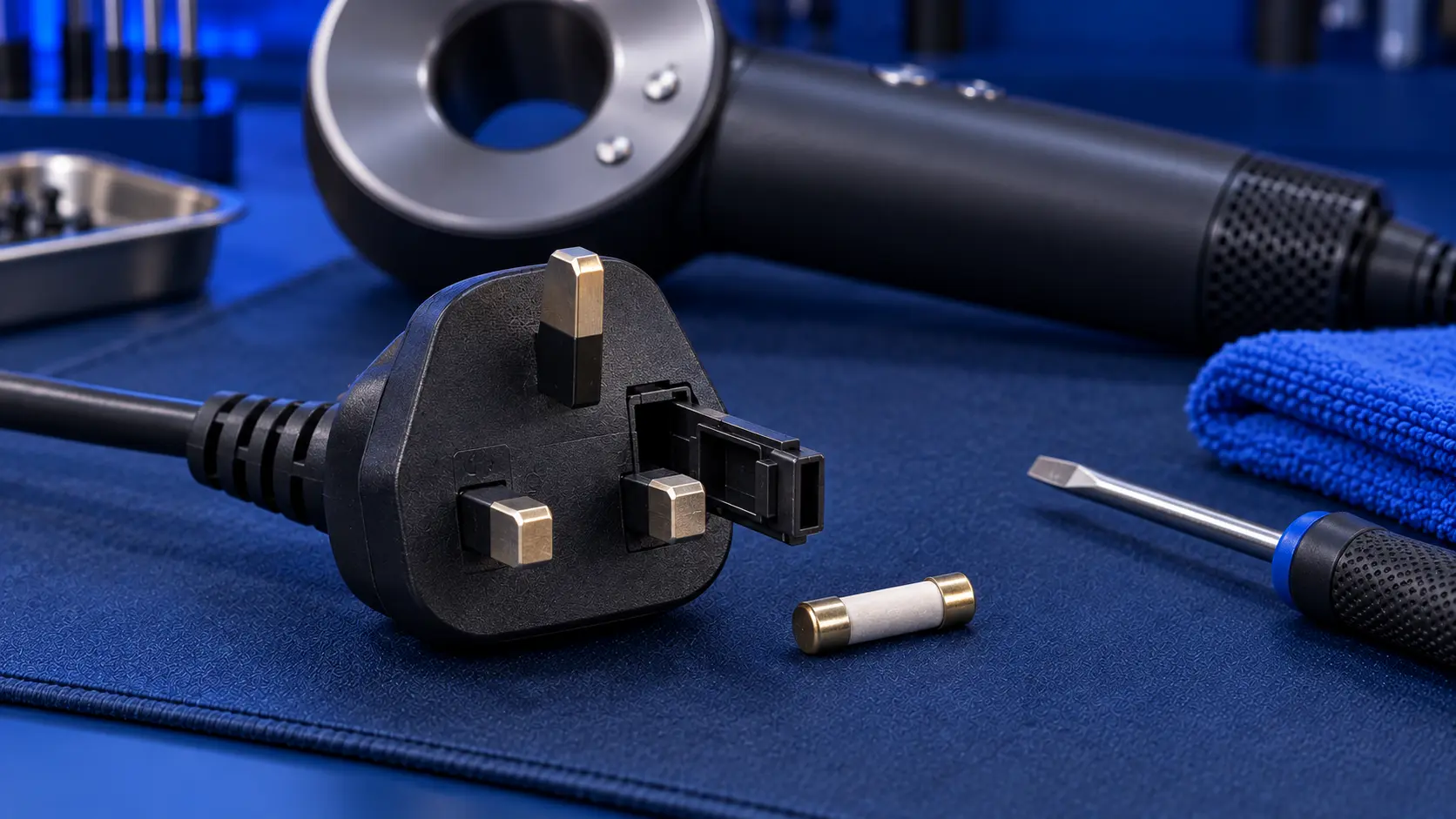
Check the fuse in the plug. This is the one people miss, and it's free. The plug has a small fuse inside it that's designed to fail before anything else does. On a moulded plug there's a carrier that slides or levers out — you'll see a slot or a small tab on the underside. Take the fuse out and look at it: if the wire inside is broken or the glass is blackened, replace it with a new 13A fuse from any hardware shop.
If a new fuse gets it going, you're done. If a new fuse blows straight away, don't fit a third one. A fuse that goes instantly is telling you something downstream of it has shorted, and that's a repair.
Why "completely dead" is the good news
This is the part that surprises people.
The expensive components in a Supersonic — the heating element, the motor, the control board — don't stop a dryer turning on. A failed heater gives you cold air. A worn motor gives you weak airflow and noise. A confused board gives you flashing lights and shutdowns. All of those are machines that do something.
A machine that does nothing at all has lost power before it reaches any of that. And in practice that means one of two things, both at the cheap end:
The mains cable. By a distance the most common fault on these. The copper inside the lead breaks, usually within a few inches of where it enters the body, from being flexed in the same spot thousands of times. When it breaks cleanly the dryer goes completely dead.
The power switch. Less common, but it happens — hairspray and product build-up work their way in over years, or the contacts simply wear out.
Both are fixable at a fixed price. A dead Supersonic is the fault I'd rather it be than almost any other.
The wiggle test, and what it tells me
Plug it in, turn it on, and move the cable slowly where it enters the body of the dryer. Then do the same at the plug end.
If it flickers, cuts in, or works at a particular angle — that's the cable, confirmed, and you don't need to look any further. It also means it isn't fully dead yet, which is a different article: why a Supersonic cuts out when you move the cable.
If nothing changes at any angle — it's still very likely the cable, just broken completely rather than intermittently. It could also be the switch. The two look identical from outside, and the only way to tell is to open it and test.
One thing worth saying plainly: stop doing the wiggle test once you've got your answer. Holding a lead at an angle to keep a 1,600W appliance running is how a broken conductor becomes a hot one.
What it isn't, usually
If it's completely dead, it is almost never the motor, the heater or the filter. Those faults produce symptoms, not silence.
The one exception worth knowing is a control board that's failed outright rather than misbehaving. That's uncommon, and I'd only conclude it after ruling out the cable and the switch on the bench — not from a description, and not as an opening guess.
When to stop and not investigate further
Everything above is safe to do with the dryer plugged in and working normally. Stop immediately, and unplug it, if you get any of the following:
A smell of burning or hot plastic
The plug, the socket or any part of the lead feeling warm
Scorch marks or discolouration on the plug pins
A fuse that blows again the moment you replace it
Anything that trips your consumer unit repeatedly
And please don't open the body of the dryer to have a look. There's no user-serviceable part in there, the internals are packed tight, and it's a mains appliance you're going to hold next to your head afterwards.
What it costs to fix
The won't-turn-on repair is £79, fixed. Cable or switch, same price — you don't pay more because it turned out to be the dearer of the two.
That covers diagnosis, the repair, parts, return postage and a PAT test, with a twelve-month warranty. And if I open it up and find it's something I can't fix, there's no repair fee — I refund what you paid, less £4.99 return postage.
Before you post anything, check which model you've got. The Supersonic r and the Travel model use completely different internals and I don't repair those yet, so find your model number first and save yourself the postage either way.
Common questions
It worked yesterday and it's dead today, with no warning.
That's typical of a cable break. The copper had been fraying for months inside the insulation where you couldn't see it, and the last strand finally went. Nothing you did caused it.
A new fuse got it working. Will it last?
Possibly, but treat it as a warning rather than a fix. A fuse doesn't fail for no reason. If it goes again within a few weeks, something is drawing more current than it should and that's worth looking at properly.
Can I just replace the cable myself?
You can buy a lead, and if you're competent with mains wiring and you test it properly afterwards, that's your call. But a hair dryer is a Class II appliance used with wet hands in a bathroom, and an untested repair on one isn't something I'd recommend to anyone who's asking whether they can.
Is it worth repairing, or should I buy another hair dryer?
A used working Supersonic on eBay is £90 to £115 with no warranty and no history behind it. Dyson's own refurbished ones are around £250, when they're in stock. A fixed repair is £79 with twelve months' cover, and you keep your own machine and your own attachments. For a dead one, where the fault is almost always at the cheap end, repairing is usually the easy call.
Run the three free checks first — different socket, consumer unit, plug fuse. They cost nothing, they take five minutes, and every so often one of them is the whole answer.
If they don't do it, you can see all the Dyson Supersonic repairs I offer and book here — £79 fixed for a dead dryer, parts, return postage and PAT test included, twelve-month warranty, and every repair done by me personally. If you're not certain what you're dealing with, a £4.99 assessment gets it properly diagnosed, and the £4.99 comes off the repair price if you go ahead. Whatever you decide, don't keep feeding it fuses — that's the machine asking for help, not a fault you can outlast.
The Repair Works is an independent UK repair service, run by me, Paul — 25 years of hands-on repair experience, working by post for customers across the whole country. Not affiliated with or endorsed by Dyson.