You've worked out the trick by now. Hold the lead at a certain angle and your Dyson Supersonic hair dryer runs. Let go, or turn to reach the back of your head, and it stops. Waggle it again and it comes back.
That's a broken cable, and you can stop wondering. It's the most common fault on these machines by a distance, and the good news is it's at the cheap end of what can go wrong.
The less good news is the part most people don't expect: the angle you've found is the thing you need to stop doing. I'll explain why, because it matters more than anything else on this page.
What has actually broken
The lead isn't a single piece of copper. It's dozens of fine strands twisted together, and that's deliberate — stranded copper bends where solid copper would snap.
But it only bends so many times. Every flex work-hardens the metal a little, and work-hardened copper gets brittle. Strand by strand, over a few years, they fracture. For a long while you notice nothing, because the survivors carry the current perfectly well. Then you cross a threshold, and suddenly the dryer only works at certain angles.
By the time it's cutting out, most of those strands have already gone.
Why it's always the same three inches
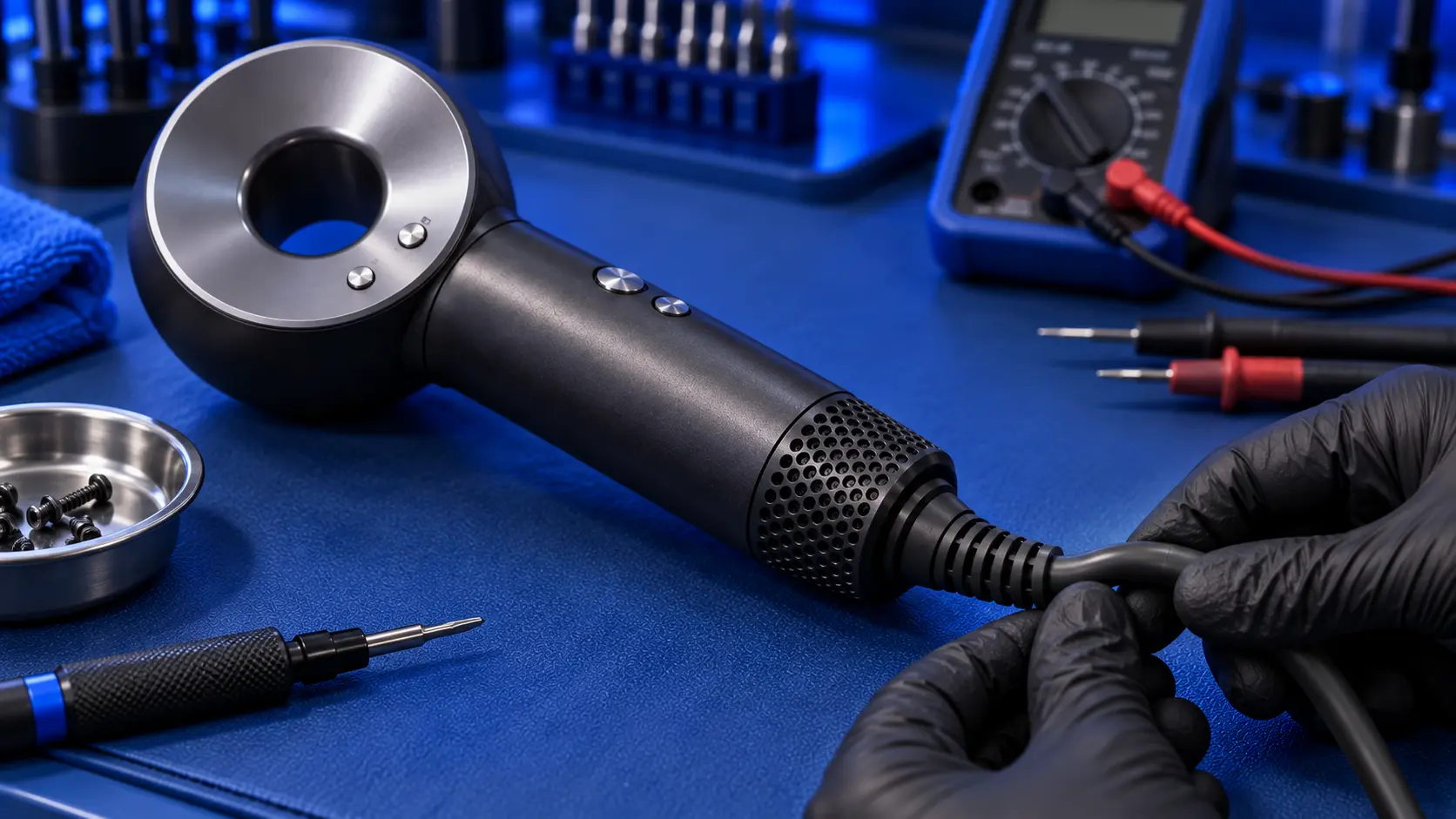
Look at where the lead leaves the body of the dryer. There's a rubbery sleeve there — the strain relief — and a failed cable has usually gone within a few inches of it.
That isn't coincidence. It's the boundary between something rigid and something flexible, and that's where all the bending concentrates. The strain relief exists precisely to spread that load out, and it does help, but it can't eliminate it. Every time you coil the lead round the body for storage, every time you tug the plug out by the cord, every time you sweep the dryer round your head, the flex happens in that same short stretch.
The plug end is the other candidate, for the same reason, though it fails less often. Between the two, the body end wins about four times out of five.
The one thing that reliably shortens a cable's life is wrapping it tightly round the handle after every use. I know that's how everyone stores them. It's also why they fail — the tighter the radius, the more damage per wrap.
I've written up the metallurgy of it properly in why Dyson Supersonic cables fail, if you want the longer version.
Make sure it is the cable
Two minutes, and worth doing before you post anything.
Flex the lead where it enters the body. Slowly, with the dryer plugged in and running. If it cuts, stutters, or comes back at a particular angle, that's your answer.
Do the same at the plug. Same test, other end. Occasionally it's there instead.
Now let it cut out, and press the button again straight away. This is the check that rules out the other fault. If it fires up immediately, it's the cable. If it refuses to run until it's sat and cooled for five or ten minutes, you're looking at a thermal fault rather than a cable one — different cause, different repair, different price.
Watch the lights when it stops. A cable fault just goes dark, like the plug came out. A thermal shutdown flashes at you.
If the wiggle test gives you a clear yes, stop there. You don't need to investigate further and there's a reason not to.
Why the angle that works is the dangerous one
This is the part I'd want anyone to read.
A Supersonic pulls about 1,600 watts, which is roughly seven amps through that lead. When the cable is healthy, those seven amps are shared across every strand and nothing gets warm.
When most of the strands have broken, the survivors carry the whole load. A conductor with a fraction of its original copper carrying full current gets hot at exactly that point — inside the insulation, where you can't see it. And when the connection is intermittent rather than merely reduced, the break arcs each time it makes and loses contact. Arcing is hotter still.
So the position you've found, the one that keeps it running, is holding a damaged conductor under full load. That's how a £79 cable repair turns into a scorched handle, a tripped consumer unit, or something worse on an appliance you hold against your head with wet hands.
It also won't get better. Work-hardened copper doesn't recover. A cable that has started doing this is on a one-way trip, and the only question is whether it ends with you booking a repair or with you smelling something burning.
If you want the earlier warning signs — the ones that show up months before the cutting out starts — they're here.
Stop immediately if you get any of these
A burning smell, or the smell of hot plastic
The plug, the socket or any part of the lead feeling warm
Scorch marks or browning on the plug pins or the casing
Crackling, buzzing or sparking when you move the lead
It trips your RCD or the sockets in that room
None of those are protection doing its job. They're signs something has already failed. Unplug it and leave it unplugged.
Can you replace the lead yourself?
Not sensibly, no — and I say that as someone who is generally in favour of people fixing their own things.
It isn't a kettle lead that unplugs. The cable enters the body through a moulded strain relief and terminates inside the handle, so getting to it means opening the dryer properly. And the obvious shortcut — cutting out the bad section and joining it with a connector block — produces a mains joint with no strain relief, no insulation rating and nothing holding it, on a Class II appliance used near water. It'll fail again, sooner, and in a worse way.
If you're qualified and you've got the parts, you don't need my permission. If you're asking whether you can, the honest answer is that this one's worth posting.
What it costs to fix
The cable repair is £79, fixed. Not "from" £79 — that's the price.
That covers the diagnosis, the repair, the parts, return postage and a PAT test, and it comes with a twelve-month warranty. Every repair is done by me personally, on my own bench.
If I open it up and find it's something I can't fix, there's no repair fee. I refund what you paid, less £4.99 return postage.
Common questions
It only happens occasionally. Can I leave it a few months?
You can, but it won't stay occasional. The pattern is always the same: works at one angle, then two angles, then only if you hold it, then not at all. Each stage is a few more broken strands and a bit more heat at the break. It's cheaper and safer to deal with it while it's still intermittent.
Can't I just use it carefully until it dies completely?
That's the option I'd argue hardest against. "Carefully" means deliberately holding the damaged section in the position that maintains contact, under full load, for however long you're drying your hair. If you're going to keep using it, you're better off with the version where it's properly broken and simply doesn't run.
Mine's going at the plug end instead.
Same fault, same cause, same fix, same price. It's less common but it happens, particularly if the plug gets pulled out by the cord.
Does this happen to every Supersonic?
Eventually, to most of them, if they're used daily for years. It isn't a design fault so much as physics — any flexible mains lead has a finite number of bends in it. How you store it makes a real difference to how many years that takes.
Is it worth repairing, or should I just buy another hairdryer?
A used working Supersonic on eBay is £90 to £115, with no warranty and no idea how it's been treated — and you'd still have a broken one sat in the cupboard. Dyson's own refurbished ones are around £250, when they're in stock. New is £279.99. A cable repair is £79 with twelve months' cover, and you keep your own machine and your own attachments. For this particular fault it's an easy call, because the expensive parts of your dryer are all fine.
Do the wiggle test, confirm which end it is, and then stop using it. That costs nothing and it's the single most useful thing you can do today — every extra drying session at the angle that works puts more heat into a conductor that's already damaged.
When you're ready, you can see the Dyson Supersonic cable repair and book it here — £79 fixed, parts, return postage and PAT test included, twelve-month warranty, and every repair done by me personally. And whatever you decide about this one, when you get a working dryer back, stop coiling the lead tightly round the handle. Loop it loosely instead. It's a small habit and it'll add years to the next cable.
The Repair Works is an independent UK repair service, run by me, Paul — 25 years of hands-on repair experience, working by post for customers across the whole country. Not affiliated with or endorsed by Dyson.