I've been repairing electronics for twenty-five years, and there are a handful of faults you can call before the parcel is open. A Supersonic with an intermittent cable is one of them. I know roughly where the break is before I've looked, because in the overwhelming majority of them it's in the same three inches.
This article is about why that is. Not because it's interesting — though it is — but because once you understand what's actually happening inside that cable, two things follow: you'll spot it early, and you'll stop doing the one thing that makes it worse.
It's always the same three inches
Take your dryer and find where the cable disappears into the handle. There's a moulded rubbery sleeve there, tapering away from the body — that's the strain relief.
The failures cluster in the short stretch of cable immediately beyond the end of that sleeve. Not at the plug. Not in the middle. Right there, in the first few centimetres of free cable past the point where the strain relief stops supporting it.
If you've had one go, that's where it went.
What flexing actually does to stranded copper
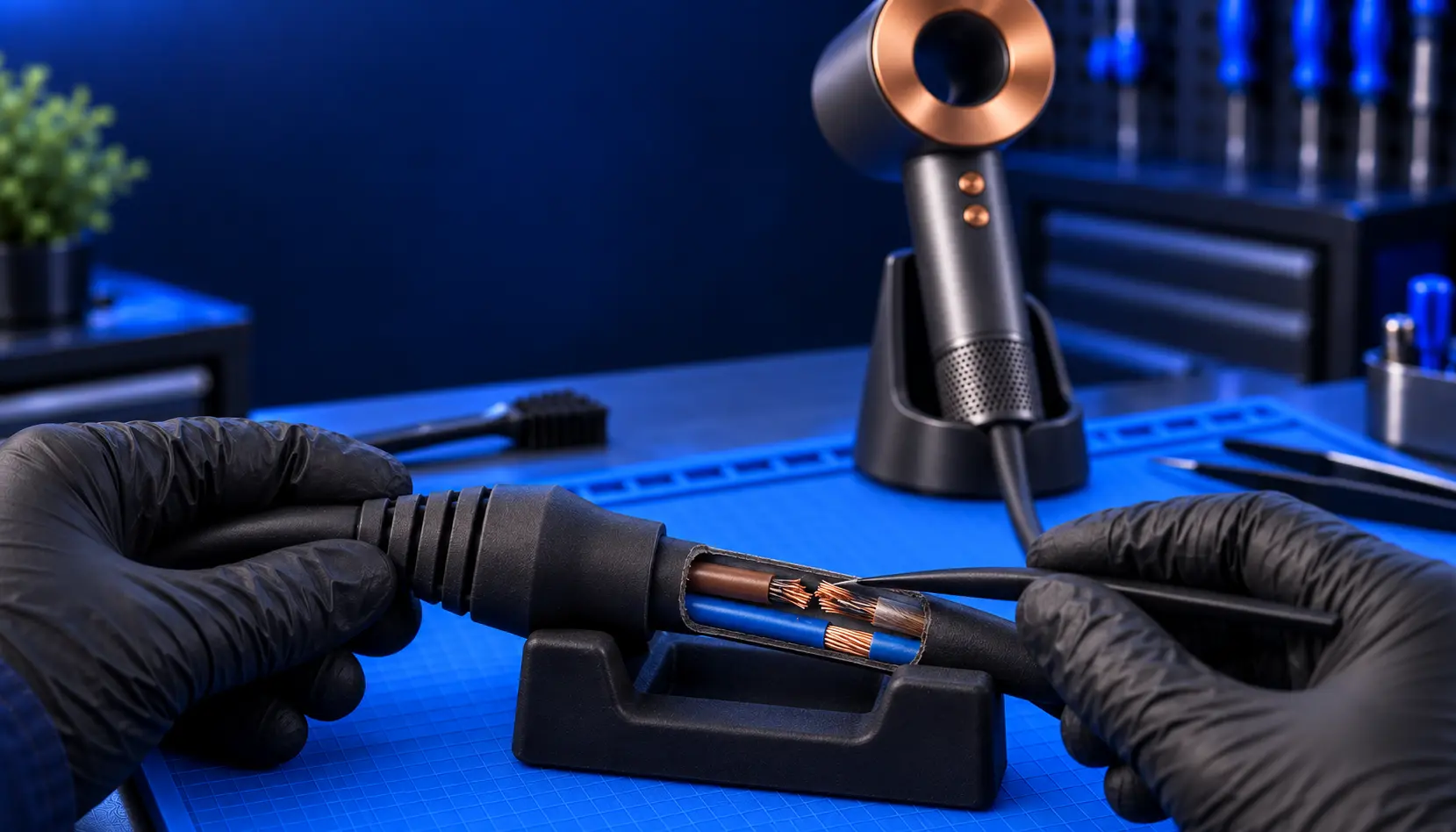
The conductor inside a mains flex isn't one solid wire. It's dozens of very fine copper strands twisted together, and it's built that way precisely so it can bend. A solid conductor of the same size would snap in weeks.
But stranded copper doesn't bend indefinitely for free. Every flex work-hardens the metal slightly — the crystal structure of the copper shifts, the material gets stiffer and more brittle exactly where the bending is concentrated. Bend it enough times and individual strands begin to fracture.
Here's the part that matters. They don't all go at once. They go one at a time, over months.
And the current still has to get through. So as strands fail, the ones left carry more of the load, get hotter, and work-harden faster. Fewer strands means more heat, more heat means faster failure, faster failure means fewer strands. It's a cascade, and it accelerates towards the end.
By the time you notice anything, that process has been running for a long while.
Why the strain relief is where it is
The strain relief isn't decoration and it isn't a cost-saving. It's doing a real job: keeping the bending away from the electrical termination inside the handle, where a break would be much worse and much harder to reach.
It does that by being stiff at the body and progressively more flexible as it tapers, spreading the bend over a length of cable instead of letting it all happen at one point.
But it can only spread the bend over the length it covers. At the end of the sleeve, the support stops and the bare flex begins, and that transition is a stress concentration — the stiffness changes abruptly, so the bending piles up just past it.
Which is exactly where the breaks are. The strain relief has moved the failure from a place you'd never repair to a place you can. It hasn't abolished it, and it was never going to.
Why the Supersonic gets this worse than other dryers
This is the bit I think most people miss, and it's a design consequence rather than a defect.
Dyson put the motor in the handle. That's the whole innovation — it's why the head is small and light and why the thing balances the way it does. But it means the cable enters the part of the machine you're holding and moving.
On a conventional dryer the motor is in the body, the cable comes out of the bottom of the handle, and the handle stays roughly still while the head moves. On a Supersonic, the cable's entry point goes wherever your hand goes. Every pass over your head flexes that cable at the strain relief. Not once a day — hundreds of times a session.
Then there's storage. The natural thing to do with a Supersonic is wind the cable round the handle, because it's a handle and the cable is right there. That puts the tightest bend in the whole loop exactly at the strain relief, and leaves it there under tension for the twenty-three hours a day the dryer isn't in use.
Daily flexing plus sustained tight bending, both concentrated on the same two centimetres. That's why it's this machine and that's why it's this spot. I've gone through the storage side properly in how to store a Supersonic without killing the cable — it's the one bit of prevention that actually works.
Why a cable that looks perfect can be the fault
Almost everyone who sends me one says the same thing: the cable looks fine.
It usually does. The failure is inside the insulation, in metal you can't see. The outer sheath is tough, flexible and designed to survive far more than the copper inside it, so it can look showroom-new over a conductor that's lost half its strands.
Sometimes there's a tell — a slight swelling, a kink that's set into the cable and won't straighten, a patch that feels stiffer than the rest, or discolouration if it's been getting hot. Those are all worth knowing and I've listed them in the early signs.
But plenty of them show nothing at all. "It looks fine" is not evidence, and it's the reason people spend money ruling out the motor and the board first on a fault that was in the flex all along.
The stage where it stops being an inconvenience
The classic symptom is position-dependence: it works if you hold it one way, or it cuts out when you move, or it comes back if you jiggle the cable near the handle.
That stage feels like a nuisance. It isn't. It's the most dangerous point in the whole failure.
What it means is that a small number of strands are doing the work of many, or that a fractured end is making and breaking contact as the cable moves. A Supersonic draws around 1,600 watts, which on UK mains is roughly seven amps. Pushing seven amps through a fraction of the intended copper generates heat, and that heat is being produced inside the insulation, in the palm of your hand, on a machine you leave switched on next to a mirror.
An intermittent connection can also arc, which is worse again.
So when the answer to "it works if I hold it like this" is to hold it like that, please don't. The wiggling isn't a workaround — it's mechanically the worst thing you can do to a cable in that condition, because you're flexing precisely the damaged section to restore contact.
Take it out of service. That's not me drumming up work; the repair costs the same next week.
What I do with one
I don't splice it. On a seven-amp appliance a joint in the flex is not something I'd put my name to, and it certainly isn't something I'd put a twelve-month warranty behind.
The whole cable assembly gets replaced. New flex, new termination inside the handle, then it's run-tested and PAT safety tested before it's packed. That's the cable repair — £79 covering everything including parts and return postage, back to you by tracked post with twelve months on the workmanship.
While it's apart I'll look at the filter and the airflow path too, because a dryer old enough to have killed a cable is usually a dryer that's never been cleaned inside, and it's daft not to look while it's open.
Common questions
Can I just replace the cable myself?
I'd rather you didn't. It's a mains appliance with a termination inside a sealed handle, and getting it wrong produces something that looks fixed and isn't. If you're qualified you don't need my opinion; if you're not, this is the wrong job to learn on.
Is it worth £79 on a dryer that's eight years old?
Usually yes, and I say that as someone who'd rather turn work away than take it dishonestly. A working Supersonic is several hundred pounds to replace, the motor in these lasts far longer than the cable does, and a cable repair typically buys you years rather than months.
Why doesn't Dyson make the cable detachable?
A detachable mains lead on a handheld appliance introduces a connector that has to survive heat, flexing and being pulled — and connectors fail too. It's a genuine engineering trade-off rather than an oversight, and Dyson went the other way.
Mine's failed twice. Am I doing something wrong?
Possibly, and it's almost always storage. If you wind it tightly round the handle, that's the cause, and it's fixable for free.
Does this happen to the newer models too?
It's the same architecture — motor in the handle, cable into the handle — so the mechanism is identical. The reason you see it most on the HD01 and HD03 is simply that they've been in service the longest. Give the newer ones a decade and they'll be here too.
Could it be something other than the cable?
Yes, and the honest answer is that some faults present similarly. But if it changes when you move the cable at the handle, it's the cable, and I've yet to be wrong about that one.
If you take one thing from this: the test is free and it takes ten seconds. Switch it on, hold the dryer still, and flex the cable gently where it enters the handle. If the behaviour changes at all — cuts out, comes back, stutters — that's your fault found.
And then stop using it. Not because I want the work, but because everything that makes that symptom happen is happening inside insulation you're holding.
The Repair Works is an independent UK repair service, run by me, Paul — 25 years of hands-on repair experience, working by post for customers across the whole country. Not affiliated with or endorsed by Dyson.