A lot of cable failures start in the drawer, not in use.
That sounds like a strange thing to say about a fault that shows up while you're drying your hair, but it's true. The dryer is in your hand for ten minutes a day. It's in storage for the other twenty-three hours and fifty minutes, and how you leave it during that time does more damage than the drying ever does.
Here's how to store one properly. It costs nothing, it takes five seconds longer than what you're probably doing now, and it genuinely prevents the repair I'd otherwise charge you £79 for.
The one thing to stop doing
Stop winding the cable tightly round the handle.
That's it. That's the whole article, really. If you do nothing else from this page, do that.
I know exactly why everybody does it. It's a handle, the cable comes out of the handle, and wrapping it round is the obvious tidy thing to do. Every hairdryer you've ever owned has probably been stored that way.
But on a Supersonic it puts the tightest bend in the whole loop precisely at the weakest point, and then holds it there under tension all night, every night, for years.
Why that spot, specifically
The cable enters the handle through a moulded rubber sleeve — the strain relief. Its job is to spread bending over a length of cable instead of letting it all happen at one point.
Where that sleeve ends, the support stops abruptly. That transition is where bending concentrates, and it's where essentially every Supersonic cable failure I've ever seen has occurred. I've written up the full reason if you want the copper-and-metallurgy version.
Wrapping the cable round the handle does two bad things to that exact spot at once: it forces a tight radius there, and it keeps it there for hours. Copper that's bent sharply and held bent work-hardens faster than copper that's bent gently and released.
So it's not the wrapping that's the problem so much as the wrapping plus the leaving it like that.
What to do instead
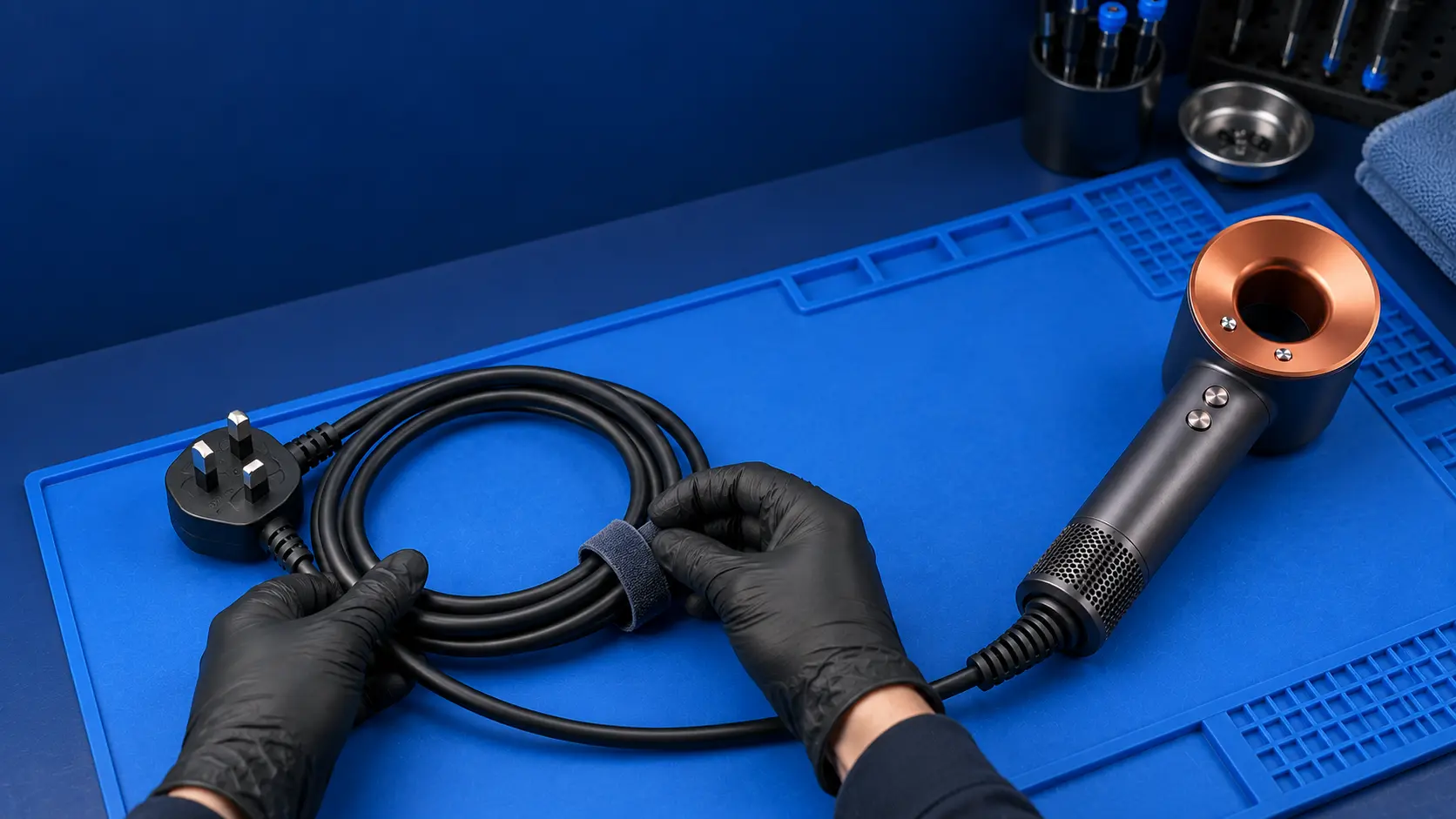
The rule: nothing tighter than your fist, and no bends at all within a hand's width of the handle.
The method:
Let the first 15–20cm of cable past the handle stay straight. Don't bend it, don't include it in the coil. That section does nothing but hang.
Coil the rest loosely into a hoop roughly the size of your open hand — a lot bigger than you think, and definitely bigger than the handle.
Secure it with something soft and slack. A velcro tie or the ribbon it came with, done up loosely. Not a tight elastic band, and not a cable tie.
Put the coil down next to the dryer rather than round it.
That's it. The coil sits beside the dryer, the cable leaves the handle in a straight line, and nothing is under tension.
The coiling trick that stops it twisting
If you find your cable always fights you — coils itself into figure-of-eights, won't lie flat, develops a twist that gets worse over time — you're coiling it the way most people do, all loops in the same direction.
Every loop in the same direction puts a twist into the cable, and that twist accumulates. Sound engineers and stage crews learned this decades ago and it's the reason their leads last for years of abuse.
The fix is over-under: make one loop the normal way, then make the next loop with your wrist turned the opposite way so it lies in the same hoop but with the twist reversed. Alternate. The twists cancel out.
It feels odd for about three attempts and then becomes automatic. Once you've got it, the cable falls out straight every time instead of needing to be wrestled, which means it gets bent less on the way in and the way out too.
Hanging it up
Hanging is good storage, as long as you hang the right thing.
Hang the dryer, not the cable. By the handle, on a hook, with the coiled cable hooked alongside it or resting on a shelf.
Don't hang the dryer from its own cable. That puts the full weight of the machine on the strain relief, permanently, in the exact spot that fails. It's the second-worst thing you can do after tight wrapping.
Don't hang it by a loop of cable pulled tight round a hook either, for the same reason.
Where you put it matters less than how the cable sits
A drawer, a basket, a shelf, the Dyson case, a heatproof bag — all fine. The container isn't the issue.
What matters is whether the cable ends up forced into a tight bend or crushed to fit. If the drawer is just slightly too shallow and you have to press the lid down, that pressure is going somewhere.
Two other small things:
Let it cool first. Warm plastic takes a set more readily than cool plastic, so a cable coiled while the dryer is still hot holds that shape. Give it a couple of minutes.
Don't store the dryer sitting on top of its own cable. The weight of the machine pressing on a bend, overnight, every night, does the same job as tight wrapping more slowly.
If you've already been doing it wrong for years
Most people reading this have, so don't panic about it.
Two things worth doing. First, change how you store it from tonight — damage already done doesn't get worse if you stop adding to it, and cables that are early in the process often go years more once the abuse stops.
Second, check where you are. There's a sixty-second hands-on check in how to tell if your cable is going — look for a kink that's set, a stiff section, or a warm plug. Those are the signs that the wrapping has already had an effect.
If it passes that check, you've caught it in time and better storage is genuinely all you need to do.
Common questions
Does the case Dyson supplies protect the cable?
The case is fine, and it protects the dryer nicely. It doesn't do anything for the cable one way or the other — how you coil the cable before it goes in is what counts.
Is a cable tidy or velcro wrap worth it?
Yes, if it's soft and you use it loosely. A velcro strap round a hand-sized coil is ideal. Anything that cinches tight is working against you.
I travel with mine constantly. Any different?
Same rules, just applied more often — which means travel is where the good habit pays most. Coil it over-under, keep the first 20cm straight, and don't use the cable to strap the dryer to anything.
Can I coil it round my hand and elbow?
That gives you a big loose loop, which is the right size, but it tends to put all the twist the same way. Fine if you don't mind fighting it later; better if you alternate.
Is any of this actually going to make a difference?
On these, yes — more than any other single thing you can do. The motor in a Supersonic outlives everything around it. The cable is the part that decides how long you keep the dryer, and storage is most of what decides how long the cable lasts.
Wind it loosely, keep the first hand's width straight, and never hang the dryer from its own flex.
Five seconds a day, and it's the difference between a Supersonic that lasts a decade and one that needs a cable at year five.
The Repair Works is an independent UK repair service, run by me, Paul — 25 years of hands-on repair experience, working by post for customers across the whole country. Not affiliated with or endorsed by Dyson.