Cables don't fail suddenly. They fail over months, and they give you warnings the whole way — it's just that most of the warnings are easy to explain away, so people do.
So here they are, in the order they usually show up, from the ones nobody notices to the ones that mean stop tonight. At the end there's a sixty-second check you can do with nothing but your hands.
The one that gives it away
It behaves differently depending on how you hold it.
That's the definitive sign, and nothing else comes close. Cuts out when you move. Comes back when you jiggle it. Works if the cable hangs one way and not another. Stutters as you turn your wrist.
If any of that happens, you can stop reading the rest of the list — it's the cable. It's about as reliable a test as there is.
Everything below is what shows up before you get to that point.
The early ones, which almost everybody dismisses
A stutter you assumed was the socket. A momentary drop in power, half a second, once a week. Then once a day. People blame the plug, the extension lead, the house. It's usually the first sign.
The plug top is warm when you unplug it. Not hot — warm. Slightly warmer than the room, warmer than it used to be. Most people have never touched a plug top deliberately so they've got nothing to compare it to, which is why this one gets missed. A healthy plug on a hairdryer should be about room temperature, maybe a touch above after a long session.
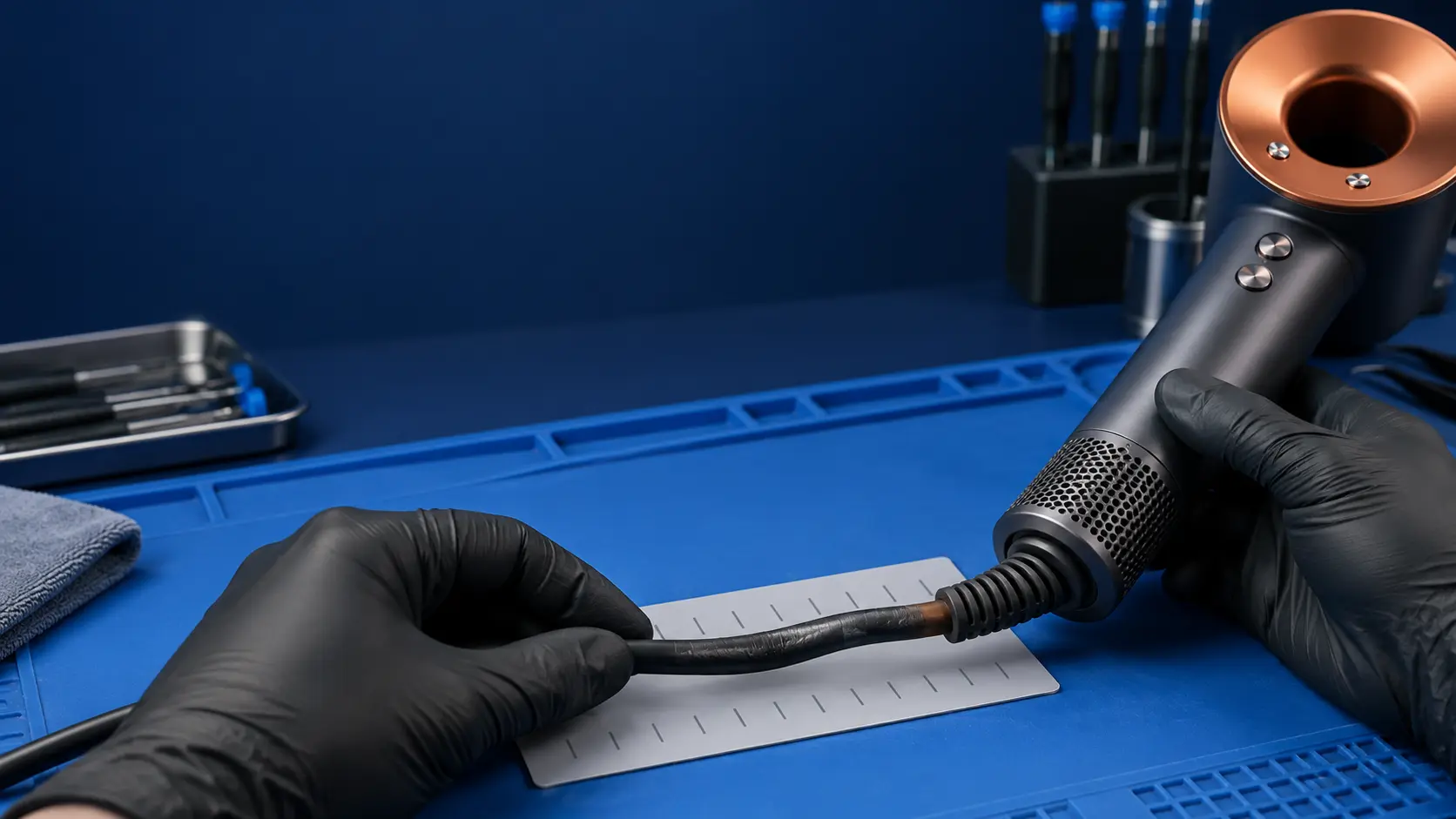
A warm patch on the cable itself. Usually in the first few inches past the handle. Run the cable through your fingers just after use and you're feeling for a spot that's warmer than the length either side of it.
Warmth in a specific spot means resistance in a specific spot, and resistance in a cable means damaged conductor. There is no innocent explanation for a localised warm patch.
The physical ones you can see and feel
A kink that's set. Straighten the cable out and let go. If there's a bend near the handle that stays bent, that's not a habit the cable has picked up — it's a section that's been deformed, and deformed cable is cable that's been over-stressed exactly where the damage happens.
A stiff section. Run the whole length slowly through loosely closed fingers. You're feeling for a change in flexibility. A short length that resists bending compared with the rest of the cable is work-hardened, and work-hardened copper is copper on its way out.
A soft spot or slight swelling. The opposite tell, and rarer, but worth knowing: a section that feels spongy or looks marginally fatter than the rest.
Discolouration near the strain relief. Any browning, yellowing or shine on the sheath where the cable meets the handle. That's heat that's already happened.
The ones that mean stop tonight
Any smell of hot plastic. Don't finish drying your hair. Unplug it.
A crackling or faint clicking from the plug or the handle. That's arcing, and arcing is the one that deserves the word urgent.
Scorch marks, melting, or exposed conductor. Obvious, but people do carry on. Don't.
The plug fuse blowing more than once. A fuse is a safety device reporting a fault, not a consumable. Replacing it repeatedly is silencing an alarm.
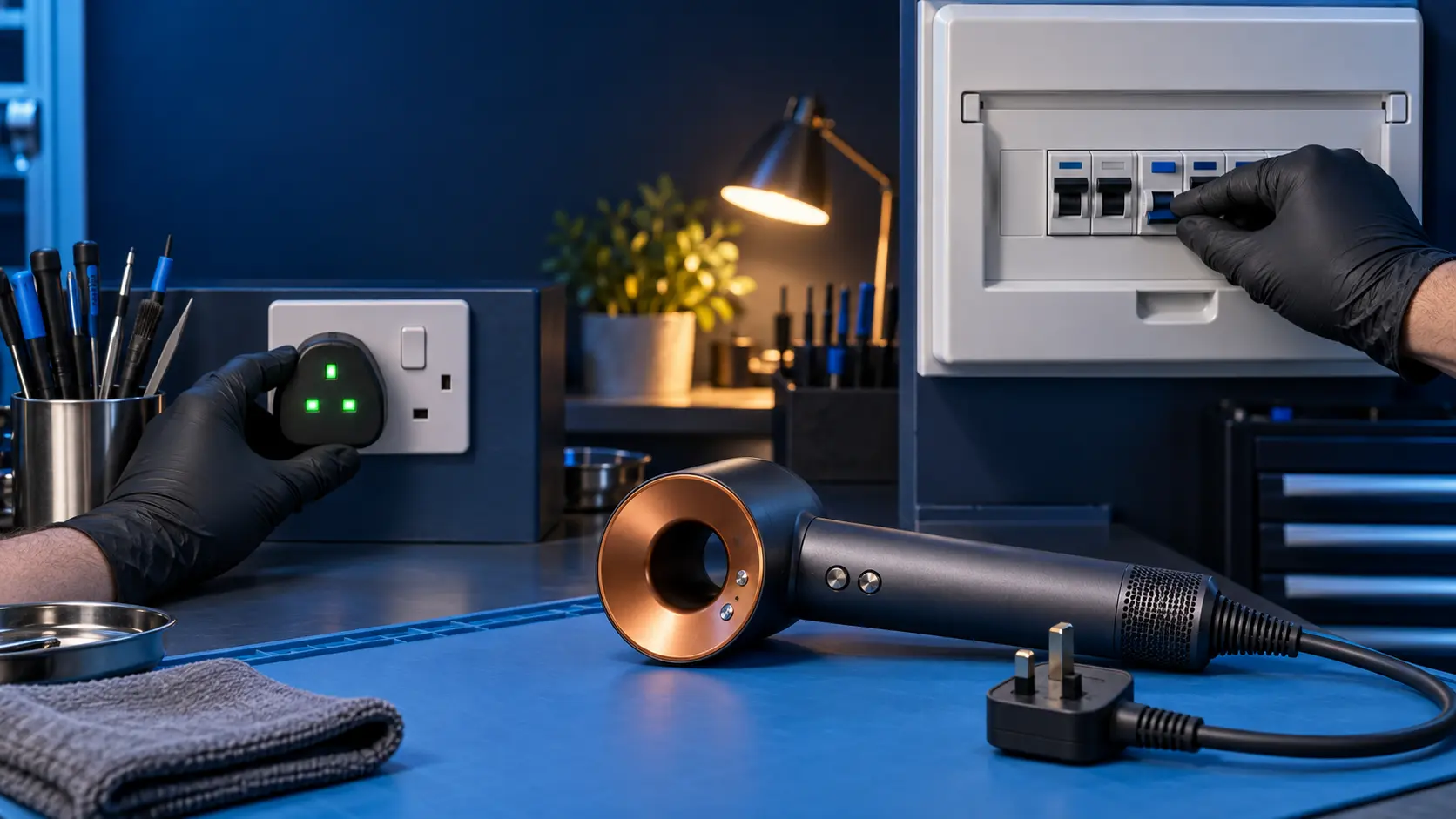
Your RCD tripping when you use the dryer. That's current going where it shouldn't. Stop using it and don't reset and retry.
The sixty-second check
Do this with the dryer on the lowest heat and the cable laid out straight, not coiled.
Look at the first six inches past the handle. Any kink, swelling, shine, browning or roughness in the sheath. That's where the failures are, so that's where you look hardest.
Run the whole length through your fingers. Slowly. You're feeling for stiff sections, soft sections, and anything that isn't uniform.
Switch it on and hold the dryer still. Does it run steadily? Give it thirty seconds.
Now flex the cable gently at the handle — gently, a normal bend, not a sharp one. Any change at all in the sound or the airflow is your answer.
Unplug it and touch the plug top. Warm is a flag. Hot is a stop.
That's the whole test. No tools, no taking anything apart, and it'll tell you more than any amount of searching.
Why catching it early actually matters
Two reasons, and neither is about my diary.
The first is safety. Early-stage cable damage is a nuisance. Late-stage cable damage is heat being generated inside insulation you're holding, on a seven-amp appliance you leave switched on. The gap between those two stages is months, and the whole point of this page is to catch it in the first one.
The second is that an early cable is a simple job and a late one sometimes isn't. If the heat has been going on long enough to affect the termination inside the handle, or the switchgear, you're into a bigger repair than a cable replacement. Same fault, more money, entirely because it ran on for another six months.
There's no prize for being brave about it.
What happens when you send it
The full cable assembly gets replaced — new flex, new termination in the handle. I don't splice cables on mains appliances and I wouldn't warrant one that had been.
While it's open I'll check the filter and the airflow path, because a dryer that's old enough to have worn out a cable is usually a dryer that's never been cleaned inside.
That's the cable repair, £79 covering everything including parts and return postage, PAT safety tested, back by tracked post with twelve months on the workmanship.
Common questions
The cable looks completely fine. Can it still be the fault?
Yes, and it very often is. The damage is inside the insulation, and the sheath is built to outlast the copper. "It looks fine" tells you nothing either way.
Is a warm cable normal? It is carrying 1,600 watts.
The whole cable being slightly warm after a long session is normal. One short section being noticeably warmer than the rest is not. It's the difference that matters, not the warmth.
Can I tape it up or use a cable protector?
A protector on an undamaged cable is prevention and it's fine. Tape over a damaged section is not a repair — it hides the thing you need to see and does nothing about the conductor.
Should I just replace the whole dryer?
Not for a cable. The motor in a Supersonic long outlives the flex, so you'd be throwing away the expensive part because the cheap part wore out.
How do I stop it happening again?
Mostly storage. Winding the cable tightly round the handle is the single biggest cause, and it's free to stop doing. Here's the right way to store one.
Mine's doing two or three things on this list. Is that bad?
It means it's further along than someone with one sign. Do the sixty-second check, and if step four changes anything, take it out of service.
If you only remember one thing: switch it on, hold the dryer still, and flex the cable where it enters the handle. Any change means the cable.
And if you've found a warm plug or a set kink but the dryer still runs perfectly — that's the best possible time to deal with it. Cheapest, simplest, and nothing has got hot enough yet to damage anything else.
The Repair Works is an independent UK repair service, run by me, Paul — 25 years of hands-on repair experience, working by post for customers across the whole country. Not affiliated with or endorsed by Dyson.