The Nural is the cleverest hair dryer Dyson has made, and that is precisely why less of it can be repaired independently than any Supersonic before it.
That sounds like a criticism. It isn't — it's just the trade. Everything that makes the Nural worth £450 is the part I can't get parts for, and everything I can fix is the part it shares with a machine that costs half as much.
So rather than take your money to find that out, here's the honest split, and how to work out which side of it your fault sits on before you post anything.
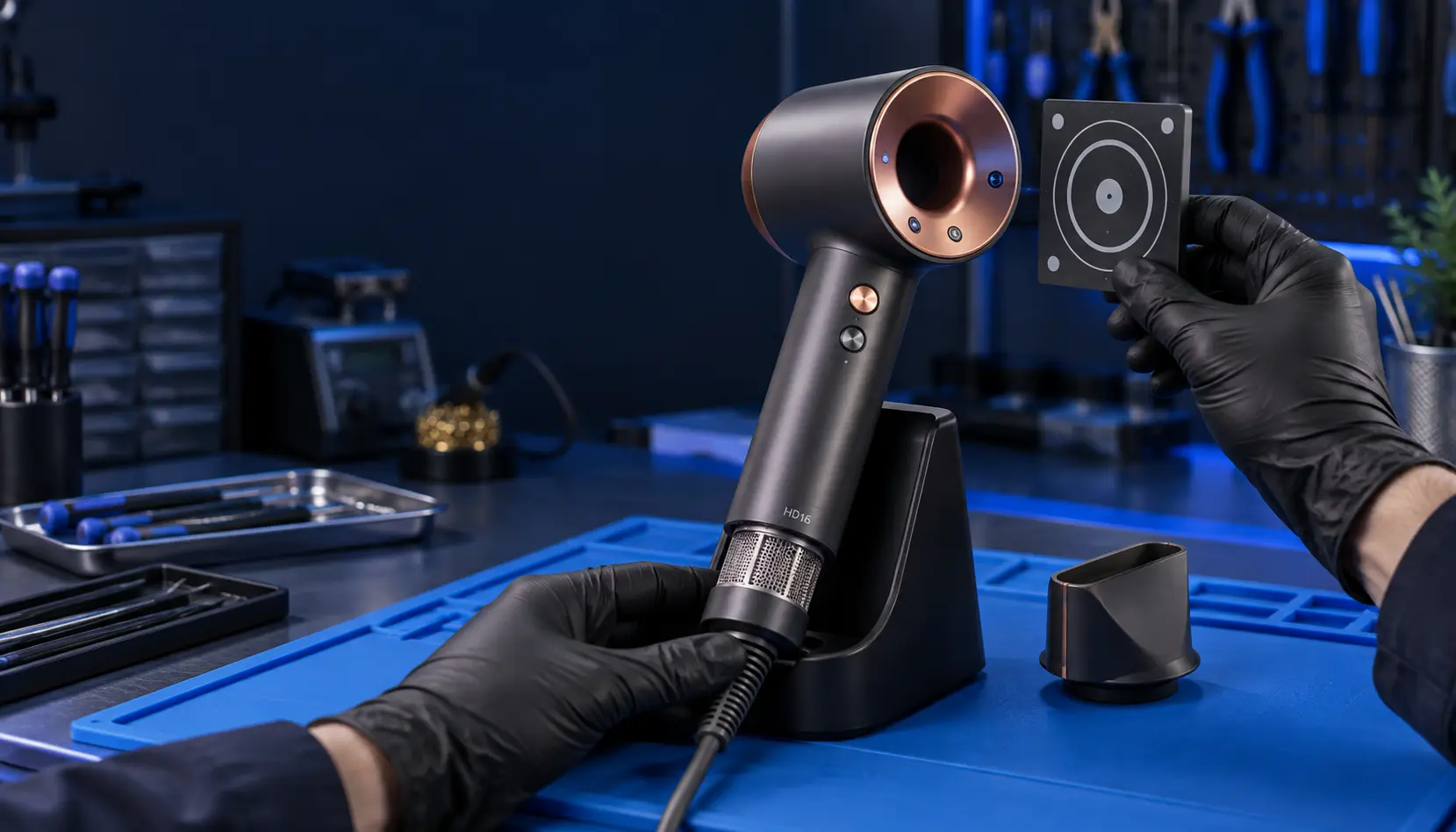
If you're not certain yours is a Nural, the model number is on the base of the handle once the filter cage slides off — it'll say HD16. Here's where to look.
What's actually different about a Nural
Less than you'd think mechanically, and much more electronically.
The motor is the same. The Nural runs the same V9 digital motor at around 110,000 rpm as the original Supersonic and every mainstream model since. Same airflow architecture, same filter arrangement at the base of the handle, same fundamental machine underneath.
What's new is a sensing layer on top of it:
Scalp Protect — the dryer senses how close it is to your scalp and drops the temperature automatically as it gets nearer, to avoid heat damage where it matters most.
Pause Detect — it senses when you've put it down and pauses the airflow rather than running on.
Attachment recognition — the attachments are RFID-tagged, so the machine knows which tool you've fitted and applies the settings you last used with it.
Those three features are the Nural. They're also, without exception, the things I cannot repair.
What I can fix
The mechanical and airflow side — which is the same machine as every other Supersonic, and which is where most faults actually live:
Cable faults. Still the most common failure on any Supersonic, and the Nural is no exception. Cuts out when you move it, won't start, a warm plug. Entirely fixable.
Restricted airflow. Clogged filter, blocked airway, debris. Often free to fix yourself, and a proper strip and clean where it isn't.
Servicing. A full clean of the filter, cage and airway, with airflow and temperature measured before and after.
Mechanical noise. Debris, a badly seated filter cage, a loose attachment.
That's a genuine majority of what goes wrong with these, because the physical wear items don't care how clever the electronics are.
What I can't fix
Anything in the sensing layer, and I'd rather say it plainly than dress it up.
Scalp Protect not working, or behaving oddly. That's the sensing and the control electronics.
Pause Detect not pausing, or pausing when it shouldn't.
Attachments not being recognised, or the machine applying the wrong settings — assuming you've ruled out the attachment itself.
Anything where a warning light points at the control system rather than at airflow or temperature.
The reason is simple and it isn't about skill: there is no independent parts supply for these components, and no independent route to the diagnostics they'd need. I can tell you what's wrong with one. I can't get the part to put it right, and a repair I can't complete is worth nothing to you.
If that's your fault, Dyson is genuinely your best option. It's their technology, it's under their support, and on a machine this recent there's a reasonable chance yours is still covered.
The Supersonic r has the same problem for the same reason, only more so — why the r can't be repaired independently covers that one.
How to tell which side you're on
Ask yourself one question: is the dryer failing to dry, or failing to be clever?
Failing to dry — weak airflow, cuts out, won't start, dead, noisy, runs hot. That's the shared machine underneath, and that's mine.
Failing to be clever — the scalp sensing isn't adjusting, it doesn't pause when set down, it doesn't recognise attachments. That's the Nural-specific layer, and that's Dyson's.
It really is that clean a split, and it'll be right far more often than not.
Two free checks before you do anything
If attachments aren't being recognised, try a different one. The RFID tag is in the attachment, not just the dryer. A single unrecognised attachment is far more likely to be that attachment than the machine — and it's an easy thing to establish with a second one.
If the airflow is weak or it's running hot, clean the filter properly. Slide the cage off the base of the handle, hold the mesh to the light, and rinse it if it looks grey or felted. A Nural is new enough that plenty of owners have never done this, and it's behind a real share of the "it's not as good as it was" complaints.
The economics are better than on any other model
Worth saying, because it changes the decision.
The Nural is the most expensive Supersonic — around £450 new. So for the faults I can fix, the case for repairing rather than replacing is stronger than on any other model in the range. A cable repair on a £450 machine is not a close call.
And if yours is out of warranty with a cable fault, that's the best possible combination: an expensive machine with its cheapest fault.
What I do with one
Exactly what I'd do with any Supersonic, within the boundary above. Cable tested along its full length rather than looked at, filter mesh and cage condition, the airway cleared properly, bearings and impeller checked, and airflow and outlet temperature measured on every setting against a known-good reference.
What I won't do is open one up, find the fault is in the sensing, and quote you for a repair I can't actually complete. If that's what I find, you'll hear it straight away.
Everything that goes back gets a PAT safety test before it's packed.
Common questions
Is my Nural still under warranty?
Quite possibly — these only launched in 2024. Check your purchase date before paying anyone, including me. If it's covered, go to Dyson; having it repaired independently will generally end any remaining cover, and that's not a trade worth making.
Can you tell me what's wrong even if you can't fix it?
Yes, though I'd rather you didn't pay postage for a diagnosis on a fault I've already told you I can't repair. Describe what it's doing before you send anything and I'll usually be able to place it from that.
Is the Nural less reliable than the standard Supersonic?
Nothing I'm aware of suggests so. It has more to go wrong in the sense that there's more in it — but the wear items are the same wear items, and those are what actually fail.
Are Nural attachments interchangeable with older models?
Physically they're the same magnetic fitting. The recognition is the Nural-specific part, so older attachments will fit and work but won't be identified by the machine.
How long does a repair take?
The current turnaround is shown when you book. If a part needs ordering, I'll tell you as soon as I've diagnosed it and give you a realistic date.
Work out which half your fault is in first. If it's failing to dry — weak, noisy, cutting out, dead — clean the filter, check the cable by flexing it where it enters the handle, and go from there. If it's failing to be clever, check the warranty date, because that's Dyson's to sort and it may well cost you nothing.
If it's the cable — and on any Supersonic it usually is — that's a £79 repair, all in: parts, labour, a 12-month warranty on the work, a PAT safety test before it's posted back, and return postage included. If I can't fix it there's no repair fee — I refund what you paid, less £4.99 return postage to send it back. Every repair is done by me personally, on my own bench, start to finish. And if what you describe turns out to be the sensing side, I'll tell you before you post it rather than after.
The Repair Works is an independent UK repair service, run by me, Paul — 25 years of hands-on repair experience, working by post for customers across the whole country. Not affiliated with or endorsed by Dyson.