It runs. Then it stops. You press the button again and you get anything from a few more seconds to another minute or two before it does exactly the same thing.
There are two completely different faults behind that behaviour, and they cost different amounts to fix. The good news is you can tell them apart yourself in about two minutes, without opening anything — and knowing which one you've got means you book the right repair rather than the dearer one.
The test that tells you which fault it is
Three questions. The answers point one way or the other almost every time.
Does it need to cool down before it'll run again?
This is the big one. Let it cut out, then immediately press the button.
If it runs straight away — even briefly — the fault isn't heat. Something is interrupting the power, and it's most likely the cable.
If it won't restart at all until it's sat for five or ten minutes, that's thermal. The machine has hit its temperature limit and won't run again until it's cooled.
Does moving the cable change anything?
Plug it in, turn it on, and flex the lead slowly where it enters the body, then again at the plug. If it cuts, stutters, or comes back at a particular angle, you have your answer and you can stop reading the rest of this section. That's a cable that's broken internally, and it's the most common fault on these.
Do the lights flash when it stops?
A thermal shutdown usually announces itself — three lights, flashing. If that's what you're seeing, here's what those lights mean and the free fix to try first.
A cable fault normally just goes dark, the way it would if you'd pulled the plug out.
If it's thermal
The dryer is protecting itself. It pulls 1,600 watts through a small body and relies on fast, constant airflow to stay at a safe temperature. When that airflow drops, the temperature climbs and it shuts down before anything cooks.
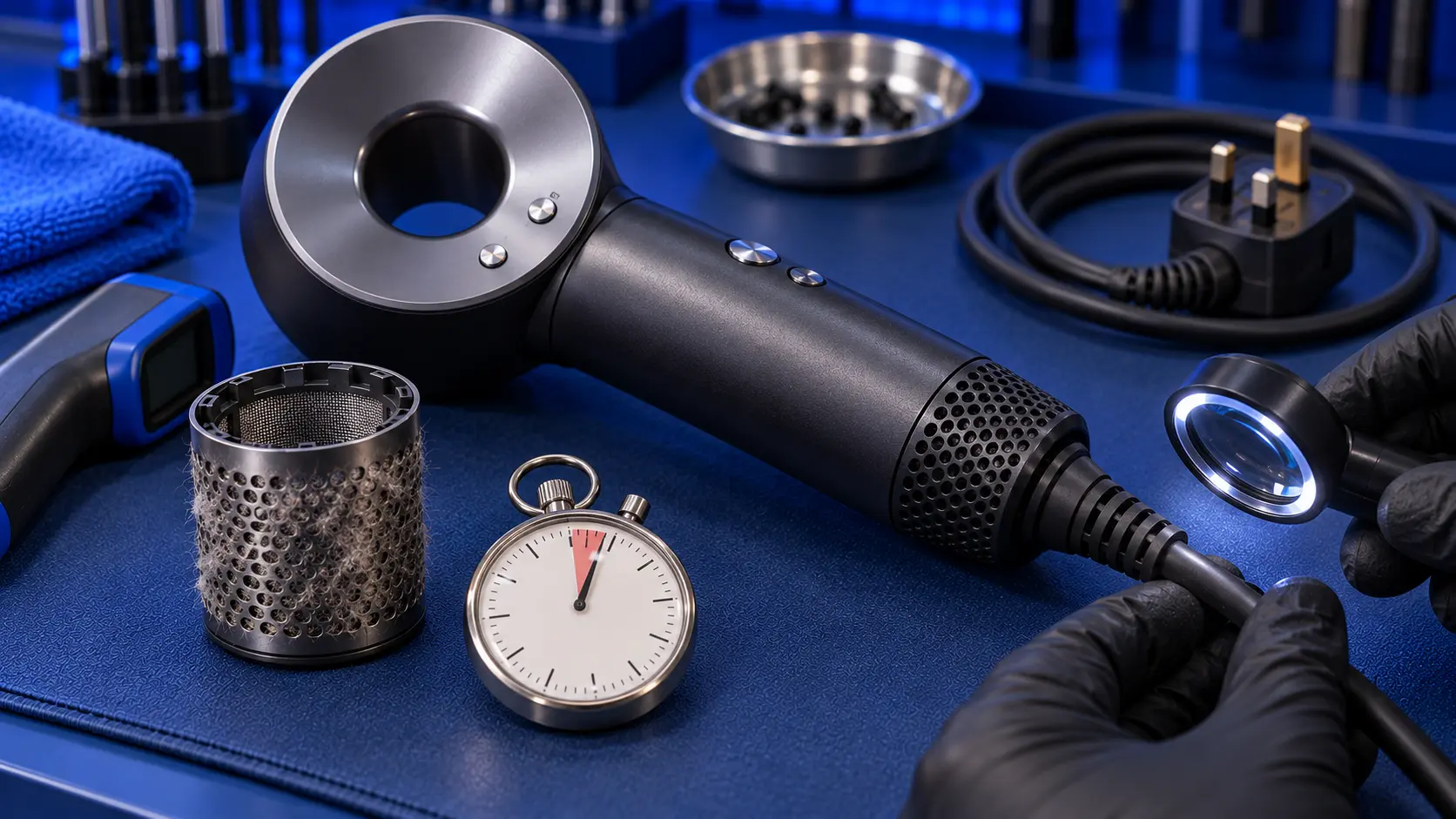
The most common cause is a filter nobody has cleaned. That's a free fix and it's worth trying before anything else — I've written out how to do it properly in the three flashing lights article, because a wipe of the outside does almost nothing.
If a proper clean doesn't fix it, the airflow is being restricted somewhere else, or the machine is measuring its own temperature wrongly. On the bench that's the temperature sensor, hair wrapped around the impeller, worn motor bearings, or the control board. All four look identical from the outside, because the machine's answer to all of them is the same: stop.
The important thing about a thermal fault is that it's a symptom, not a diagnosis. Clearing it without finding out why the airflow dropped just means it comes back in a fortnight.
If it's the cable
The copper inside the lead breaks from being flexed in the same place thousands of times — almost always within a few inches of where it enters the body.
It starts intermittent. It cuts out when you move, comes back when you move it again, and for a while you can find an angle that works. Then one day it doesn't come back at all.
Two things worth knowing. First, it only goes one way — a cable that's started doing this doesn't recover. Second, the "find an angle that works" stage is the part to stop doing. A partly broken conductor carrying 1,600 watts gets hot at the break, and that's how a cheap repair becomes an expensive one, or worse.
The third possibility
Occasionally a dryer cuts out and then won't restart at all, cold or otherwise. If yours has crossed that line — no lights, no sound, nothing, however long you leave it — that's a different article and usually a cheaper one, because a completely dead Supersonic has almost always lost power at the cable or the switch rather than anywhere expensive.
Should you keep using it?
Short answer: no, not for long.
Every thermal shutdown means the machine reached its limit. Repeatedly taking a heating element and the electronics around it to their maximum shortens the life of both. A cable that's breaking gets warm at the break. Neither fault gets better on its own and both get dearer the longer they run.
Stop straight away, and don't investigate further, if you get any of these:
A burning smell, or hot plastic
Visible smoke, however faint
A plug, socket or lead that feels warm
It trips your consumer unit
Those aren't protection working properly. Those are signs something has already failed on a mains appliance you hold next to your head.
I've written more on whether it's safe to carry on using a Dyson that cuts out if you want the longer answer.
What it costs to fix
This is why the two-minute test is worth doing — the two faults aren't the same price.
Cutting out from heat: £85, fixed. Diagnosis, the repair, parts, return postage and a PAT test, with a twelve-month warranty. I find out why the airflow dropped and fix that, rather than clearing the fault and posting it back to do the same thing again.
A broken cable: £79, fixed. Same inclusions, same warranty.
If you genuinely can't tell which you've got — and some of them are genuinely ambiguous — send it in on the cutting-out repair and I'll sort it either way. You won't be charged twice for the same machine because the fault turned out to be the other one.
And if I can't repair it at all, there's no repair fee. I refund what you paid, less £4.99 return postage.
Common questions
It cuts out on hot but runs fine on cool.
That's thermal, and it's a strong clue. The dryer only overheats when the element is working, so a machine that's happy on the cold setting and shuts down on full heat is telling you the problem is airflow or temperature sensing, not power.
It got worse over a few weeks rather than starting suddenly.
Gradual is usually thermal — a filter blocking up, or bearings wearing. Sudden is usually the cable. Not a rule, but it's the way it goes more often than not.
I cleaned the filter and it's still cutting out.
Then the filter wasn't the whole problem. Something else is restricting airflow, or the temperature sensor has drifted. That's a bench job, and it's the £85 repair.
Is it worth repairing, or should I just buy another hair dryer?
A used working Supersonic on eBay is £90 to £115 with no warranty and no history. Dyson's own refurbished ones are around £250, when they're in stock. A repair is £79 or £85 with twelve months' cover, and you keep your own machine and attachments. For most people that's straightforward — but if yours is very old and the motor has gone, I'll say so rather than take your money.
Do the two-minute test before you do anything else. Cool it down and press the button; flex the cable; watch for the lights. Those three answers tell you which fault you've got, and if it turns out to be a blocked filter you've fixed it for nothing.
If it's not the filter, you can see all the Dyson Supersonic repairs I offer and book here — £85 fixed for a thermal fault, £79 for a cable, parts, return postage and PAT test included, twelve-month warranty, and every repair done by me personally. Whatever you decide, don't keep running it through the shutdowns. Each one takes a little more out of the heater and the electronics, and the machine is telling you something rather than just being awkward.
The Repair Works is an independent UK repair service, run by me, Paul — 25 years of hands-on repair experience, working by post for customers across the whole country. Not affiliated with or endorsed by Dyson.