No. And I'd rather tell you that plainly than dress it up.
I know that's not a convenient answer, because a dryer that cuts out and then starts again feels like a machine that's coping. It isn't coping. It's protecting itself, and it's doing that because it keeps arriving at a condition it was designed never to reach.
What cutting out actually is
There's a protective device inside your dryer whose only job is to disconnect the heater when the temperature goes past a safe limit. It isn't a feature, it isn't a comfort setting, and it isn't there to be used. It's the last line of defence.
In normal service, across the entire life of the machine, it should never operate once.
So the honest way to read a cut-out is this: a component that was fitted in case everything else failed has now been called on. Something upstream of it has gone wrong, and the protection is the only thing standing between that fault and its consequences.
"It starts again when it cools down" is the problem, not the reassurance
This is the bit that catches everyone, and I understand why. The dryer stops, you put it down, five minutes later it works. Nothing is smoking, nothing smells, no harm done.
But that recovery is exactly what protection is supposed to do. It cut the heater, the machine cooled below the threshold, it reset. The system worked. What it tells you is that the system was needed, not that the machine is fine.
And these devices don't last forever. Each trip is a mechanical and thermal event, and repeated operation degrades them. A protective device that's been tripping for months is a protective device you're relying on and can no longer rely on.
There are two ways one of those eventually fails. It can fail open, and the dryer is simply dead — annoying, harmless. Or it can fail closed, and stop protecting anything at all, while the fault that was tripping it carries on unchecked.
You don't get to choose which, and you get no warning.
There are two different faults here, and one of them is worse
"Cuts out" covers two completely different problems, and telling them apart takes ten seconds. Do this before anything else.
Switch it on, hold the dryer completely still, and let it run. Then, separately, switch it on and flex the cable gently where it enters the handle.
If it runs for a while and then stops — a minute, two minutes, five — that's thermal. The machine is overheating. Nearly always that's restricted airflow, and nearly always the first cause is a blocked filter. More on the timing pattern here.
If it stops the moment you move the cable, or comes back when you wiggle it, that's not thermal at all — that's the cable. And that one is more serious, because a Supersonic draws around 1,600 watts, roughly seven amps on UK mains, and an intermittent connection at that current means heat and possible arcing inside insulation you're holding in your hand.
If it's the cable, the answer isn't "hold it at the angle that works". Please stop using it. Why cables fail where they do, if you want the detail.
What the risk actually is
I'm not going to tell you your hairdryer is about to burn your house down, because that isn't honest and you'd rightly stop reading.
Here's the proportionate version. A hair dryer is a high-current mains appliance that you hold, that runs near your head and your hair, that gets put down on soft surfaces while still hot, and that frequently gets left switched on. Its protection is the thing that keeps all of that safe when something goes wrong.
The risk of continuing to use one that keeps cutting out isn't that something dramatic happens tonight. It's that you're running a faulty appliance while steadily wearing out the one component that's making it safe, and you have no way of knowing how much of that component's life is left.
That's a bad bet to keep taking, on a machine that's usually cheap to put right.
When it's genuinely fine to carry on
I'd rather be useful than frightening, so here's the other side.
If it cut out once, on a long session, in a hot bathroom, on the highest heat setting, and it has never done it before or since — that's within the realms of normal. Protection has a threshold and unusual conditions can reach it. One event isn't a pattern.
What isn't fine is a pattern. If it's happened more than once, or it's happening more often than it used to, or it happens reliably after a certain amount of use, that's a fault and it's getting worse. Faults of this kind don't plateau.
What to do tonight
Stop using it if it's cable-related. That one's not a "get round to it".
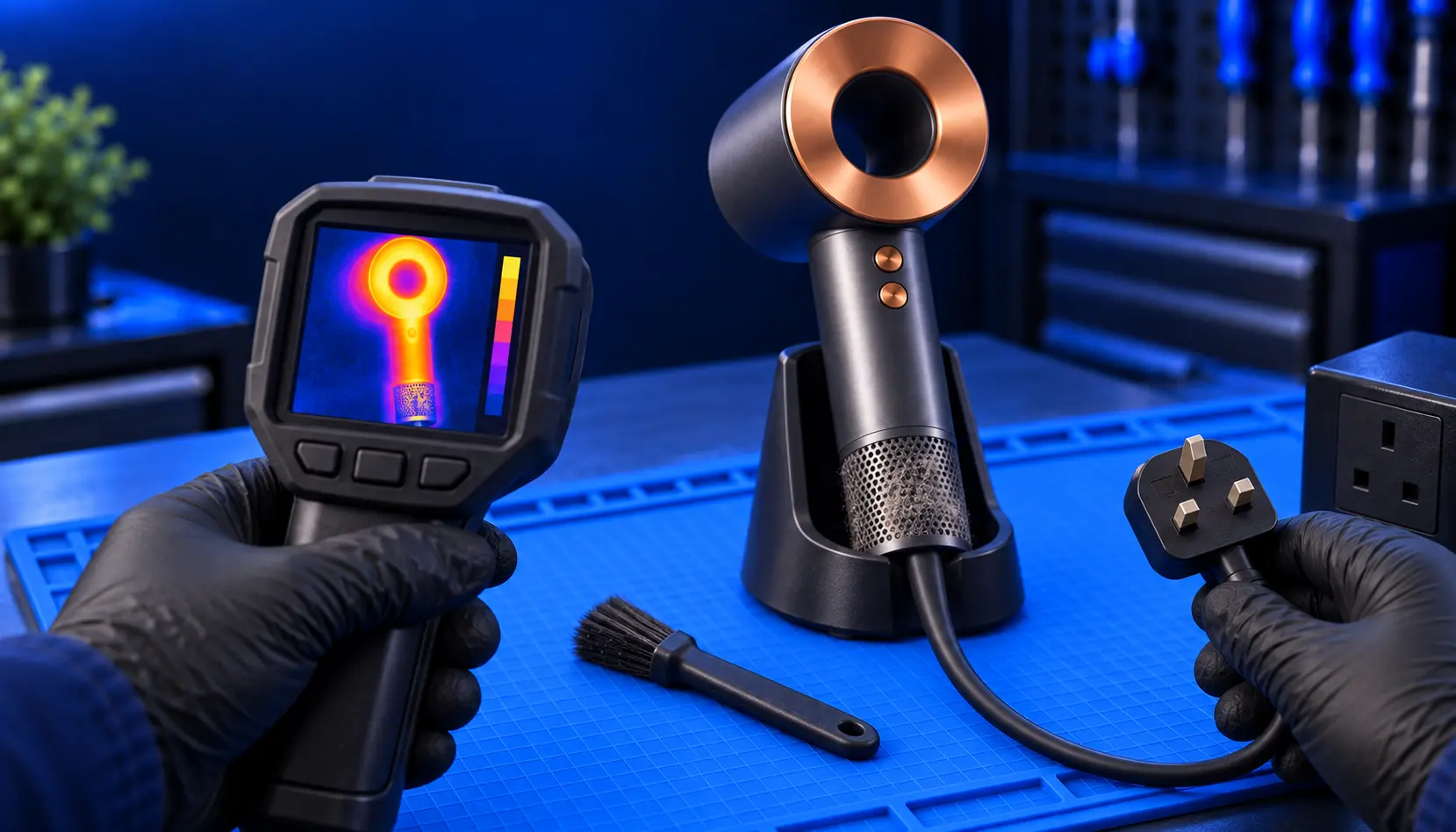
Clean the filter properly if it's thermal. Dry, soft brush, and do the intake on the machine as well as the mesh on the cage. It's free, it takes two minutes, and it's the answer more often than anything else. Here's how.
Run it again and time it. If it now runs indefinitely, that was your fault and you've fixed it for nothing.
If it still cuts out after a genuine clean, stop. The restriction is past the filter where you can't reach it, or the sensing or the board has a fault. Neither improves with use.
That last case is what the cutting-out repair is for — the airflow path cleaned properly, a correctly specified thermal cut-off fitted, the thermistor and motor verified, and temperatures actually measured rather than assumed. But do steps one to three first. I'd rather you fixed it yourself for free.
Common questions
It only cuts out on the highest heat. Can I just use it on medium?
You can, and it'll probably work, and you'll have hidden the symptom rather than fixed it. The machine is still overheating at high heat; you've just stopped asking it to. Meanwhile whatever's restricting the airflow carries on getting worse.
How many times is too many?
More than once is a pattern. I wouldn't use one a third time without at least cleaning the filter.
Could it be the socket or the fuse?
If it cuts out completely — no lights, no noise, nothing — and comes back when you reset something at the wall, that's a different problem and worth ruling out. Thermal cut-outs stop the dryer, not the circuit.
It cuts out and there's a smell. Same thing?
No, that's more urgent. A burning smell on a 1,600 watt appliance isn't a wait-and-see fault. Unplug it and don't use it again until someone's looked at it.
Is it worth repairing or should I replace it?
Depends on what's found, and I'd want to know before you spend anything. But if it's the filter or the airflow path, you're looking at far less than a new one, and the motors in these long outlive everything around them.
What actually happens if I ignore all this?
Most likely, one day it stops working and never starts again, because the protection has failed open. That's the good outcome and it's the common one. It's the less common outcome that I'd rather you didn't gamble on, and I've written that up separately in what happens when one overheats.
The whole article in one line: a dryer that cuts out is a dryer telling you something is wrong, and the fact that it recovers is the protection doing its job rather than the problem going away.
Clean the filter first. It's free and it's usually the answer. And if it's the cable — if it changes when you move it — stop tonight, and don't hold it at the angle that works.
The Repair Works is an independent UK repair service, run by me, Paul — 25 years of hands-on repair experience, working by post for customers across the whole country. Not affiliated with or endorsed by Dyson.