"It's getting too hot" turns out to mean two completely different things, and people use the same words for both.
Some mean the air is too hot — it's uncomfortable on the scalp, or their hair has started behaving differently. Others mean the dryer itself is too hot — the handle or the body is warm in a way it never used to be, even though the air seems fine.
Those are different faults with different causes and different costs, and the first useful thing you can do is work out which one you've got. It takes about a minute.
Which one is it?
Hold your hand where your head normally is, on the highest heat setting, with no attachment fitted. It should be hot. It should not be painful, and you should be able to leave your hand there.
Then run it for five minutes and feel the handle and the body. Warm is normal — there's a motor in there. Uncomfortable to hold is not.
If the air is too hot, read the next section. If the body is too hot, skip to the one after. If it's both, that's usually one cause and it's covered below.
And before either: if there's any smell of burning, stop now and don't use it again until it's been looked at. That's a different problem with a different urgency, and I've written about what a burning smell from a Supersonic actually means separately.
When the air is too hot
Here's the thing most people don't know about this hairdryer, and it's the whole reason this fault matters.
The Supersonic doesn't just have heat settings. It measures the temperature of the air leaving the machine, continuously, many times a second, and modulates the element to hold it where it should be. That regulation is the entire point of the product — it exists specifically to stop the dryer reaching the temperatures that cause lasting damage to hair.
So when the air is too hot, one of two things is happening.
Either the machine is fighting a restriction. Same energy going into less air means hotter air coming out. The regulation is working, it's just working against something. That's nearly always a clogged filter, and it usually comes with reduced airflow you may or may not have noticed.
Or the regulation itself isn't working. If the temperature sensor drifts or fails, the dryer loses its sense of how hot it actually is, and the element runs where it shouldn't.
That distinction matters more than it sounds:
A blocked filter makes it hot and the dryer knows. A failed sensor makes it hot and the dryer doesn't.
The first one will usually protect itself eventually — you'll get cut-outs, or you'll notice the airflow. The second one just quietly runs hot and feels normal to the machine. That's the one that costs you hair.
When the body is too hot
If the air seems right but the machine is uncomfortable to hold, the heat isn't being carried away.
The Supersonic's airflow does double duty — it dries your hair and it cools the motor and the electronics on the way past. Restrict that flow and the heat stays inside the machine instead of leaving with the air. The handle gets warm, then hot, and internal temperatures climb.
Same underlying cause as the first case, usually. Different symptom because of where the heat ends up.
There's a longer explanation of the airflow path and why thermal protection exists in what happens inside a Supersonic when it overheats, which is worth reading if you want to understand the machine rather than just fix it.
Is it damaging my hair?
This is what most people actually came here to ask, so a straight answer: if the air is genuinely running hotter than it should, then yes, over time.
Heat damage to hair isn't dramatic. It's cumulative. The cuticle — the outer layer — takes the punishment first, and the result is hair that feels rougher, looks duller, frizzes more, and breaks more easily at the ends. It creeps up over months, which is exactly why it's easy to blame on a change of shampoo, the weather, or your hairdresser.
The threshold where damage starts to accumulate varies with how wet your hair is and whose research you read, but the principle holds regardless: temperature and time both count, and a dryer running hotter than designed moves you the wrong way on both.
Here's the practical test that catches it. If your hair has got noticeably worse over a few months and nothing else changed — same products, same routine, same person cutting it — the dryer is worth eliminating. People almost never think of it, because the dryer still works.
The uncomfortable irony is that a Supersonic with a failed sensor is potentially harder on hair than a cheap dryer, because you trust it not to be.
The free checks
Do these before spending anything.
Check the heat setting. Obvious, and it happens more than you'd think — the buttons are easy to catch when you pick it up, and on some models the setting doesn't persist the way people assume.
Clean the filter properly and reseat the cage. A restricted filter is behind the clear majority of both symptoms. Not a wipe — a proper clean of the mesh, and the cage pushed fully home afterwards.
Take the attachments off and compare. A concentrator holds heat against a smaller area by design. Judge the machine bare.
Compare the settings. On the lowest heat, is it still too hot? If a low setting produces air that's clearly hotter than a low setting should, that points towards the regulation rather than a restriction, and it's worth having looked at.
What I do with one that runs hot
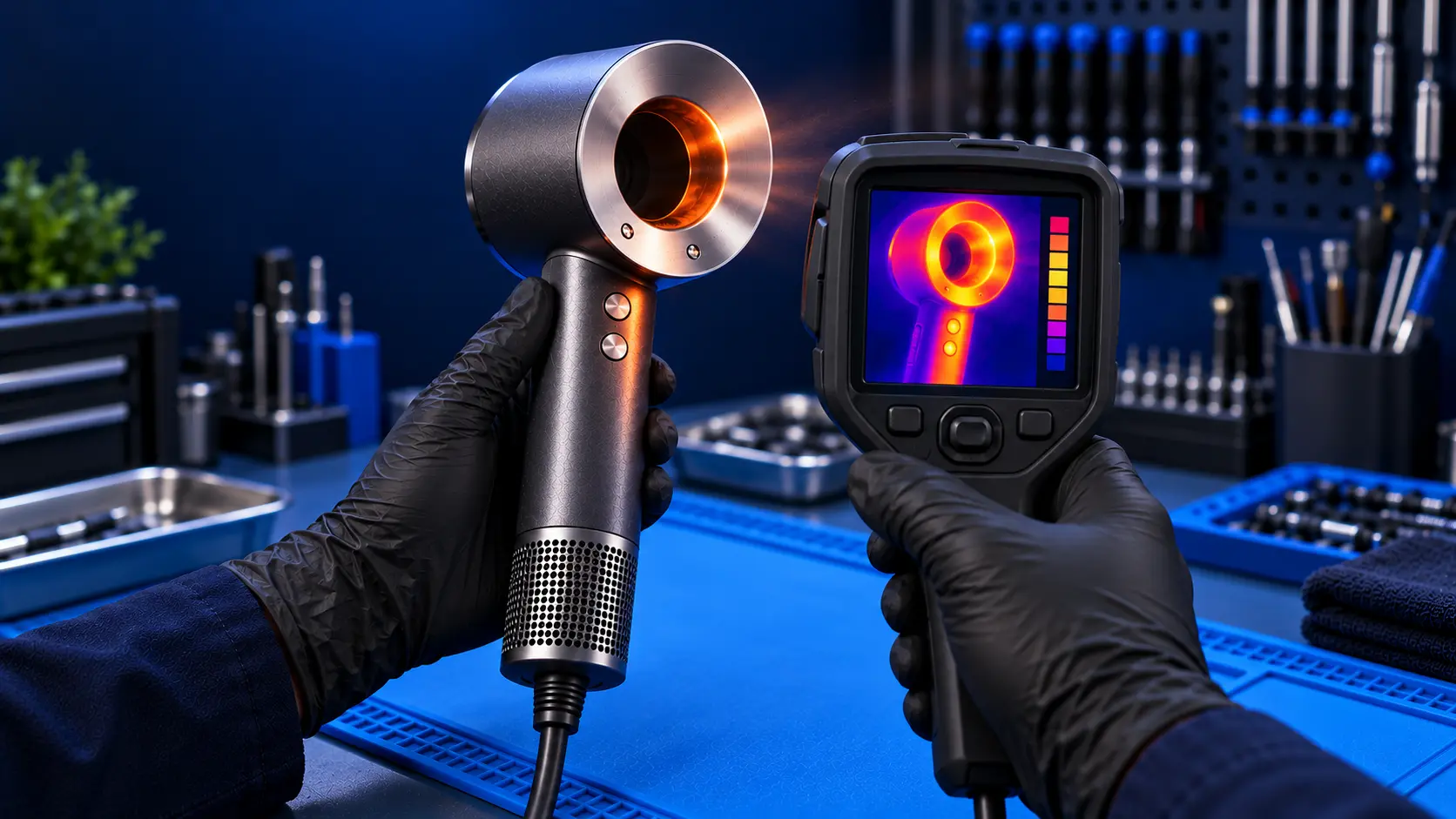
I measure the outlet temperature against a known-good unit on the bench, on each setting, and I measure the airflow at the same time. Those two numbers together tell you most of what you need: hot with weak flow is a restriction; hot with normal flow points at regulation.
Then it comes apart. Filter mesh and cage condition, the full airway cleared, the element inspected for residue and discolouration, the sensor and its wiring checked, the motor checked for free rotation and speed. Back together, measured again on every setting, and PAT safety tested before it's packed.
Often it's a restriction, and they go home genuinely fixed by a proper clean. A minority are the sensor, and those I'll tell you about before doing anything.
Common questions
How hot should a Supersonic actually get?
Hot enough to dry hair quickly, and not hot enough to be painful to hold your hand in at normal working distance on maximum. If you can't comfortably keep your hand where your head goes, something is wrong.
The body gets warm. Is that normal?
Warm, yes — there's a high-speed motor a few inches from your hand. Uncomfortable or genuinely hot after a few minutes, no.
It's hot but it hasn't cut out. Is it still a problem?
Yes, and arguably more of one. The thermal cut-out is a last line of defence against damage to the machine. It isn't there to protect your hair, and it triggers well past the point where the air is hotter than it should be. "It hasn't cut out" is not the same as "it's fine".
Is this the same fault as cutting out after a few minutes?
Frequently, yes — same restriction, caught at a different stage. Running hot is what happens before it starts shutting itself off. Which means dealing with it now is cheaper than dealing with it later.
How long does it take?
The current turnaround is shown when you book. If a part needs ordering, I'll tell you as soon as I've diagnosed it and give you a realistic date.
Start with the filter and the heat setting, because between them they account for most of these and they cost you nothing but a few minutes. Then run the low-setting comparison — if low heat still feels too hot, that's the signal that this isn't just a clogged filter.
If it's still running hot, send it to me for a service and deep clean. That's £49 all in — a full strip, the airway and element cleared properly, temperature and airflow measured on every setting against a reference unit, a PAT safety test, a 12-month warranty on the work and return postage included. If I open it up and find it's the sensor rather than a restriction, I'll come back to you with a price before I do anything, not after. Every repair is done by me personally, on my own bench, start to finish. And in the meantime, drop it a heat setting and dry from a bit further away — that won't fix the machine, but it will take some of the load off your hair while you decide what to do.
The Repair Works is an independent UK repair service, run by me, Paul — 25 years of hands-on repair experience, working by post for customers across the whole country. Not affiliated with or endorsed by Dyson.