If your Dyson Supersonic hair dryer smells of burning, stop using it and unplug it at the wall. Do that before you read the rest of this.
I'm not being dramatic. This is a 1,600-watt mains appliance that you hold a few inches from your face, often in a bathroom, often with wet hands. Most faults on a Supersonic can wait a fortnight. This one is in a different category, and the sensible order is unplug first, work out what it was second.
The good news is that once it's unplugged, nothing is getting worse while you decide what to do.
Don't plug it in again if any of these are true
Some of what follows involves careful judgement. This bit doesn't. If you can see any of the following, the dryer doesn't go back in a socket at all — not to test it, not "just once more to check":
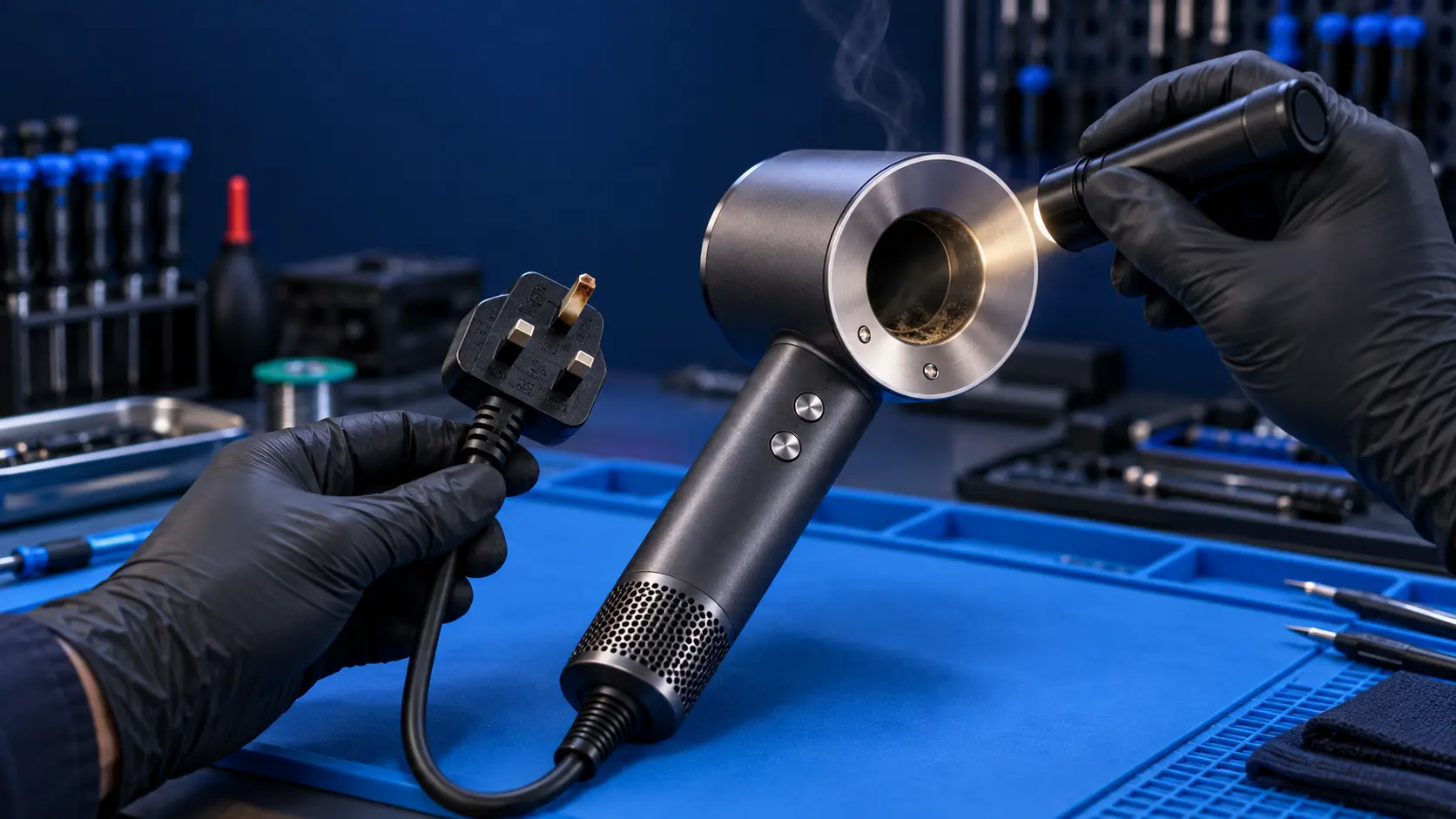
Any visible smoke, however faint
Scorch marks, browning, or melted or deformed plastic anywhere on the body, the lead or the plug
Discoloured or blackened plug pins
The plug, the socket or any part of the lead feeling warm to the touch
It tripped your RCD or the sockets in that room
Crackling, buzzing or a spitting noise
Any one of those means something has already failed rather than something is about to. Leave it unplugged and get it looked at.
Where was the smell coming from?
This is the question that tells you most, and you can answer it from memory — you don't need to plug it in again to work it out.
From the air coming out of the nozzle. The smell is in the airflow itself, strongest at the front. That points at the heating element or something on it, and it's the most common of the three.
From the plug, or from a point along the lead. The smell is at the wall or partway down the cable, not in the air. This is the one I'd treat most seriously. It means a conductor is overheating or arcing, and that happens where a cable has broken internally — usually within a few inches of where the lead enters the body, sometimes at the plug. If yours has also been cutting out when you move the lead, those two symptoms together are the same fault, and it's well past the point of using it.
From the body, with a change in the motor noise. Whining, grinding or a new pitch alongside an acrid smell suggests the motor. Less common, more expensive, and not something to run further.
You genuinely can't tell. That's fine and it's honest. It's also a reason to have someone look at it rather than guess.
The one case that usually isn't a fault
There is a version of this that's normal, and I'd rather tell you than have you pay me for nothing.
Dust, hair and hairspray residue settle on the heating element over time. The first time the dryer runs after a long gap — the first cold morning of the year, or after it's been in a drawer all summer — that residue burns off and produces a brief hot smell. It's the same thing a radiator does when the heating comes on in October.
That is probably what happened, but only if every one of these is true:
It lasted seconds to a minute, not the whole time you used it
It happened on the first use after a long period unused
It hasn't come back on subsequent uses
There are no marks, no warm plug, no noise change, nothing from the list above
It smelled dusty or hot, not sharp, acrid, chemical or like melting plastic
If all five hold, clean the filter properly and carry on. If any one of them doesn't, treat it as a fault.
What you should not do is run it deliberately to "burn the smell off". That advice is everywhere online and it's only safe when dust is genuinely the cause — which is precisely the thing you don't know yet.
Check the socket as well
Worth thirty seconds, and it occasionally saves people a repair bill for a dryer that was never broken.
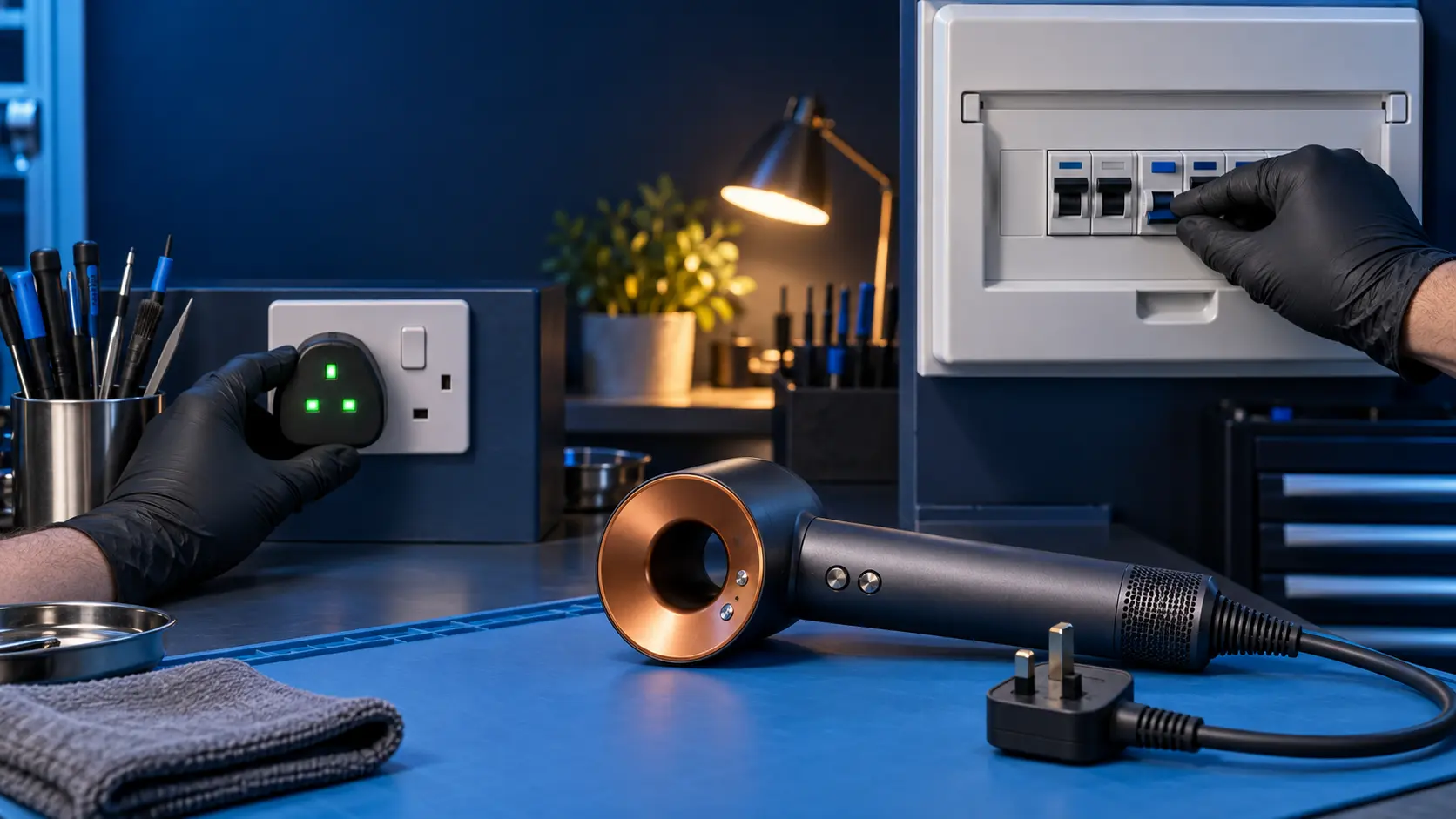
With everything unplugged, look at the socket the dryer was in. Discolouration around the pin holes, a scorched or browned faceplate, a socket that feels loose when a plug goes in, or one that's warm — any of those and the fault may be the socket, not the appliance.
If that's what you're looking at, don't use that socket, and get an electrician rather than a repairer. A failing socket will do the same thing to the next appliance you plug into it.
What's usually burning
For what it's worth, here's what I check when one of these arrives on the bench.
Residue on the element. The benign one described above, sometimes with a filter so clogged that the element has been running far hotter than it should. That's a service and clean rather than a parts job.
A cable breaking down internally. Stranded copper fractures from years of flexing, the surviving strands carry the full seven amps, and the break gets hot inside the insulation where nobody can see it. This is the most common cause of a smell at the plug or lead end.
Restricted airflow cooking the element. When the air can't move fast enough, the element and the plastics around it run above their design temperature. That's what overheating actually does to a Supersonic over time, and it's cumulative.
A motor on its way out. Worn bearings, more friction, more heat, and eventually the insulation on the windings starts to suffer. This one nearly always announces itself with noise first.
Occasionally, a component on the control board. Uncommon, but a failed component has a distinctive sharp electrical smell and usually leaves a visible mark.
If it's under two years old, go to Dyson first
The Supersonic comes with a two-year manufacturer's warranty. If yours is still inside that, this is a warranty claim and you should ring Dyson before you ring anyone else — including me.
I'd rather say that than take a job that should have cost you nothing. Check your receipt or your registration before you post anything to anybody.
What it costs to have it looked at
Out of warranty, this fault is the one I won't quote a fixed price for, because a burning smell can originate anywhere from the plug to the motor and those are very different repairs.
It starts with a £4.99 assessment. I open it, find where the heat is actually coming from, and tell you plainly what's failed and what it would cost to put right. The £4.99 comes off the repair if you go ahead.
Most Supersonic repairs land between £49 and £85 all-in — parts, return postage, a PAT test and a twelve-month warranty, every repair done by me personally. If yours turns out to be beyond that, I'll tell you the number before I touch anything, and I'll tell you honestly if I don't think it's worth repairing.
If I can't fix it, there's no repair fee. I refund what you paid, less £4.99 return postage.
One thing I won't do is clear a fault and post it back without finding out what caused it. A thermal cut-out that's blown, blown for a reason, and replacing it alone gives you a dryer that does exactly the same thing in a fortnight.
Common questions
It only smelled for a few seconds and now it's fine.
Most likely dust on the element, if it was the first use after a long break and nothing on the warning list applies. Clean the filter properly and keep an eye on it. If it comes back, it wasn't dust.
Is it safe to post a dryer that's been smelling of burning?
Yes. Unplugged, in a box, it's inert — there's nothing to catch fire without power going through it. Just don't run it before you pack it.
Can I keep using it on the cold setting?
I wouldn't. If the smell came from the cable or the plug, the heat is being made by the current, and the motor draws current on cold as well. If it came from the element, you're avoiding the symptom rather than the cause. There's more on why "it still works, mostly" isn't a safe standard in is it safe to keep using a Dyson that cuts out.
It smells of burning and it's tripping the electrics.
Stop there. That combination isn't a repair question yet — it's a live electrical fault. Leave it unplugged and don't reset the breaker with it connected.
Is it worth repairing after something has burnt?
Often, yes. A burning smell tells you something got too hot, not that the machine is scrap — a cable or an element is a real repair on a machine whose expensive parts are usually fine. The inspection exists so you find out which before you commit.
Leave it unplugged, and have a proper look at the plug, the lead and the socket in daylight. That costs nothing and it answers a surprising amount — a browned plug pin or a warm socket changes who you should be calling.
If there's nothing obvious and you want it looked at properly, you can book a £4.99 assessment here — a full bench diagnosis, a straight answer on where the heat was coming from and what it would cost, taken off the repair if you go ahead, and every repair done by me personally. But whatever you decide about the repair, don't decide to carry on using it in the meantime. Of all the things a hair dryer can do wrong, this is the one that doesn't wait.
The Repair Works is an independent UK repair service, run by me, Paul — 25 years of hands-on repair experience, working by post for customers across the whole country. Not affiliated with or endorsed by Dyson.