Here's the idea that makes everything else about hair dryers make sense, and almost nobody is told it: the moving air isn't the product of the machine, it's the cooling system.
We think of a hair dryer as a thing that makes hot air. Mechanically it's closer to a heating element that would destroy itself in seconds if air weren't being forced over it continuously. The hot air coming out of the nozzle is what's left over after that element has been kept alive.
Once you see it that way, everything that goes wrong with these follows logically. So let's go through it properly.
Where the air actually goes
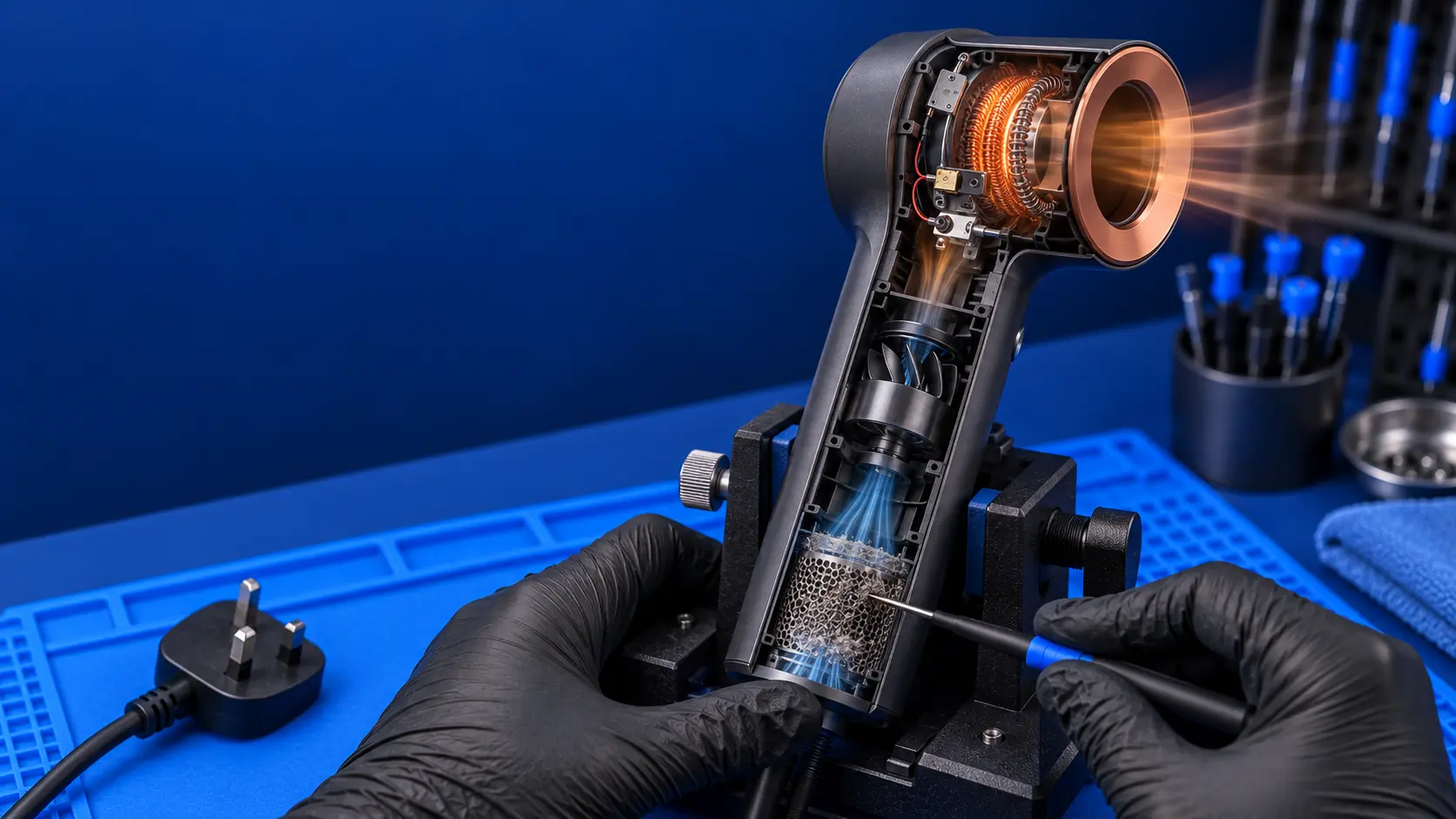
A Supersonic is unusual because the motor is in the handle rather than the head, and the airflow path runs the length of the machine.
Air is drawn in through the filter cage at the bottom of the handle. It passes through the impeller — the spinning part of the motor, turning at a genuinely startling speed; Dyson quote around 110,000 rpm for the V9 motor in these. It's then pushed up through the inside of the handle, round the corner into the head, past the heating element, and out of the nozzle at you.
That's one continuous path from the bottom of the handle to the tip. Anything that restricts it anywhere restricts the whole thing, which is why a blocked filter at the very bottom affects what happens at the very top.
The air is the cooling system
The element in a hair dryer dissipates a lot of power in a very small space. A Supersonic is rated at around 1,600 watts.
To get a feel for what that means: it's roughly the same electrical power as a small electric heater, concentrated into something you hold in one hand. The only reason that's survivable is that a large volume of air is being driven past it every second, carrying the heat away as fast as it's produced.
Take the air away and nothing else changes. The element still draws its power. It still produces its heat. There's just nowhere for that heat to go except into the element itself, the parts around it, and the plastic holding all of it.
That's the whole mechanism of overheating, and it's why airflow is the thing the machine watches most closely.
How the dryer knows
There's a temperature sensor — a thermistor — in the airflow, and a control board reading it.
This isn't an occasional check. It's a continuous conversation: the board reads the air temperature many times a second and adjusts the power going into the element to hold the setting you've chosen. On the newest machines Dyson quote a hundred measurements a second. That's what "intelligent heat control" means, and it's also why these don't scorch hair the way a cheap dryer can — the temperature is being actively held rather than just roughly aimed at.
So the first thing that happens when airflow drops isn't a cut-out. It's regulation. The air coming through is getting hotter than it should for the setting, the board sees that, and it reduces the power to compensate.
Which is why the earliest sign of a restriction isn't a dramatic failure. It's that the dryer seems a bit less effective than it used to be, and takes longer. It's quietly turning itself down to stay safe.
Then, step by step, what goes wrong
Airflow falls. Product residue on the filter mesh, deposits in the airflow path, hair round the intake. Less air per second through the same machine.
The air leaves hotter. Same power, less air to spread it across. Each unit of air picks up more heat.
The element itself runs hotter. This is the part that matters more. Less air over the element means less heat carried away from it, so its own temperature climbs — faster and higher than the air temperature does.
The board turns the power down. You notice a weaker, slower dryer. Most people blame the dryer getting old.
Turning down isn't enough. Restriction keeps worsening. Eventually the board can't hold temperature even at reduced power.
Protection operates. A thermal cut-out disconnects the heater. The dryer stops. It restarts once it's cooled below the threshold.
Step six is the point at which most people first realise anything is wrong — and by then steps one to five have been running for months.
What's actually restricting it
Hairspray is the honest answer, and it's worth understanding why.
Most styling products are a polymer carried in a solvent. The solvent evaporates and leaves the polymer behind — that's the entire point, it's what makes it hold. But a dryer standing in a cloud of that mist is inhaling it, and the same thing happens inside the machine: solvent evaporates, polymer stays.
The filter catches most of it. Not all. What gets through condenses onto whatever internal surface it meets first, and over years builds a genuine lining on the inside of the airflow path.
That lining does two bad things at once. It narrows the path, reducing airflow. And it insulates the surfaces it's on, so heat that used to be carried away into the metal and plastic of the machine no longer is.
Add hair — which is drawn to the intake by definition — and fine dust, and you have a restriction you can't reach from the outside and can't brush out.
What the protection is protecting
Worth being clear about, because "overheating" is vague and the actual concerns are specific.
The element and its supports. These run hot by design and have a limit. Beyond it, mountings soften and geometry shifts.
Wiring insulation. There's insulated wiring inside a machine designed to be full of moving cool air. Remove the cool air and insulation ages far faster than it was ever meant to.
The motor. At 110,000 rpm the bearings depend entirely on their lubricant behaving as intended. Heat thins lubricant. The motor is also cooled by the same airflow, so a restriction makes it run hotter at exactly the moment it's working harder.
The plastics you're holding. Not likely to fail, but they're rated for a temperature range and repeated excursions above it don't do them good.
You. The machine is next to your head, your hands, and your hair. That's not a dramatic claim, it's just where a hairdryer is.
Repeated overheating damages the protection itself
This is the part I'd most want someone to take away.
A thermal cut-out isn't a switch designed to be operated daily. It's designed to work reliably once, in an emergency, after years of never being needed. Every trip is a thermal and mechanical event, and repeated operation degrades it.
There are two ways one eventually fails. It can fail open — the dryer is simply dead, which is the good outcome and the common one. Or it can fail closed, and stop protecting anything, while the restriction that was tripping it carries on unchecked.
You don't get to pick, and you get no warning.
Which means the recovery people find reassuring — it stops, it cools, it works again — isn't the machine coping. It's the machine spending the one component that's keeping it safe. I've written the practical version of that argument in is it safe to keep using one that cuts out.
Common questions
If restriction makes the air hotter, why does my dryer feel weaker?
Because the board is turning the power down to hold the temperature. You lose airflow and heat output together, and you feel that as a dryer that isn't what it was. If it feels hotter and weaker, that's regulation losing the fight — that's getting-too-hot territory.
Would running it on cool avoid all this?
It avoids the element side, yes. It doesn't avoid the motor side, and it doesn't clear the restriction. You'd be managing a symptom indefinitely.
Does overheating damage the motor permanently?
It can, though the motor is usually the last thing to go on these. What's far more common is everything around it aged prematurely while the motor itself is still fine — which is exactly why repair usually makes sense on a Supersonic.
How much residue are we talking about?
On a six-year-old daily-use dryer that's never been apart, more than people expect. Enough to see, and enough to explain the missing airflow on its own.
Can I clean the airflow path myself?
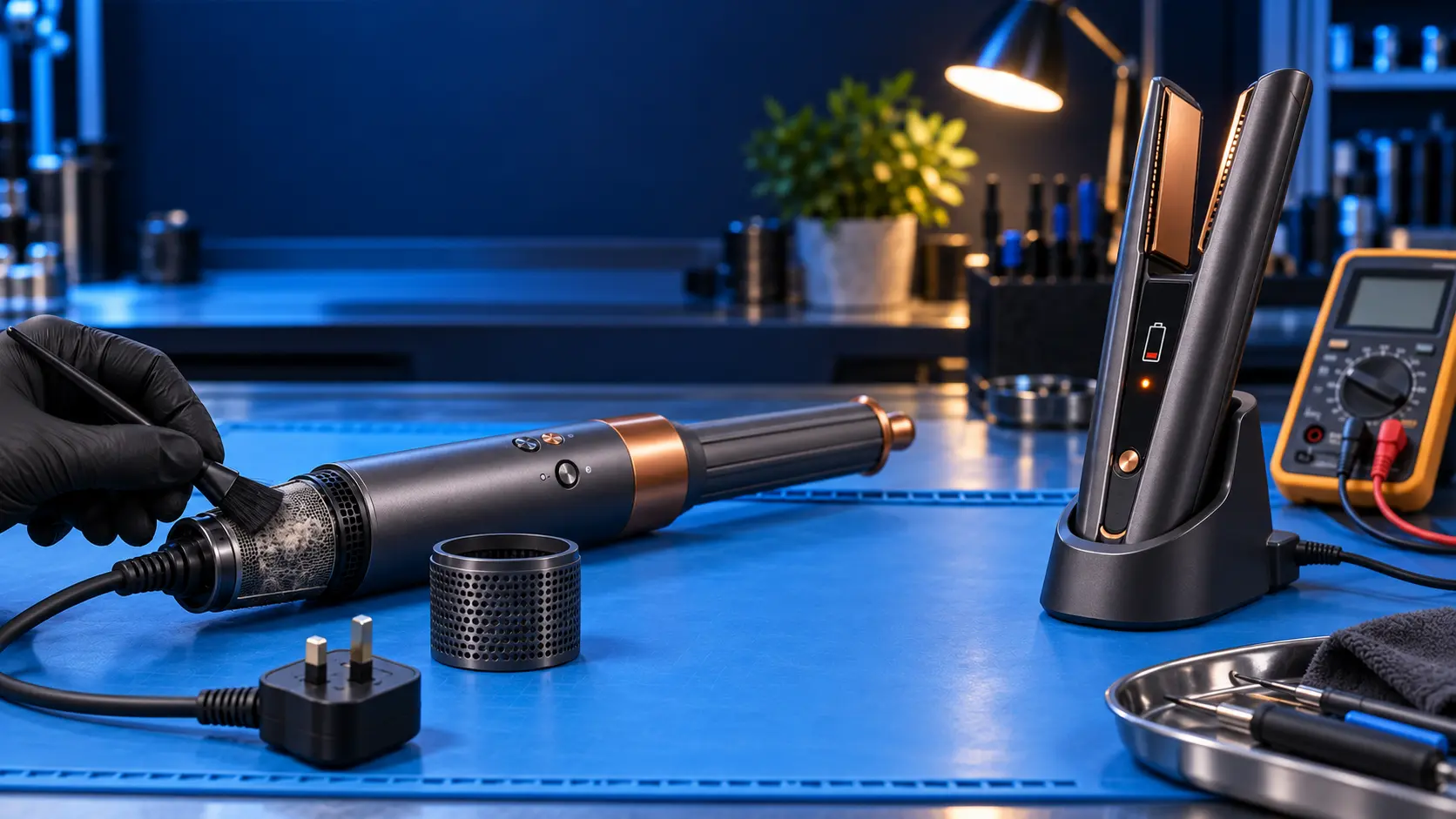
Not meaningfully. You can reach the filter mesh and the intake, and you should. The rest is behind the impeller and you can't get to it without taking the machine apart. That's the service and deep clean — the whole path cleaned, a new inner filter, thermistor and motor verified, and actual temperatures measured rather than assumed.
Is Dyson's design to blame?
No, and I'd say so if I thought otherwise. Every hot-air appliance works this way and every one of them depends on airflow to survive. The Supersonic is better protected than most and the filter is more accessible than most. What it can't do is stop you never cleaning it.
The short version: the air is the cooling system, the element only survives because the air is moving, and everything that goes wrong with these is some version of the air not moving enough.
Which is why a two-minute filter clean is the single most valuable thing you can do to one, and why a dryer that cuts out is telling you something rather than just being annoying.
The Repair Works is an independent UK repair service, run by me, Paul — 25 years of hands-on repair experience, working by post for customers across the whole country. Not affiliated with or endorsed by Dyson.