There are three different faults that people describe in almost the same words, and they have almost nothing in common. Before you read any further, work out which one is yours, because two of them are on other pages.
Nothing happens at all. No sound, no lights, no movement. That's a dead machine, and it's covered in why a Supersonic won't turn on.
It runs normally for a few minutes, then shuts down. That's thermal protection doing its job after the machine has got too hot, and it's usually a restriction.
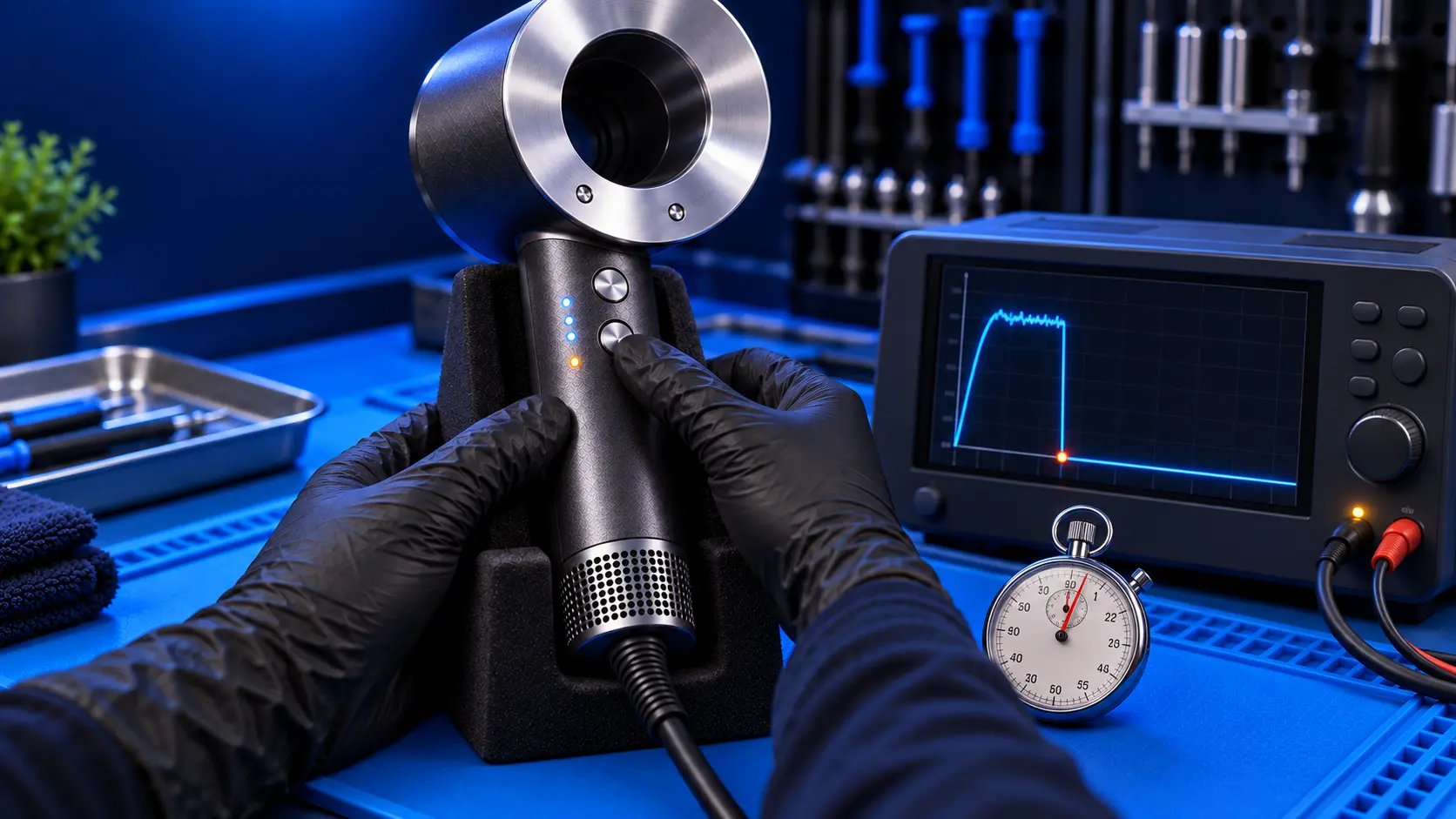
It starts, runs for a second or two, then stops. It never gets going properly. That's this page.
The third one behaves differently from the other two because something different is happening: the machine is starting, checking itself, deciding it doesn't like what it sees, and shutting down before it ever reaches working speed.
That's not a machine dying. That's a machine protecting itself. Which is good news more often than people expect.
First: has it just been running?
If it cut out on you a few minutes ago and you've been trying to restart it ever since, stop.
A Supersonic that has shut down on thermal protection needs to actually cool before it will run again — and while it's still hot, every attempt gives you exactly this symptom. It starts, sees a temperature it doesn't like, and shuts straight back off.
Put it down for half an hour. If it then runs normally, you don't have this fault at all — you have an overheating fault, and the thing to chase is what's restricting the airflow.
This catches a genuine number of people, and it costs nothing to rule out.
Then: is it the supply?
The motor in a Supersonic draws a substantial surge of current in the instant it spins up — far more than it uses once it's running. If the supply can't deliver that surge cleanly, the machine starts and drops straight out.
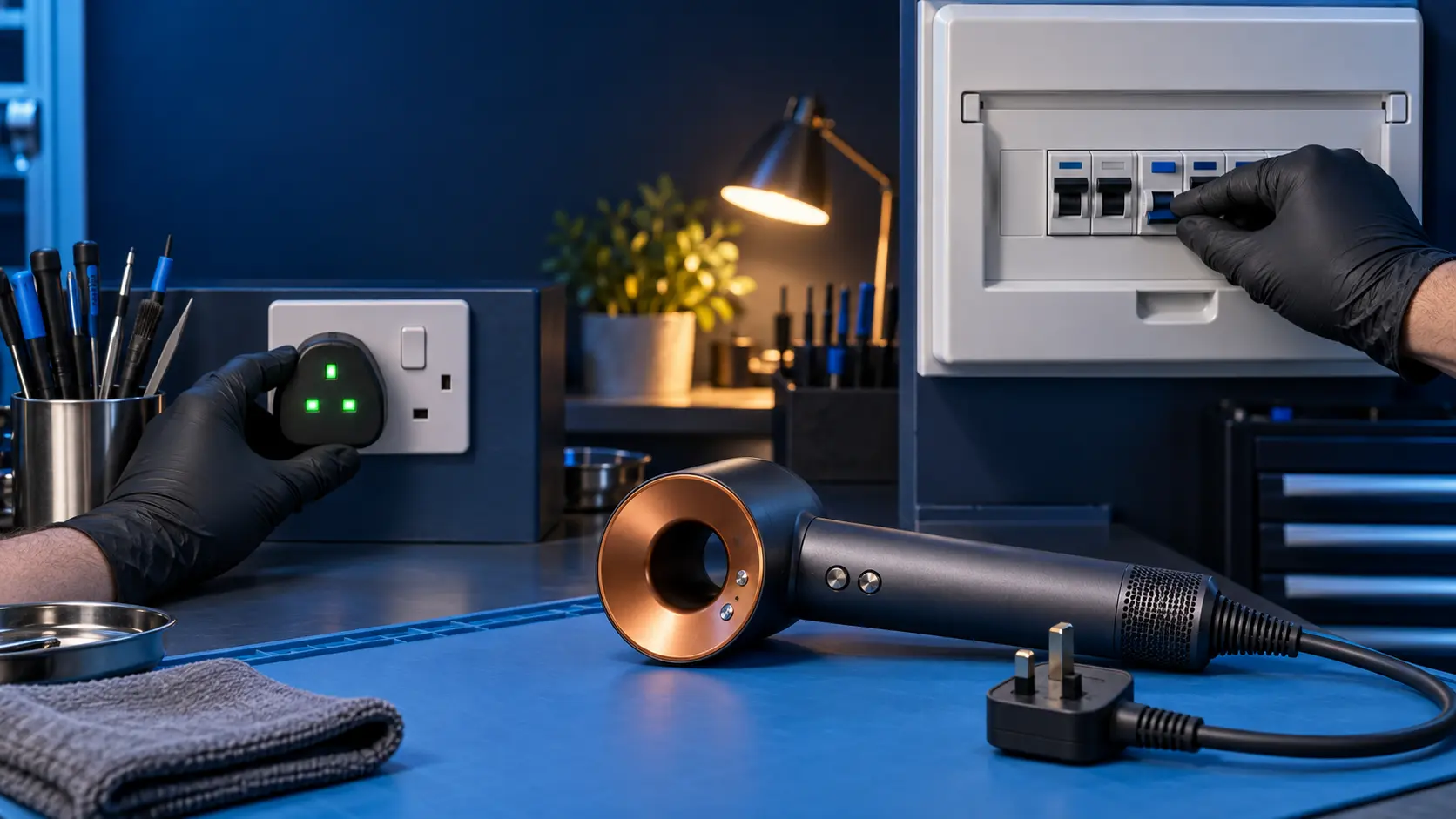
Plug it directly into a wall socket. No extension lead, no multi-way adaptor, no travel adaptor. Extension leads in particular are a common culprit, especially older or thin ones, and especially if something else is plugged into the same strip.
Try a different socket, ideally on a different circuit.
Check whether anything is tripping. If your RCD or breaker is clicking when you switch the hairdryer on, that's a different and more serious conversation, and the dryer should not be used again until someone has looked at it.
Then: the cable test
This is the one that finds most of them.
Plug it in, switch it on, and hold the machine completely still — don't move your hand at all. Does it run?
Now do it again, and this time gently flex the cable where it enters the handle while it's running. Then where it enters the plug.
If the behaviour changes — if it cuts when you move it, or runs when you hold the cable at a particular angle — you've found your fault, and it's the cable rather than anything inside the machine.
The reason this shows up as start-then-stop rather than as a constant fault is worth understanding. The flex at the handle end has been bent thousands of times, always at the same spot, and the individual copper strands break gradually. For a while there are enough left to carry a small current but not enough to carry the surge the motor needs at startup. So the machine has power, tries to spin up, can't draw what it needs, and quits.
It's also why this fault tends to get worse fast once it starts.
What the machine is actually doing
Assuming the supply is fine and the cable is sound, what you're seeing is the control board refusing to run.
The Supersonic monitors itself continuously — temperature, motor speed, current draw — and it checks all of that at startup. If any of it comes back outside the range it expects, it shuts down immediately rather than running with a fault. The most common reasons it does that:
The motor can't spin up. Debris jamming the impeller, or a bearing that's gone far enough to create real drag. The board sees the motor failing to reach speed and stops it rather than cooking it. There's often a noise alongside this, even in the second or two it runs.
A sensor is reading something impossible. If a temperature sensor fails open or short, the board doesn't get "too hot" — it gets a value that can't be real, and the safe response to that is to refuse to run. This is a genuine fault but it's a component-level one, not a dead machine.
Current draw is out of range. Something in the motor or the drive circuitry is drawing more than it should. That's the one that points at real electrical work.
If there are lights
Any warning lights alongside the shutdown will narrow this down considerably, because the machine is telling you what it decided.
Count them carefully and note the colour and the pattern — flashing versus solid matters, and so does how many. What the lights on a Supersonic mean goes through the patterns and what each one indicates.
If you're sending it to me, include what the lights did. It genuinely shortens the diagnosis.
What I do with one
I start with the supply and the cable, because that's where most of them are, and I test the cable along its length rather than looking at it — the break that causes this is almost always invisible under intact insulation.
If the cable's sound, it comes apart. Impeller checked for free rotation and obstruction, bearings checked for drag, sensors tested for sane values rather than assumed good, and the motor's current draw measured at startup rather than inferred. The board gets inspected for heat marking round the drive circuitry.
Then back together, run through every setting repeatedly — because an intermittent fault that only shows on one start in five is still a fault — and PAT safety tested before it's packed.
Common questions
Is it safe to keep trying it?
A few attempts to diagnose, yes. Repeatedly, no. If the reason it's stopping is that the motor can't turn freely, every attempt is pushing current into a motor that isn't moving, and that's how you turn a cheap fault into an expensive one.
It works if I hold the cable a certain way. Can I just keep doing that?
Please don't. A cable with broken strands carries its current through fewer and fewer conductors, and that means heat concentrating at a weak point inside the insulation. That's the failure mode you don't want on a 1600-watt appliance you point at your head.
It's intermittent — sometimes it runs fine. Does that make it less serious?
No, it makes it earlier. Intermittent faults of this kind are almost always mechanical or connection-related, and they don't recover. It's a better time to deal with it than in three weeks.
Is this the same as cutting out after a few minutes?
No, and the difference matters. Cutting out after a few minutes is thermal — the machine got too hot during use. Turning on and straight back off means it never got going, which points at supply, cable or the startup checks instead.
How long does it take?
The current turnaround is shown when you book. If a part needs ordering, I'll tell you as soon as I've diagnosed it and give you a realistic date.
Let it cool properly if it's just been running, plug it straight into a wall socket with no extension lead, and do the cable test — hold it still, then flex the cable at the handle. Between them those three take five minutes, cost nothing, and identify the cause in most cases. If flexing the cable changes anything, you already know what's wrong.
If you've done all that and it still won't get going, send it to me and I'll find out why. It's £85 all in — diagnosis, repair, parts, a 12-month warranty on the work, a PAT safety test before it's posted back, and return postage included. If I can't fix it there's no repair fee — I refund what you paid, less £4.99 return postage to send it back. Every repair is done by me personally, on my own bench, start to finish. In the meantime, stop retrying it — if the motor's being obstructed, each attempt costs you a bit more than the last.
The Repair Works is an independent UK repair service, run by me, Paul — 25 years of hands-on repair experience, working by post for customers across the whole country. Not affiliated with or endorsed by Dyson.