Most guides to Supersonic faults cover three machines: the original, and the two mainstream generations that followed it. If yours says something else on the base of the handle — Origin, Shine, or a model number that doesn't appear in anyone's list — it's easy to assume you've ended up with an orphan nobody supports.
You haven't. Here's what these actually are and what it means for getting one fixed.
If you haven't found your model number yet, it's printed on the base of the handle once the filter cage slides off — here's where to look.
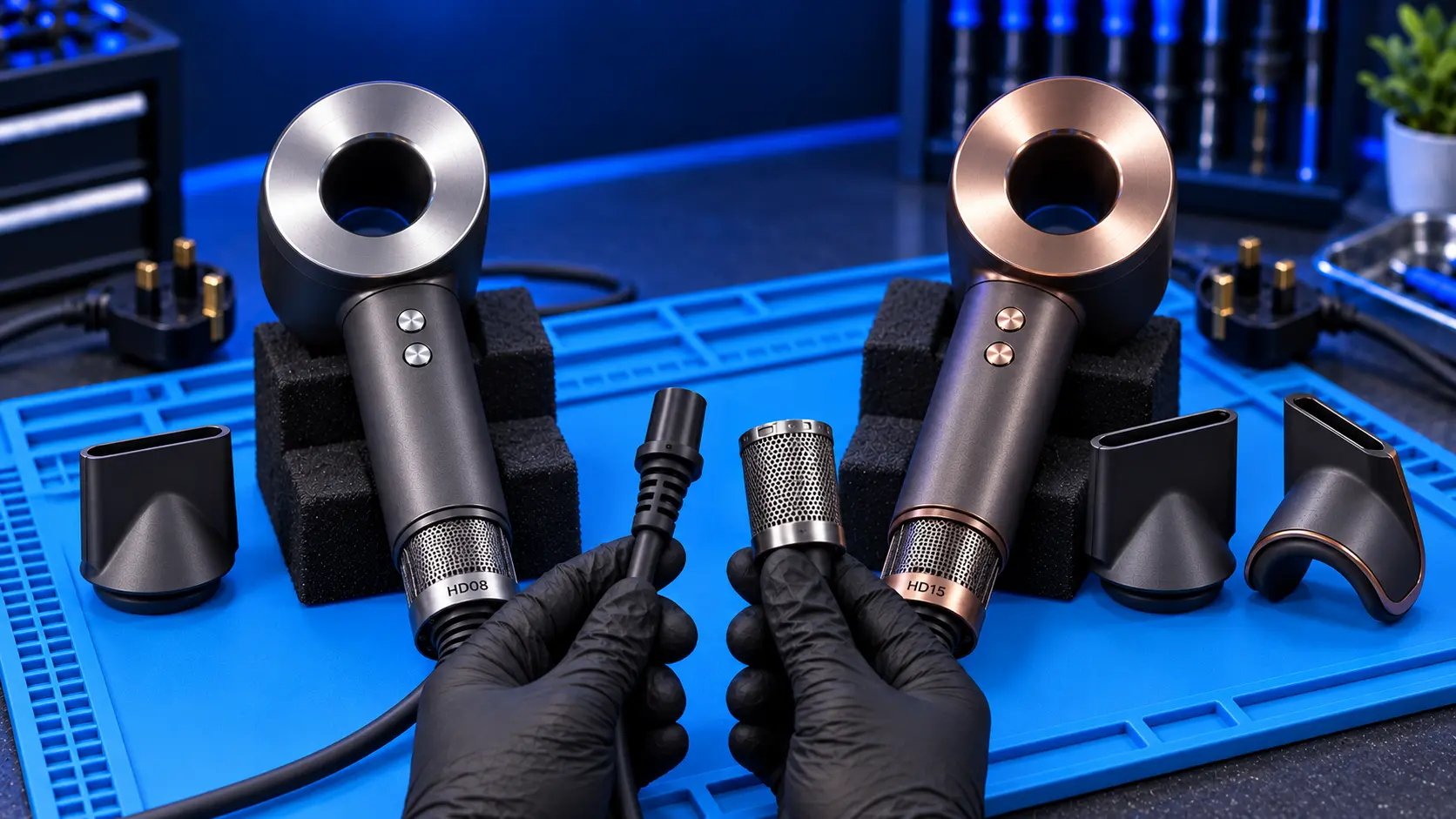
The Supersonic Origin (HD08)
This is the big question, and the answer is more reassuring than people expect.
The Origin is the same hair dryer with fewer attachments in the box. Dyson sold it as a streamlined version — you get the dryer and the styling concentrator, and the diffuser, wide-tooth comb, flyaway attachment and gentle air attachment that come with the full package aren't included. You can buy them separately if you want them.
That's the difference. Not a smaller motor, not a cut-down machine — a different bundle at a lower price.
Which matters enormously for repairs, because it means an Origin repairs exactly like any other Supersonic. The cable is the same cable — a UK parts supplier lists a single power cord covering the whole HD01 to HD08 range, which tells you what you need to know about how much these machines share. The airway is the same, the filter is the same, the faults are the same.
If you've been worried that buying the cheaper one has left you with something unsupportable, it hasn't.
The Supersonic Shine (HD15)
A later variant, and a less well-documented one. It sits in the same family as the models above and to the best of my knowledge repairs the same way.
I'd rather be straight with you: I've had less hands-on time with these than with the mainstream models, and I won't claim certainty I haven't earned. If yours is an HD15, message me before you post it and I'll confirm what I can do rather than have you pay postage to find out. That's a two-minute conversation and it costs you nothing.
HD02 and other numbers
If your machine shows a number that isn't HD01, HD03, HD07, HD08 or HD15, it's most likely a regional variant — Dyson has used different model numbers in different markets for what is essentially the same machine.
Same advice as above: tell me the number when you get in touch and I'll confirm before you send anything.
The ones I can't help with
Worth restating clearly, because it's the difference between a useful parcel and a wasted one.
The Supersonic r (HD17) and the Supersonic Travel (HD19) are not repairable independently. There's no parts supply outside Dyson for either, and that isn't something goodwill or experience gets around. If yours is one of these, Dyson is genuinely your only route, and I'd rather tell you here than have you pay to post it, only for me to tell you the same thing.
The Supersonic Nural (HD16) sits in between. There's a limited set of work I'll take on and a larger set I won't, because the sensing and electronics are a different proposition. Check with me before booking rather than after.
What goes wrong on any of them
The faults don't vary by variant, because the machine doesn't:
The cable, first and by a distance. It fails where it enters the handle and where it enters the plug, because that's where it bends. Cuts out when you move it, then won't start, then a warm plug.
A clogged filter. The mesh at the base of the handle felts up with fine hair and product residue. Weak airflow, hotter running, eventually cut-outs. Free to fix and very often the whole problem.
Thermal cut-outs, which are nearly always a consequence of the above rather than a fault of their own.
Sticky buttons, from years of product residue working into the seam. Usually a clean.
Bearings, eventually. The motor runs at around 110,000 rpm and they're the wear item. A dry, grinding note quite unlike a rattle, and the one fault that's sometimes uneconomic.
Does the cheaper model change whether it's worth repairing?
Slightly, and it's worth being honest about the arithmetic.
The Origin cost less new than the full-bundle Supersonic, so the case for an expensive repair on one is marginally weaker. But the gap is smaller than people assume, and the dominant fault — the cable — is a fixed, modest cost on any of them. A cable repair is comfortably worth doing on every model in this family.
Where it tightens is a failed motor on an older machine. Whether a Supersonic is worth repairing goes through the full comparison against a used one, Dyson's refurbished machines and buying new — and there are cases where the answer is no. I'll tell you if yours is one of them.
One thing that doesn't change: your attachments. If you've bought extra ones for an Origin over the years, they're worth real money and they stay with your machine when you repair it rather than being replaced.
What I do with one
The same as any Supersonic, because it is one. Cable tested along its length rather than looked at, filter mesh and cage condition, the airway cleared properly, bearings and impeller checked, buttons and switches tested rather than pressed, and airflow and outlet temperature measured on every setting against a known-good reference.
Back together, run repeatedly to catch anything intermittent, and PAT safety tested before it's packed.
Common questions
Is the Origin a worse machine than the standard Supersonic?
No. It's the same dryer sold with fewer attachments. The drying performance is the performance of a Supersonic.
Can I buy the missing attachments for an Origin?
Yes, separately. They're the same attachments — they fit any Supersonic in this family.
My model number isn't on your list at all. What now?
Get in touch with the number before posting anything. Most unusual numbers turn out to be regional variants of a machine I service routinely, but I'd rather confirm than have you pay postage on a guess.
Does having the cheaper model mean fewer parts are available?
No. The parts that matter — cables especially — are shared across the whole range. That's one of the genuine advantages of how consistently Dyson built these.
How long does a repair take?
The current turnaround is shown when you book. If a part needs ordering, I'll tell you as soon as I've diagnosed it and give you a realistic date.
Whatever it says on the base of the handle, start with the filter — take the cage off, hold the mesh to the light, and clean it properly if it looks grey or felted. Then hold the dryer still, run it, and flex the cable where it meets the handle. Between them, those two checks find most faults on any model in this family and they cost you nothing.
If it's still not right, send it to me and I'll find out why — and if you've got one of the less common models, drop me the number first and I'll confirm before you spend anything on postage. It starts with a £4.99 assessment. I quote before doing any work, and if you go ahead the £4.99 comes off the repair, which includes a 12-month warranty, a PAT safety test and return postage. If you decide not to, or I can't fix it, I post it back and the £4.99 covers that postage. Every repair is done by me personally, on my own bench, start to finish. And if it turns out to be an HD17 or an HD19, I'll tell you straight away and save you the trip.
The Repair Works is an independent UK repair service, run by me, Paul — 25 years of hands-on repair experience, working by post for customers across the whole country. Not affiliated with or endorsed by Dyson.