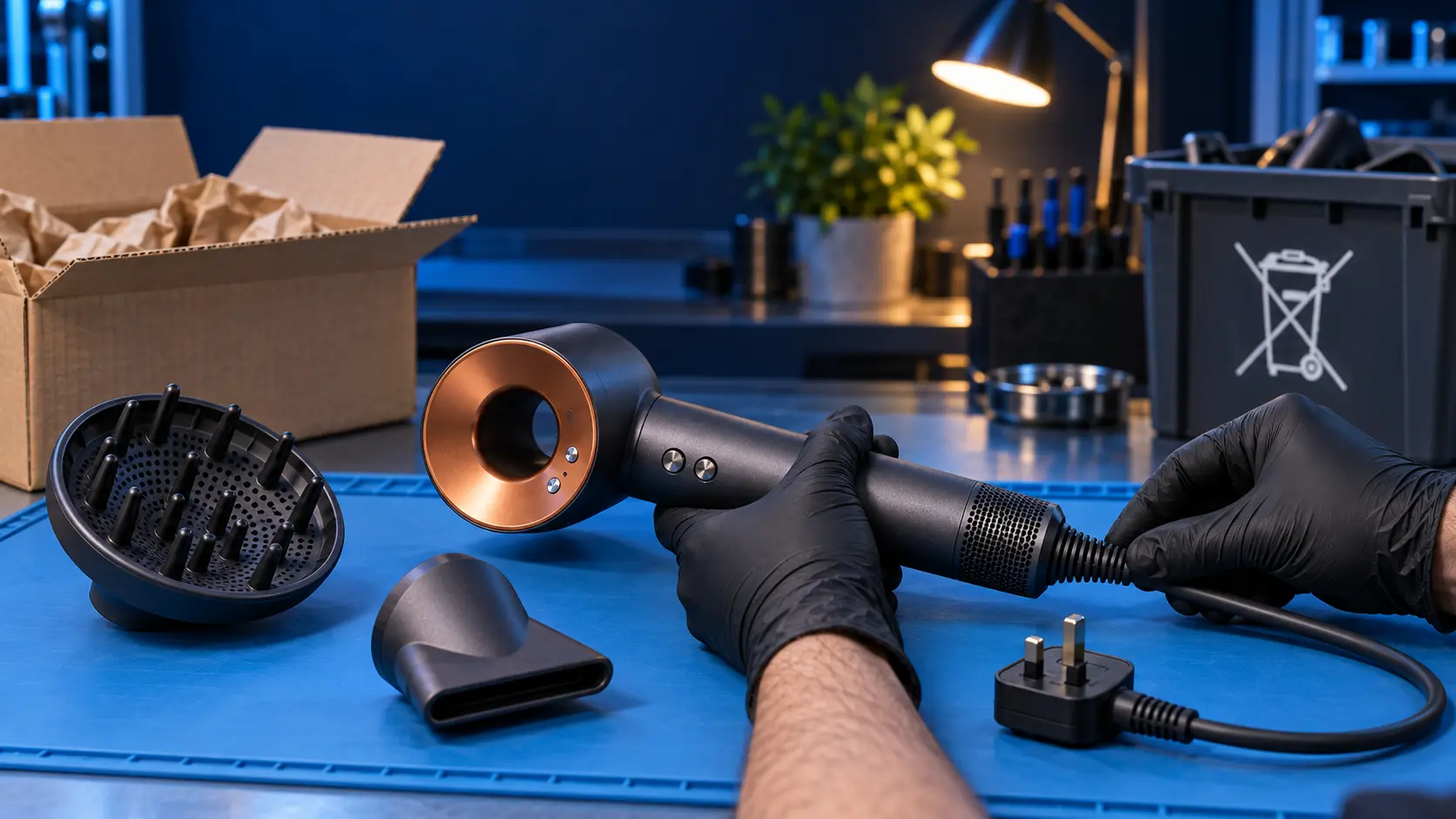
The HD03 is the one most people have. It sold in enormous numbers over a long run, and if you own a Supersonic and haven't checked which one, the odds say it's this.
I'm going to start with something most pages about this model won't tell you: the HD03's faults are essentially the same as the original HD01's. Same architecture, same motor, same airflow path, same things that wear out. You'll find articles online listing "HD03-specific problems" — and having had both apart, I'd be inventing distinctions if I did the same.
What genuinely differs isn't the fault. It's the age. And on a model that sold for years, that changes the answer more than you'd think.
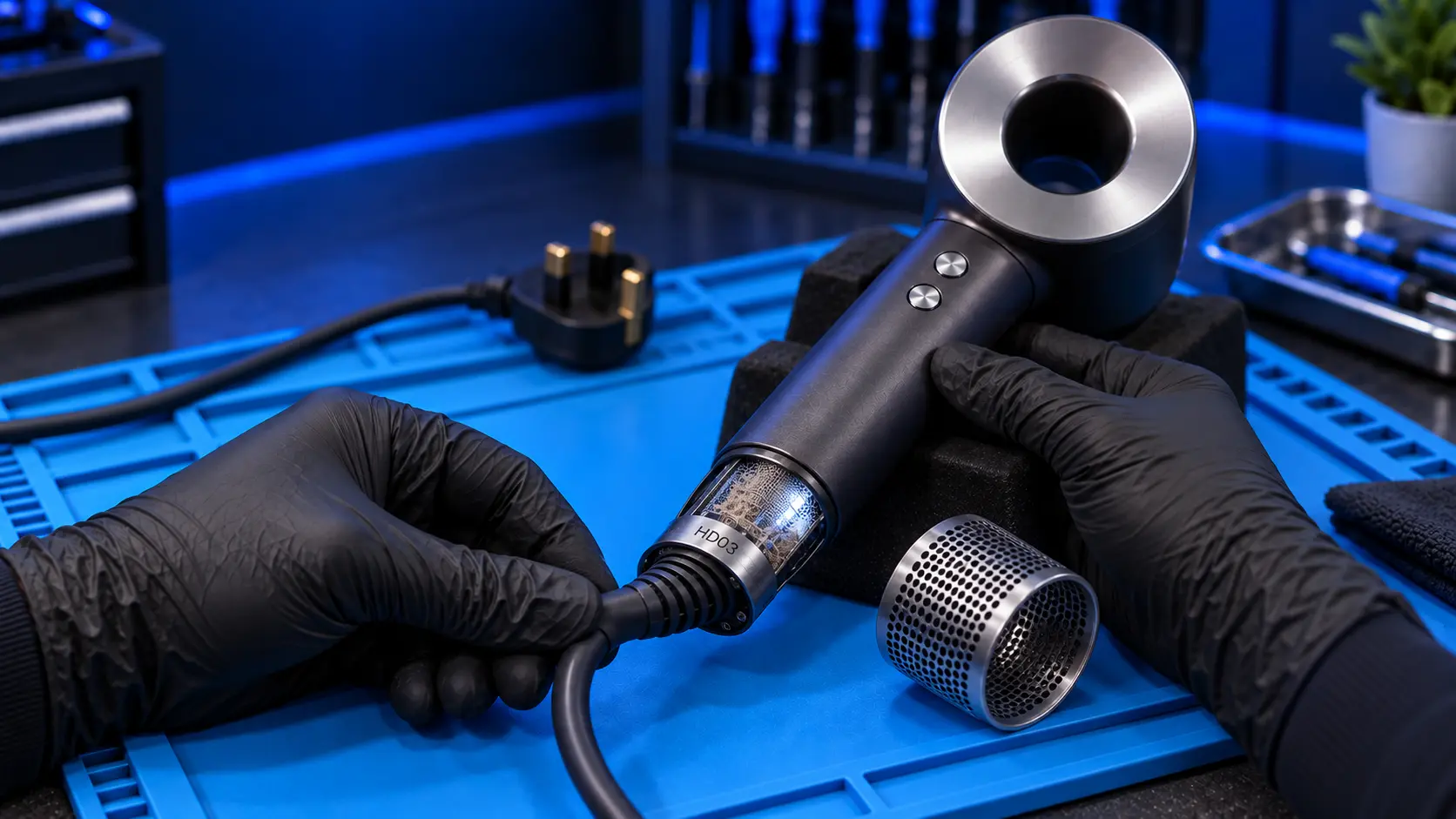
If you haven't confirmed which model you've got, it's printed on the base of the handle once the filter cage is off — here's where to look.
What goes wrong
Most likely first:
The cable. Still the single most common fault, and for the same reason as on every Supersonic — it's flexed hardest where it enters the handle and where it enters the plug, and copper strands break gradually until there aren't enough left to carry the motor's startup surge. Cuts out when moved, then won't start, then a warm plug.
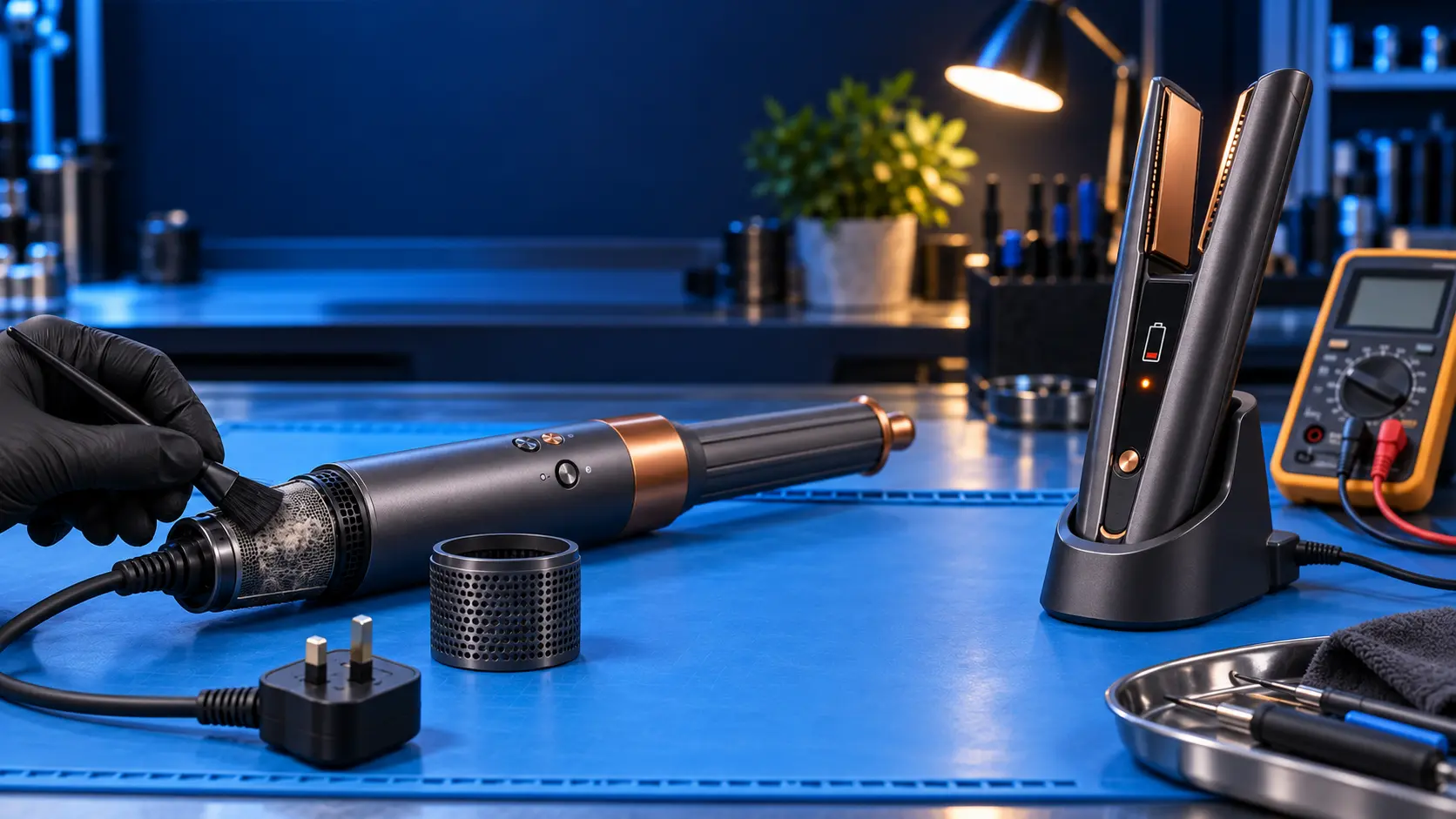
Restricted airflow from a clogged filter. The mesh at the base of the handle felts up with fine hair and product residue. Weak airflow, hotter running, and eventually cut-outs. Free to fix and very frequently the whole problem.
Thermal cut-outs. Runs a few minutes, shuts down. Almost always the consequence of the above rather than a fault in its own right — there's a full breakdown in why a Supersonic cuts out after a few minutes, including how to tell a thermal shutdown from a cable fault.
Sticky buttons. Hairspray and product residue work into the seam around the controls. Usually a clean rather than a part.
Bearings, eventually. The motor runs at around 110,000 rpm and the bearings are the wear item. A dry, grinding or screeching note, quite unlike a rattle. This is the one that's sometimes uneconomic.
That's the list. It's the same list as the HD01's, and anyone telling you otherwise is filling a page.
The thing that actually differs: how old yours is
An HD01 is uniformly old — they all date from the same period, so "it's had a decade" applies to every one of them.
The HD03 ran for years. Yours might have been an early one that's now been through the best part of a decade of daily use, or a late one that's had a fraction of that. Same model number, very different machine in terms of remaining life — and that's what should drive your decision, not the fault code.
How to work out roughly how old yours is
I can't decode a Dyson serial number and I'm not going to pretend I can. But there are three practical routes:
Your own records. Search your email for the order confirmation. Most people bought these online and the receipt is still sitting in an inbox.
Dyson registration. If you registered it, the purchase date is on your Dyson account.
Ask Dyson. Their support can identify a machine and its manufacturing date from the serial number. That's a two-minute job and it costs nothing.
If none of those work, a rough proxy: think about when you bought it and what else was going on. People usually remember whether a hairdryer was a recent purchase or something they've had "for ages", and for this purpose "ages" versus "a few years" is precise enough.
What the age changes
A newer HD03 — a few years old. Repair is straightforwardly worth it, including the bigger jobs. There's plenty of life left and the alternative is spending £280 to replace something that's barely used. Fix it.
A middle-aged one — five-ish years. Still comfortably worth repairing for a cable, a clean or a switch. If it's the motor, it's a closer call and worth an honest conversation before committing.
An older one — approaching the HD01's vintage. Same logic as the original: cable repairs are excellent value, major internal work sometimes isn't. At that age you may also find a second fault behind the first, because that's what long service looks like from the inside.
The one constant across all three: a cable fault is worth fixing on any HD03, at any age. It's the cheapest fault, it's completely fixable, and it doesn't touch the parts that are expensive.
Why I'm not giving you an HD03-specific fault list
Because it wouldn't be true, and you'd find out.
The Supersonic generations are close relatives. The revisions between them are real but they're refinements, not redesigns — the things that fail, fail for the same physical reasons. A page that tells you the HD03 has its own distinct set of problems is either guessing or padding, and in a market where most of the content is written by people who've never had one apart, that matters.
What I can tell you specifically about the HD03 is what usually goes wrong: cables, then filters, then everything else a long way behind.
What I do with one
Cable tested along its length rather than looked at, because the break is invisible under intact insulation. Filter mesh and cage condition. Airway cleared properly. Bearings checked for drag and noise, impeller for chips. Buttons and switches tested rather than pressed. Airflow and outlet temperature measured on every setting against a known-good reference, so I know what I'm sending back instead of assuming.
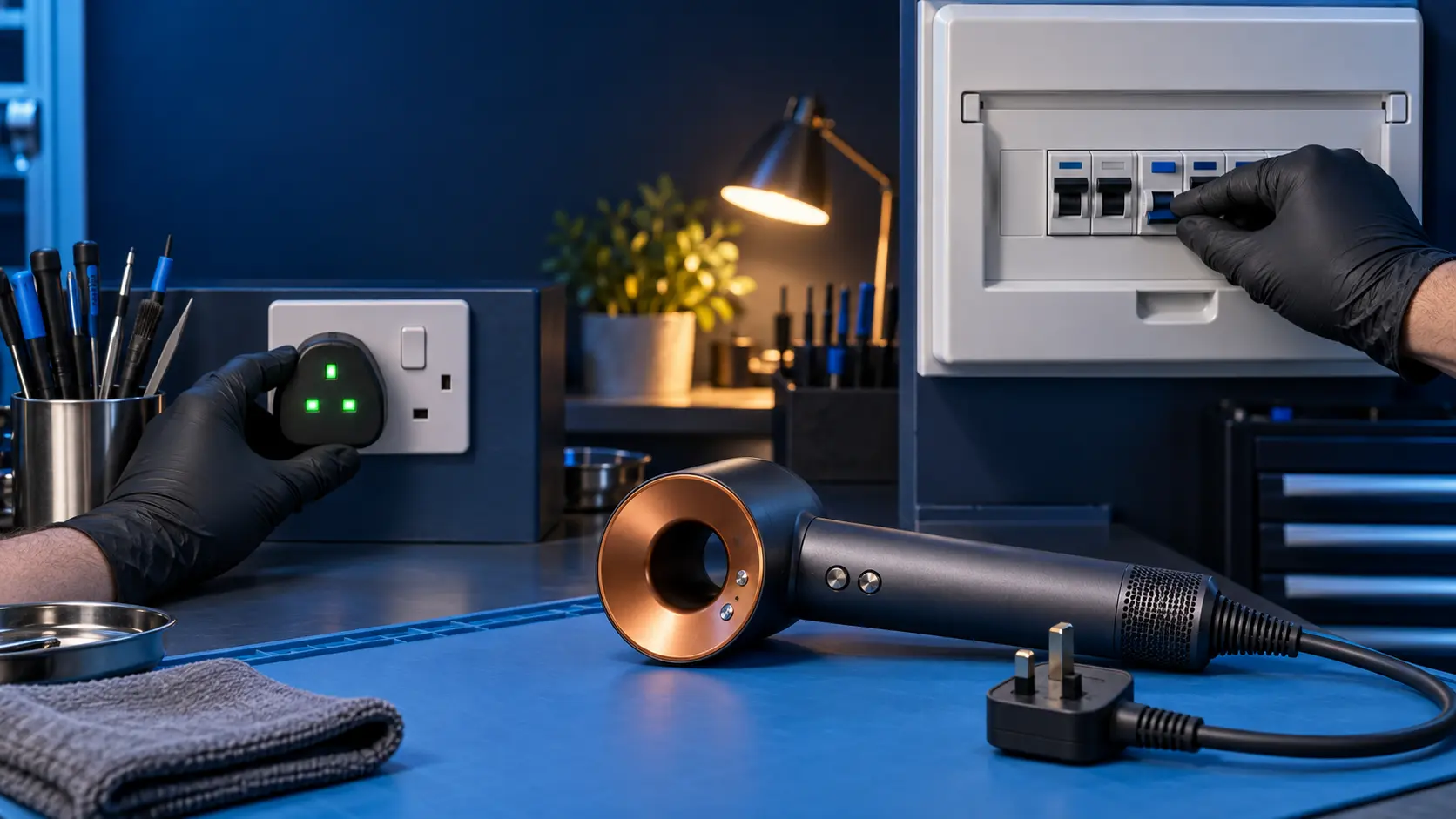
Back together, run repeatedly to catch anything intermittent, and PAT safety tested before it's packed.
Common questions
Is the HD03 better or worse built than the HD01?
Neither, in any way that shows up on a bench. It's a refined version of the same machine, and both have lasted remarkably well.
Mine is only a few years old and it's already faulty. Is that normal?
For a cable fault, yes — cable failure is about how it's been handled, not how old it is. Someone who wraps the flex tightly round the body after every use will kill a cable in three years; someone who loops it loosely might never have a problem. It isn't a reflection on the machine.
Could mine still be under warranty?
Possibly, if you bought it recently. Check the serial with Dyson before booking anything with me — if it's in warranty, that's their job and it'll cost you nothing.
Is it worth repairing an HD03?
For a cable, a clean or a switch: yes, clearly, at any age. For a failed motor on an older one, that's the case where I'll tell you honestly what it costs against a used machine at £90–£115, Dyson's refurbished at around £210, or £279.99 new — and sometimes the answer is that it isn't.
How long does it take?
The current turnaround is shown when you book. If a part needs ordering, I'll tell you as soon as I've diagnosed it and give you a realistic date.
Clean the filter properly first — take the cage off, hold the mesh to the light, and rinse it if it looks grey or felted. On a machine that's been in daily use for years that's rarely been done, and it resolves a real share of the weak-and-hot complaints on its own. Then hold the dryer still, run it, and flex the cable where it meets the handle. If that changes anything, you've found your fault.
If it's the cable — and on an HD03 it usually is — that's a £79 repair, all in: parts, labour, a 12-month warranty on the work, a PAT safety test before it's posted back, and return postage included. If I can't fix it there's no repair fee — I refund what you paid, less £4.99 return postage to send it back. Every repair is done by me personally, on my own bench, start to finish. And a habit worth picking up whatever you decide: stop wrapping the flex tightly round the body when you put it away. That single thing causes more Supersonic failures than everything else combined.
The Repair Works is an independent UK repair service, run by me, Paul — 25 years of hands-on repair experience, working by post for customers across the whole country. Not affiliated with or endorsed by Dyson.