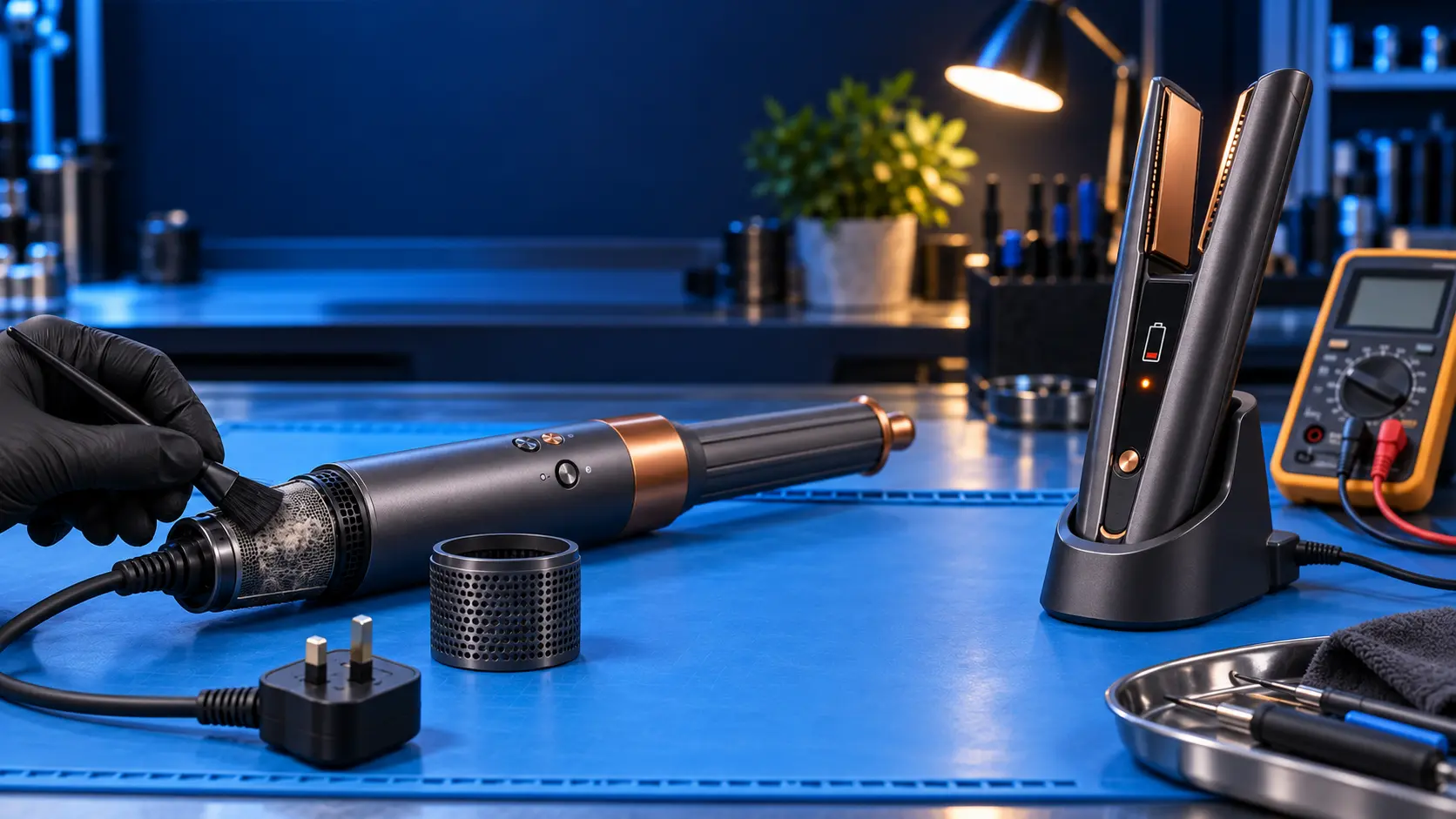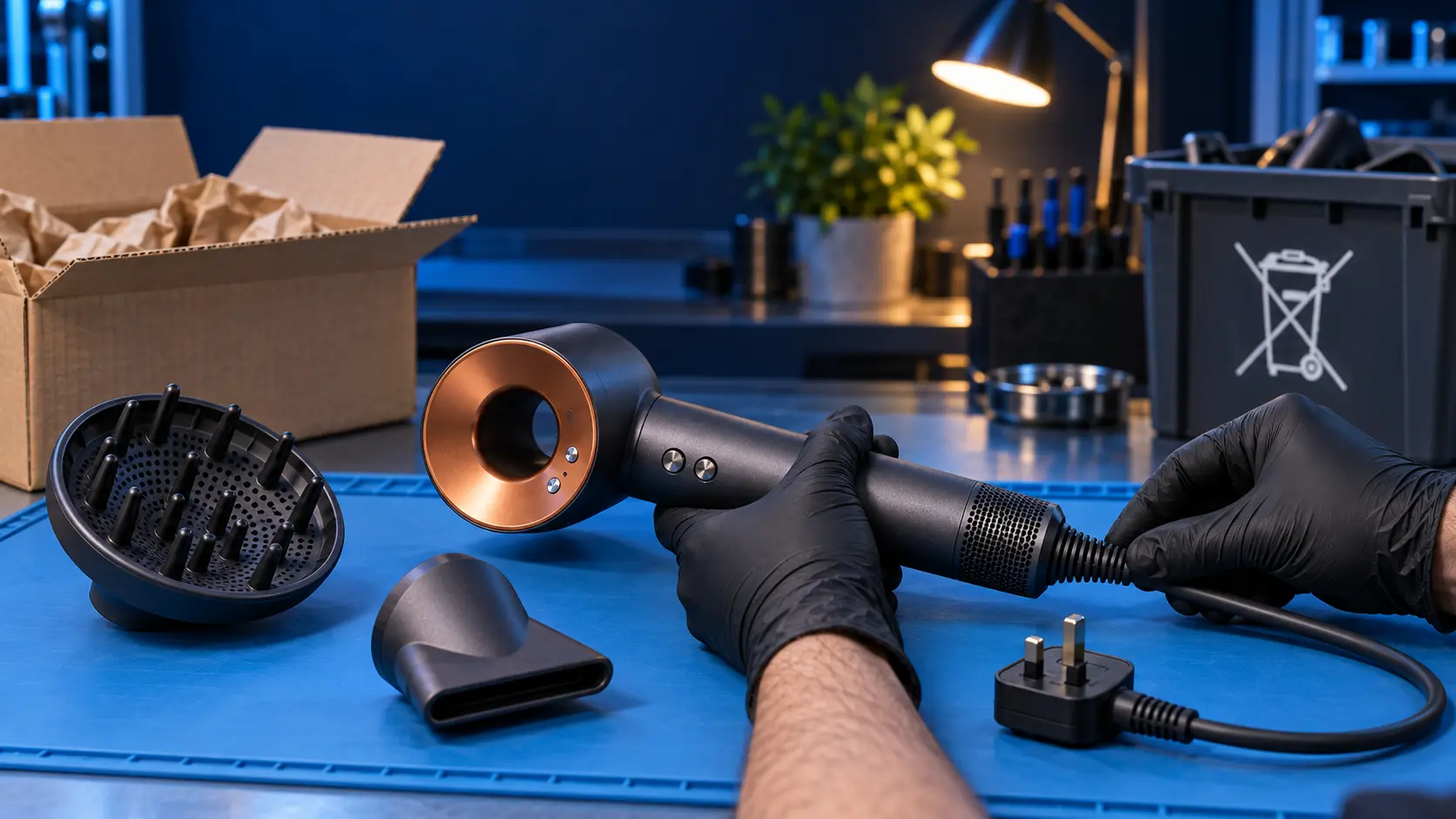
A blocked filter is the single most common reason a Supersonic stops behaving, and it's the one thing on the machine you can put right yourself in about two minutes.
It's also the thing people most often get wrong, because the instinct with a mesh full of gunk is to run it under a tap — and on a Supersonic that's the one thing you mustn't do. So here's the whole job properly, and then the bit nobody else tells you: what it means if the dryer still misbehaves afterwards.
Two minutes, and nothing you don't already have
You need a soft brush and a lint-free cloth. That's it.
An old, clean toothbrush is fine. A make-up brush is fine. The little brush that came in the box with a Professional edition is ideal if you've still got it. What you don't need is water, detergent, compressed air, or anything sharp.
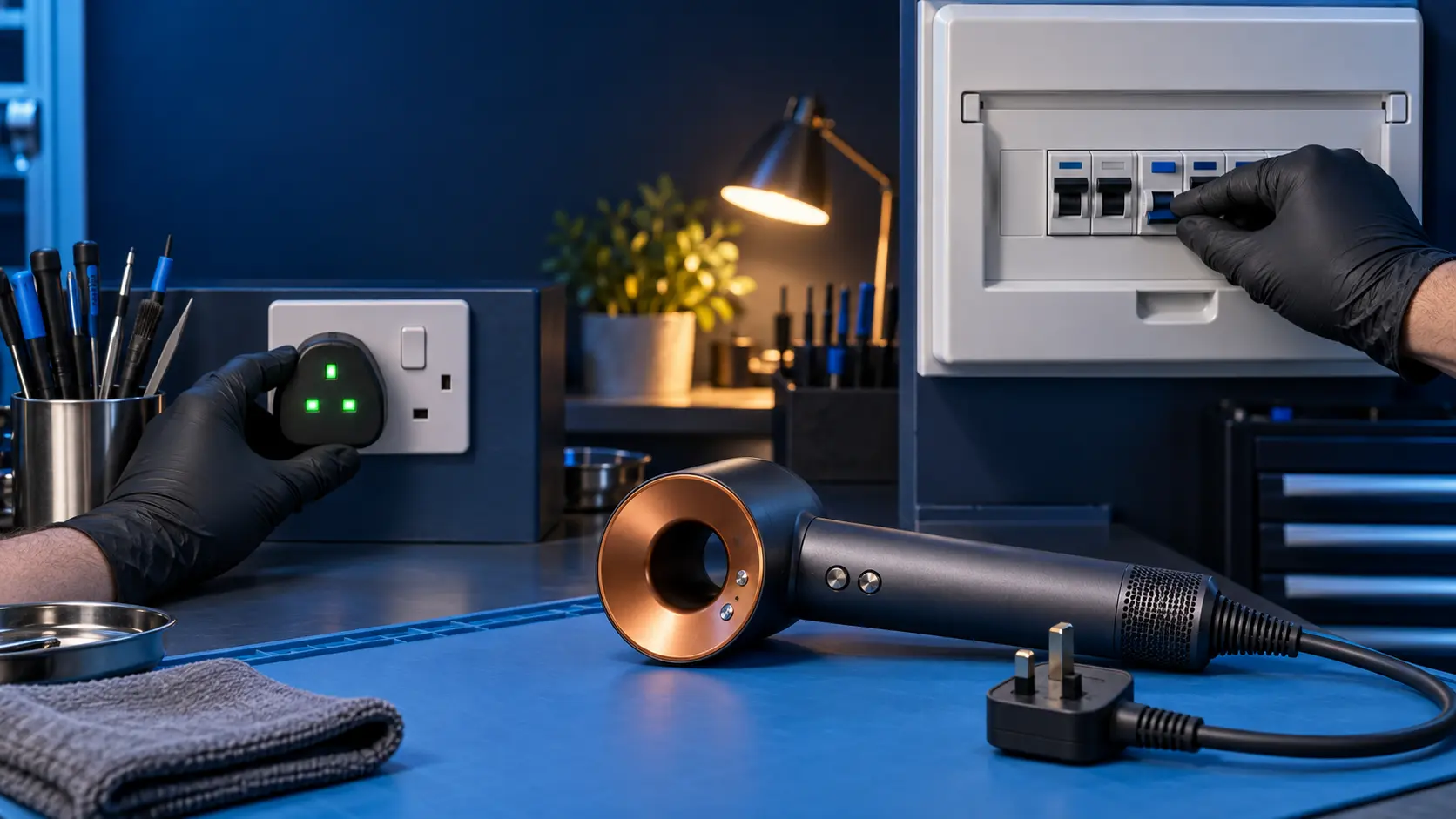
Unplug it. Obvious, but it needs saying, because the filter sits right at the air intake and you'll have your fingers in there.
Getting the cage off
On an HD07 and anything newer, hold the handle firmly and rotate the filter cage anti-clockwise, then pull it down and away from the machine. It's a positive movement — it either turns or it doesn't.
If it won't turn, don't force it. The earlier Supersonics use a cage that comes straight off the bottom of the handle without twisting first. Forcing a twist on one of those is how the locating tabs get broken, and a broken cage is a part you then have to buy.
So: try turning gently. If there's no give, pull straight down instead.
Do not wash it — this is where people ruin them
Dyson's own instruction for the Supersonic filter is a dry clean only. No water, no washing-up liquid, no soaking.
This catches people out because Dyson vacuum filters are washable, and everybody knows it. The hair dryer is not the same machine. The mesh is fine enough that water carries the surface residue deeper into it rather than flushing it out, and a filter that goes back on damp is worse than the one you started with.
If yours has already had a bath, let it dry completely — properly completely, overnight — before it goes anywhere near the dryer.
Cleaning it properly
Two parts to clean, and most people only do one of them.
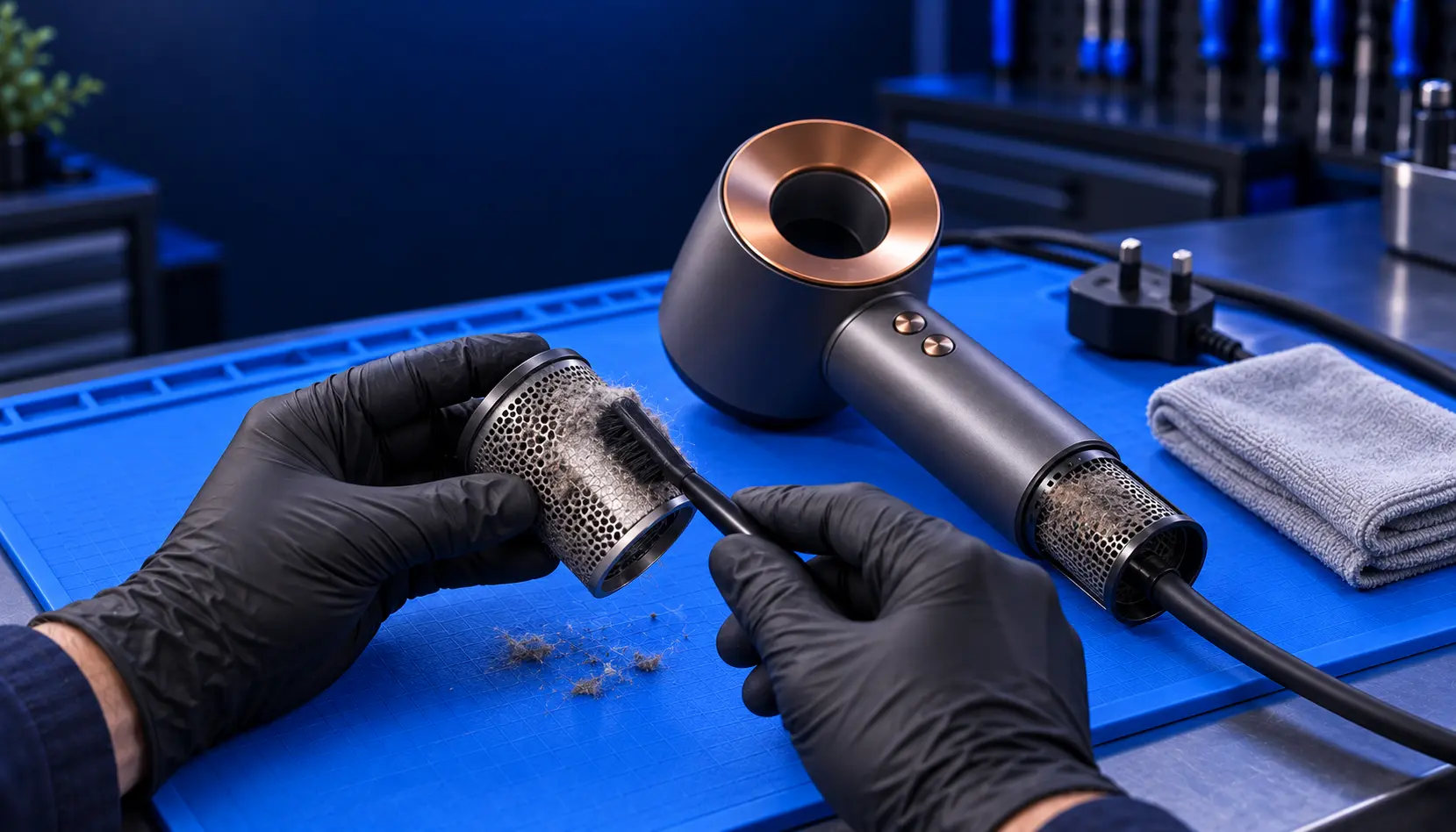
The mesh on the cage itself. Brush it, working in one direction rather than scrubbing back and forth. Then wipe it over with the lint-free cloth. Light pressure — the mesh will deform if you lean on it, and a deformed mesh restricts airflow permanently.
The intake on the machine. With the cage off, have a look at the opening it was covering. There's usually a ring of compacted fluff and product sitting in there. Brush that out too. This is the half everyone skips, and on a dryer that's been in service a few years it's often carrying more than the mesh was.
Take your time with the mesh. Product residue is sticky rather than dusty, and it takes a few passes. When you can see light through it evenly across the whole surface, you're done.
Putting it back on
Line the cage up properly before you turn anything. Then rotate clockwise until it locks — or for the older type, push it squarely back on until it seats.
If it doesn't want to go, something's misaligned. Take it off and start again rather than forcing it, for the same reason as before.
What a filter clean won't fix
This is the honest bit, and it's why this article doesn't stop here.
The filter is the first restriction in the airflow path, not the only one. Everything that gets through the mesh — and over a few years a great deal does — carries on into the machine and settles on the inside of the airflow path and eventually around the motor itself.
Cleaning the mesh deals with what's on the outside of the door. It does nothing about what's already in the house.
So if your Supersonic has been going for five or six years and it's never been apart, a filter clean will help and it won't be enough. That's not a sales line, it's just where the dirt is.
If it still cuts out after cleaning
Cutting out mid-use is thermal protection doing its job. The machine is getting too hot, it shuts down, it restarts when it cools. Restricted airflow is the usual cause, which is why the filter is always the first thing to check.
If you've cleaned it properly and it still cuts out, the restriction is past the filter and you can't reach it. Nothing you do from the outside will change that.
That's the point where it needs opening up — the whole airflow path cleaned rather than just the mesh, a new genuine inner filter fitted, and the motor checked while it's apart. That's the service and deep clean, £49 with nothing else to pay, PAT safety tested and back to you by tracked post with a 12-month warranty.
And if it's doing something stranger than cutting out — dead in one cable position, noisy, or worse after the clean than before it — I've written that up separately, because that's usually not the filter at all.
Common questions
How often should I be doing this?
Monthly for normal home use, and considerably more often in a salon. There's a bit more to it than that, so I've gone through it properly here.
The three white lights are flashing — is that the filter?
Yes. Continuous flashing of the three white LEDs is the filter warning. It's not a fault code and nothing is broken; it's the machine telling you to do exactly the job above.
Can I use compressed air?
I'd rather you didn't. It drives residue further into the mesh instead of lifting it off, and on a fine filter that's the wrong direction entirely. A brush lifts. Air pushes.
Mine's never been cleaned and it's years old. Is it too late?
Not too late, but don't expect the clean alone to fix it. Do it anyway — it costs nothing — and judge by whether the airflow comes back. If it doesn't, the deposits are past the filter.
Do I need to replace the filter rather than clean it?
The outer mesh cage is cleanable and rarely needs replacing unless it's physically damaged. There's a separate inner filter that does get replaced, and that's part of the service rather than something you can get to.
Will cleaning it affect my guarantee?
No. It's routine maintenance and Dyson publish the instructions themselves. Opening the machine up is a different matter, which is why you'd send it rather than attempt it if it's still in cover.
If your Supersonic has been getting hotter, noisier or weaker, do this before you spend anything. It's free, it takes two minutes, and it fixes the problem more often than not.
If it doesn't fix it, you've lost nothing and you've ruled out the cheapest cause — which means whatever's left is worth looking at properly.
The Repair Works is an independent UK repair service, run by me, Paul — 25 years of hands-on repair experience, working by post for customers across the whole country. Not affiliated with or endorsed by Dyson.