You did what everybody told you to do. You took the filter off your Dyson Supersonic hair dryer, cleaned it properly, let it dry, put it back — and it still cuts out.
First thing worth saying: you haven't wasted your time. A blocked filter is the most common cause of a Supersonic shutting down and it's the only one you can fix for nothing. Trying it first was the right move. What you've actually done is eliminate the cheapest possibility at no cost, which is exactly how this should go.
What's left splits into two very different questions, and it's worth working out which one you're in.
Is it worse than before, or the same?
This matters more than anything else on the page.
The same as before — it cut out before the clean and it cuts out after. The filter wasn't the cause. Skip to the next-but-one section.
Worse than before, or it's doing something new — weaker airflow, cutting out sooner, cutting out when it didn't used to, or not running at all. That points at the clean itself, and there are four things that go wrong. All four are free to put right.
If it got worse after the clean
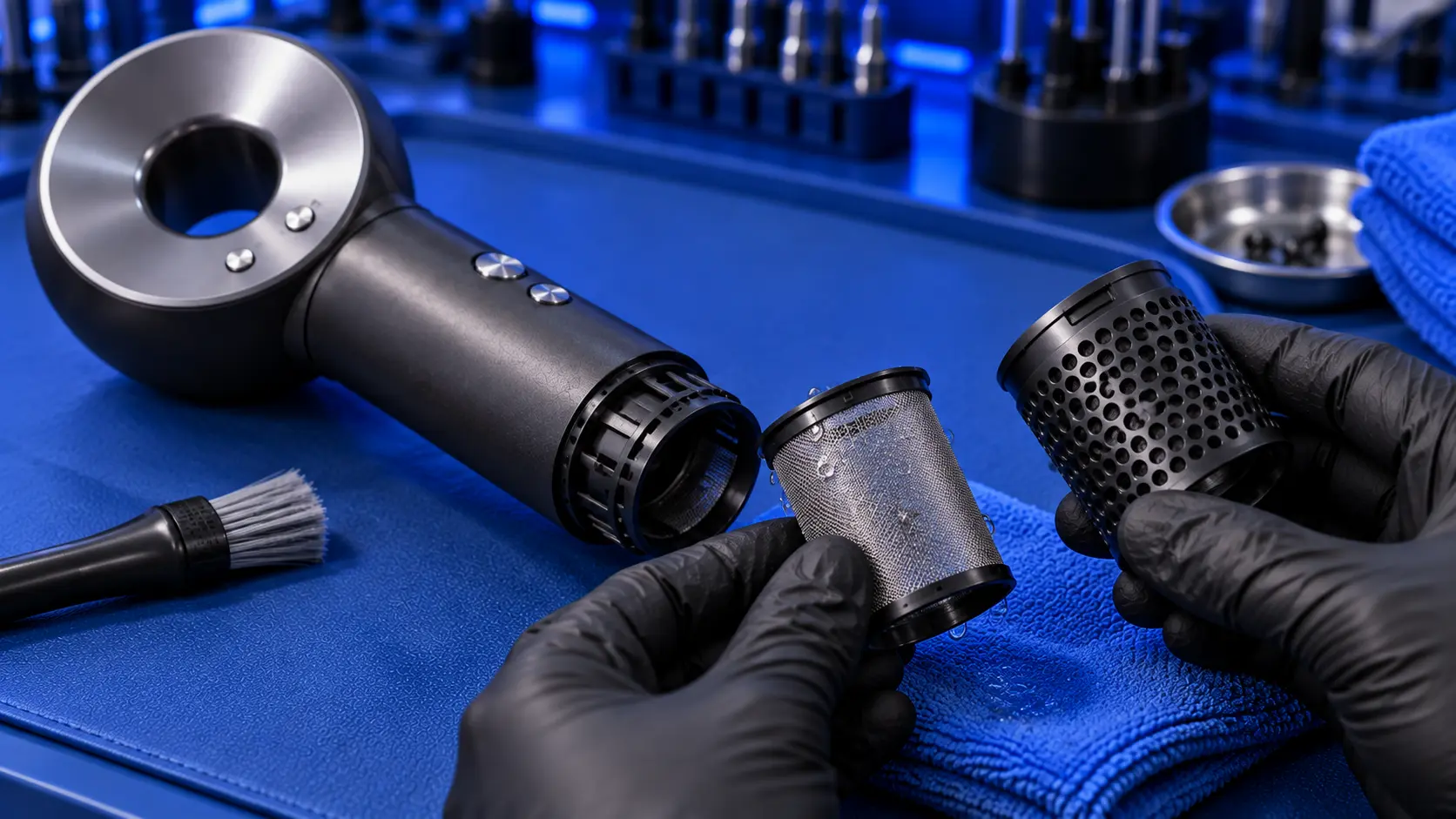
It wasn't completely dry. This is the big one. Not "dry to the touch" — properly, thoroughly dry, right through the mesh. A damp filter restricts airflow badly, and reduced airflow is precisely what triggers the shutdown you're trying to cure. Overnight is the right answer, longer in a cold room. If you cleaned it a couple of hours ago, that's very probably your whole problem.
The mesh sleeve isn't seated properly. The fine mesh pulls off the cage, and it has to go back fully — pulled all the way down, sitting flat, not rucked up or twisted. A sleeve that's partly bunched blocks part of the inlet and leaves another part uncovered, which is the worst of both.
The cage isn't locked home. Line the mark up with the outline on the body and twist until it seats. It shouldn't need force, but it does need to go all the way. Half-on feels fitted and isn't.
You've stretched or torn the mesh. A soft toothbrush is fine. Anything stiffer, or enough pressure, and the mesh distorts. That's a problem for two reasons: it can restrict airflow where it's bunched, and where it's opened up it lets hair straight through to the impeller — which causes the exact fault you were trying to fix, only permanently.
If the mesh is damaged, replace the filter cage. They're inexpensive, far cheaper than any repair, and it's a part you can fit yourself.
One thing to check while you're there: nothing should have been poked into the inlet while the filter was off. If anything went in, that's worth mentioning when you send it.
There's a proper step-by-step in my guide to cleaning a Supersonic filter, including how dry is dry enough.
If it's exactly as it was before
Then the filter genuinely wasn't the cause, and you've narrowed things down usefully.
A Supersonic shuts itself down when it gets too hot. It pulls 1,600 watts through a small body and relies on fast, constant airflow to stay at a safe temperature. A blocked filter is one way that airflow drops. It is not the only way, and the machine's response to every one of them is identical: stop.
Here's what's left, roughly in order of how likely it is.
Hair wrapped around the impeller. The filter catches most things but not everything, and what gets past accumulates on the fan over years. It unbalances the impeller, cuts the volume of air moving, and makes the motor work harder. You can often hear it before you can measure it — a change in pitch, or a faint rattle that wasn't there last year.
The inlet behind the filter. People clean the outer mesh, which is right, but debris also builds up in the path behind it. That doesn't come out with a toothbrush and a tap.
The temperature sensor has drifted. The dryer measures its own heat and stops at a set point. A sensor reading high will shut the machine down when it isn't actually too hot. From the outside this is completely indistinguishable from a blocked filter, which is why guessing costs people money.
Worn motor bearings. A motor that spins slower moves less air and runs hotter, tripping the same protection. This one almost always announces itself with noise first.
The control board. Least common of the five, but it happens. A board that misreads the sensor or loses track of fan speed shuts the machine down as a precaution.
The honest position is that you cannot tell these apart without opening it. That isn't me being cagey — the symptom is the same for all five, because the machine only has one way of saying "too hot."
If you want the wider picture of how this fault behaves, why a Supersonic cuts out after a few minutes covers the thermal-versus-cable split, and what three flashing lights mean explains what the machine is telling you when it stops.
Stop using it if you see any of these
A burning smell, or the smell of hot plastic
Visible smoke, however faint
The plug, socket or lead getting warm
It trips your RCD or the sockets in that room
Those aren't thermal protection working correctly. Those are signs something has already failed on a 1,600W mains appliance, and no amount of filter cleaning is relevant to them.
What it costs from here
You've done the free part. This is the paid part, and I'd rather give you the number than make you ask.
A £4.99 assessment. I open it on the bench, find out what's actually restricting the airflow or triggering the cut-out, and tell you plainly what's wrong and what it would cost. The £4.99 comes off the repair price if you go ahead.
From there, the repair is fixed-price depending on what I find:
£49 — full service and deep clean, if it's hair on the impeller or debris in the inlet
£85 — cutting-out repair, if it's the sensor, the bearings or the board
There's nothing open-ended. No "labour plus parts," no estimate that grows. And if I open it and find it's something I can't fix, there's no repair fee at all — I refund what you paid, less £4.99 return postage.
Every repair includes return postage, a PAT test and a twelve-month warranty, and is done by me personally.
Common questions
It was working before I cleaned it. Have I broken it?
Almost certainly not. Usually it's a filter that isn't fully dry or a cage that isn't seated. Take it off, check the mesh is flat and undamaged, leave it somewhere warm overnight, and try again before you conclude anything.
How long does the filter actually need to dry?
Overnight, minimum. The mesh holds water in places you can't see or feel, and a filter that seems dry after an hour usually isn't. If you're in a hurry, you'll get a false result and think the clean failed.
I can't get the filter cage back on.
It doesn't need force — it needs the alignment mark lined up with the outline on the body. If it won't twist, the marks aren't aligned. Forcing it can damage the catch, which turns a free fix into a parts order.
Should I just replace the filter instead of cleaning it?
If the mesh is torn, stretched or so clogged it won't come clean, yes. A replacement cage costs a small fraction of a repair and you can fit it yourself in seconds. If the mesh cleans up properly and the dryer still cuts out, a new filter won't change anything — the problem is somewhere else.
Is it worth repairing, or should I buy a new one?
A used working Supersonic on eBay is £90 to £115, with no warranty and no history. Dyson's own refurbished ones are around £250, when they're in stock. New is £279.99. Against that, £49 or £85 with twelve months' cover — and you keep your own machine and attachments — is usually straightforward. If yours turns out to be very old with a failed motor, I'll tell you that rather than take your money.
Before anything else, check the filter is bone dry and the cage is fully locked home. That accounts for most of the machines people think they've broken by cleaning, and it costs nothing but a night on a warm windowsill.
If it's properly dry, properly seated and still cutting out, the filter was never the cause, and the only way to know what is means opening it. You can book a £4.99 assessment here — a proper bench diagnosis, a straight answer on what's wrong and what it would cost, and the £4.99 comes off if you go ahead. Whatever you decide, don't keep running it through the shutdowns while you think about it. Each one takes a little more out of the heater and the electronics, and a £49 clean becomes an £85 repair faster than most people expect.
The Repair Works is an independent UK repair service, run by me, Paul — 25 years of hands-on repair experience, working by post for customers across the whole country. Not affiliated with or endorsed by Dyson.