Clean it. That's the answer for the large majority of people asking this, and it's free.
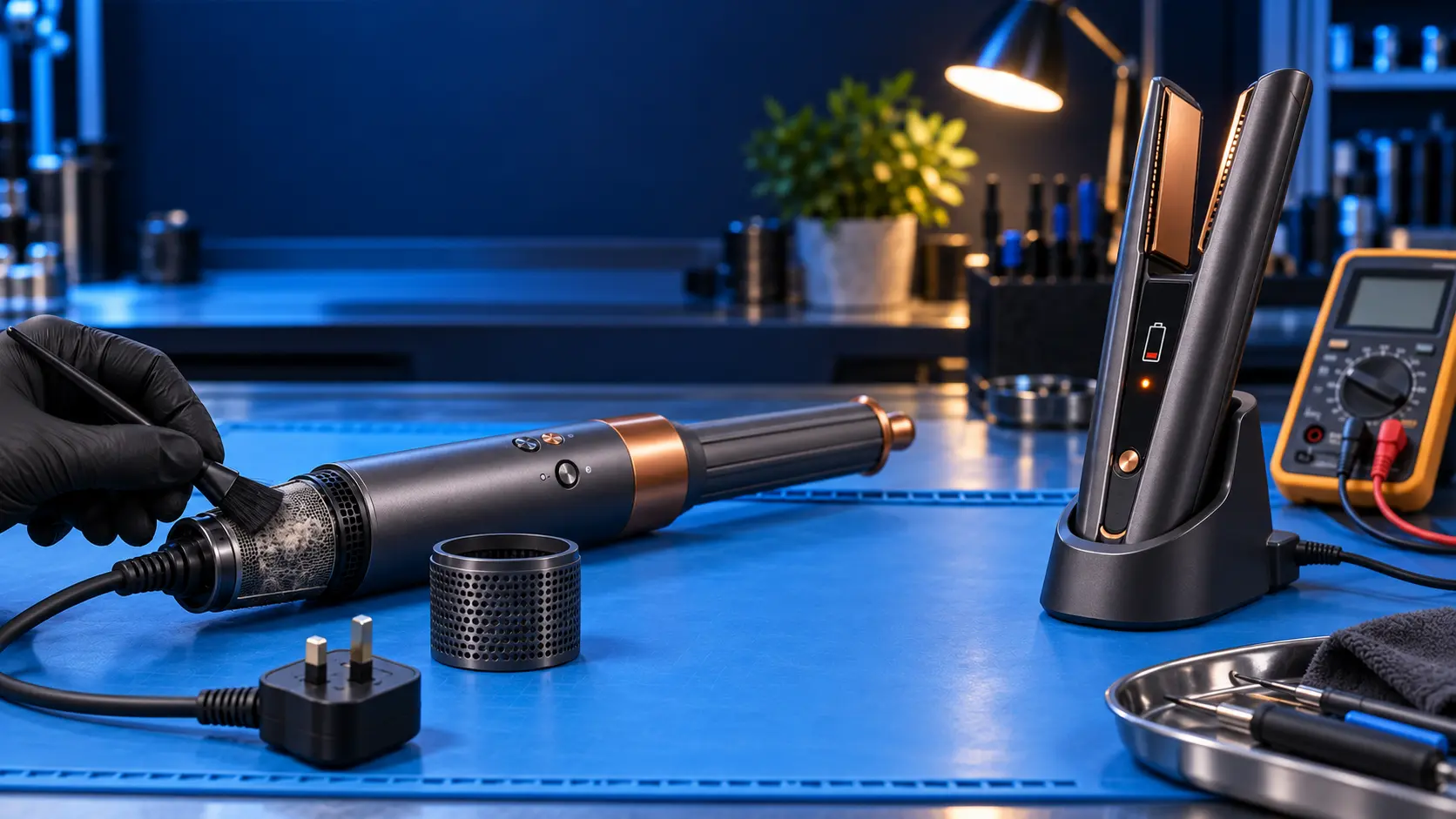
The filter cage is a mesh screen in a plastic ring. There's nothing in it to wear out — no electronics, no moving parts, nothing that degrades with age. A cage that's ten years old and filthy is a cage that needs ten minutes with a brush, not £20 with a courier.
But there are four situations where replacement genuinely is the right call, and one very common reason people buy a new one that doesn't fix anything at all. Both are worth knowing before you spend.
When replacement is actually the right call
The mesh is torn or holed. Any breach in the mesh means unfiltered air going straight into the machine — which is worse than a blocked filter, because a blocked filter restricts airflow while a holed one lets product and fluff into the airflow path and eventually the motor. Replace it.
The mesh is pushed in or deformed. This is the one people cause themselves, usually by scrubbing hard or leaning on it while cleaning. Fine mesh dented inwards stays dented, and a deformed mesh restricts airflow permanently no matter how clean it is. If you can see a dip, a flat spot, or an area where the weave has opened up unevenly, it's done.
The locating tabs are broken. Usually from forcing a twist on one of the older cages that doesn't twist. If it won't lock on positively — if it wobbles, sits proud, or comes off in use — it isn't sealing, and unsealed is the same as holed.
Product has baked on and won't come off dry. Occasionally you get a cage where the residue has effectively set. You can't wash it, water makes it worse, and no reasonable amount of brushing shifts it. At that point the part is cheap and your time isn't.
Everything else — grey, furry, matted with fluff, ten years of dry shampoo, looks revolting — is a cleaning job.
The mistake that wastes money
Here's the one I'd most like people to read before they order anything.
A lot of people buy a new filter cage to fix a dryer that's cutting out, or one that's lost airflow, or one that keeps flashing at them. They fit it, the problem is unchanged, and they conclude the dryer is beyond help.
The cage is the first restriction in the airflow path, not the only one. Over years, a great deal of product mist gets through the mesh and settles inside the machine — on the internal surfaces, the inner filter, and eventually around the motor. A new cage does nothing whatsoever about any of that.
So if you've cleaned the mesh properly and the dryer still cuts out, still runs weak, or still flashes, the restriction is past where the cage lives. Replacing the cage is buying a new front door to fix a blocked hallway.
That's the point where it needs opening up rather than another part thrown at it: the full service and deep clean does the whole airflow path and fits a new inner filter, £49 with nothing else to pay.
How to tell whether the mesh is actually damaged
Worth doing properly, because "it looks bad" and "it is bad" are different things.
Clean it first — dry, soft brush, both sides, the way I've set out in how to clean it. You can't assess a dirty mesh.
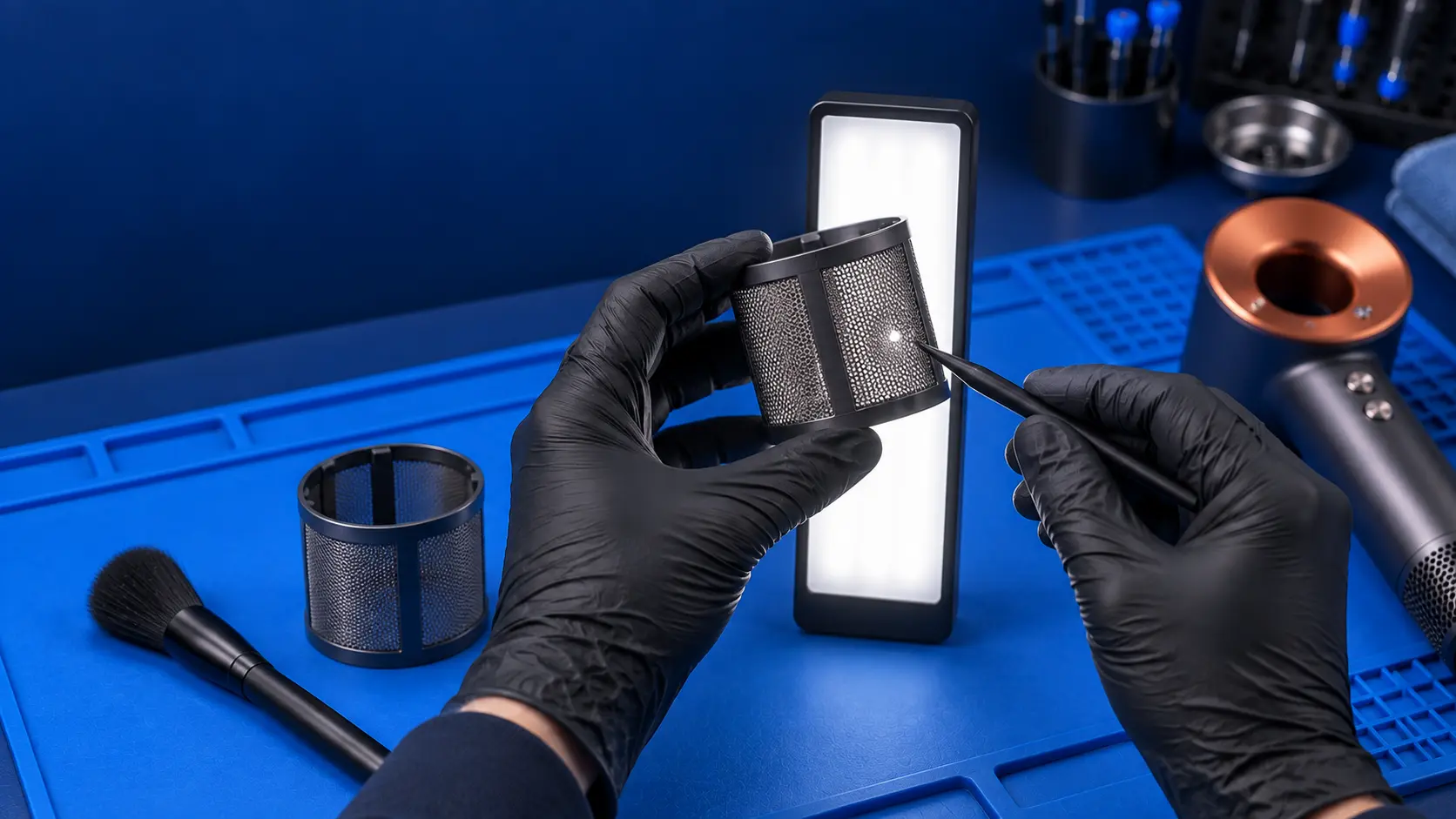
Then hold it up to a light and look through it. What you want to see is light coming through evenly across the whole surface. What you're looking for:
Bright spots or visible gaps — that's a hole or an opened weave. Replace.
Dark patches that survived cleaning — still blocked. Try again; if it won't shift, replace.
An area where the mesh curves inwards — deformed. Replace.
Even light all over — you're fine. Refit it.
Then check the fit. It should locate positively and lock without force. If it doesn't, the tabs or the ring have gone.
Genuine or third party
Genuine is the safe answer and it's what I fit.
Third-party cages are available cheaply and some are perfectly serviceable, but the mesh is the entire function of the part and mesh specification is exactly what gets cut to hit a price. Too coarse and it filters less than it should, which puts the debris inside the machine instead. Too fine or badly tensioned and it restricts airflow, which produces the symptom you were trying to cure.
You also can't tell which you've bought by looking at it, which is the real problem.
For a part this cheap relative to the dryer, I wouldn't gamble. If you do buy third-party, buy from somewhere with a returns policy and do the light test above before you fit it.
What about the inner filter?
Different part, and it's the one people don't know exists.
The cage is the outer screen you can get at. There's also an inner filter further in, and that one isn't user-serviceable — you can't reach it without taking the machine apart, and it does get genuinely loaded over years in a way brushing the outside can't address.
It's replaced as part of the service rather than as a separate job. If your dryer has never been apart and it's more than five or six years old, that inner filter has never been changed, and on a machine that's been used daily that's often where the missing airflow has gone. More on the symptom side in why a Supersonic's airflow goes weak.
Common questions
Can I wash the cage instead of brushing it?
No. Dry only — cloth or soft brush, no water. Water carries surface residue deeper into the mesh rather than flushing it out, and a cage that goes back damp is worse than the one you started with. If yours has already been washed, let it dry completely — overnight — before it goes near the dryer.
How often would a cage actually need replacing?
On a well-treated dryer, never. Often, the ones that need replacing were damaged during cleaning rather than worn out.
It's gone grey and furry and won't come white again. Is that a problem?
Cosmetic. What matters is whether air goes through it evenly, not what colour it is. Do the light test.
I've lost mine. Can I run the dryer without it?
No — don't. That's every bit of fluff, hair and product going straight into the machine, and it's a much more expensive fault than a missing cage.
Does a new cage reset the flashing lights?
Only if the mesh was genuinely the restriction. If the lights come back within days of fitting one, the problem is further in, and no amount of new cages will change that.
Is it worth replacing the cage at the same time as a service?
If it's damaged, yes — and I'd tell you when I've got it apart rather than sell you one up front. If it's just dirty, it comes back clean and you don't need one.
Clean it first, then hold it up to the light. Even light all the way across means keep it; holes, dents or patches that won't shift mean replace it.
And if the dryer still misbehaves with a spotless cage on it, don't buy another one — the restriction is somewhere you can't reach from the outside.
The Repair Works is an independent UK repair service, run by me, Paul — 25 years of hands-on repair experience, working by post for customers across the whole country. Not affiliated with or endorsed by Dyson.