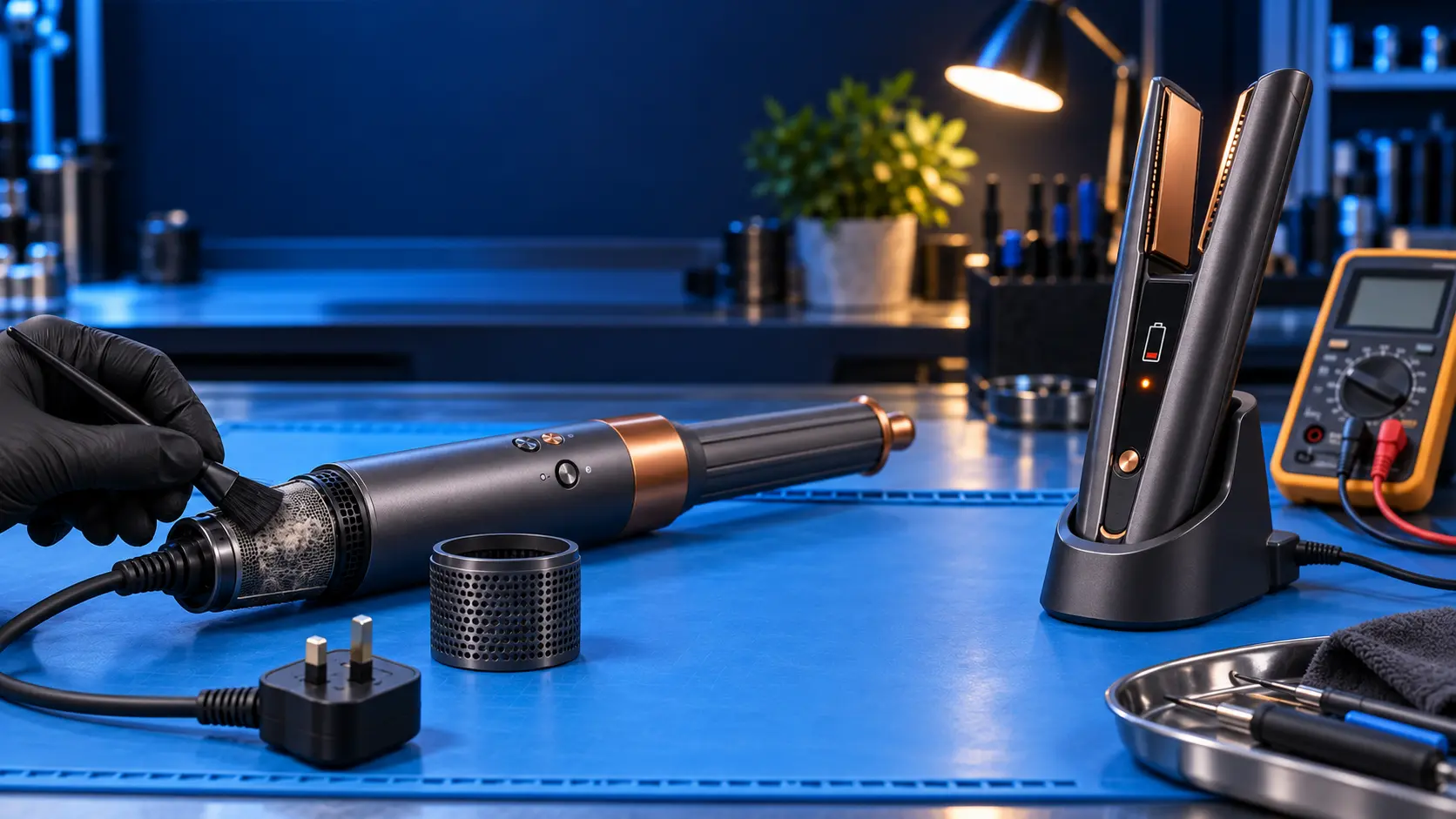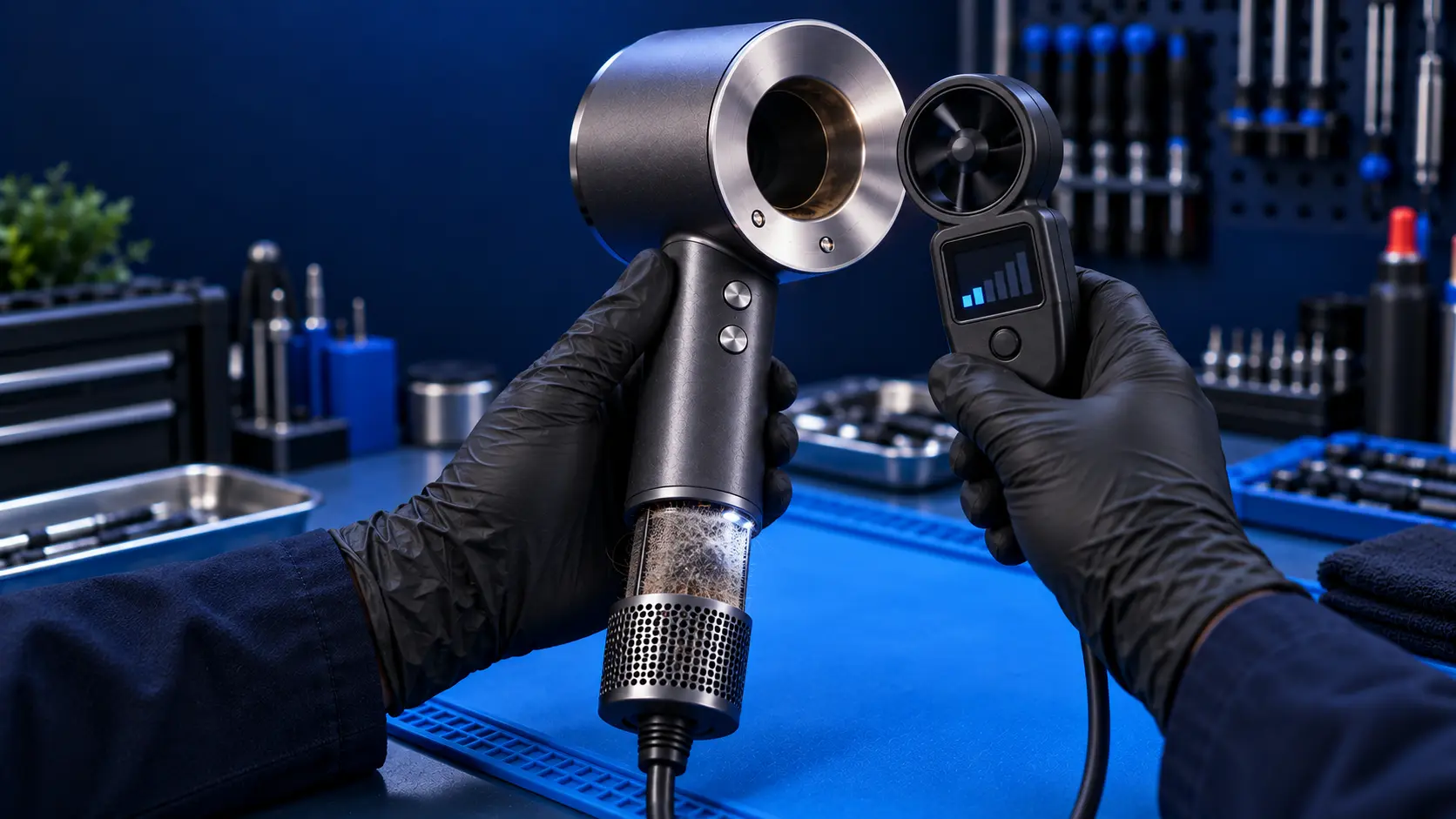
Drying your hair is taking longer than it used to. The dryer still runs, still heats, still sounds more or less right — there's just less coming out of the end than there was.
Almost every time this reaches me, it's the filter. Not the motor, not the impeller, not anything that needs a part. A mesh cylinder at the bottom of the handle, clogged with a year of the finest hair and product residue, doing exactly what a blocked filter does.
That's good news, because you can check it yourself in two minutes and it costs nothing. So before anything else, here's how to rule it out properly — and then what it means if you've done that and it's still weak.
Why the filter matters more on this machine than on most
A conventional hair dryer pulls air in at the back and pushes it out at the front. The Supersonic doesn't work like that. It draws a relatively small volume of air through the handle at very high speed, then uses that jet to entrain a much larger volume of surrounding air as it passes through the ring.
The practical consequence is worth understanding: a restriction at the inlet costs you more than the volume it blocks. Choke the motor's supply a little and you don't just lose that bit — you lose the ambient air it would have dragged along with it. It's why these go from "fine" to "noticeably weak" faster than people expect, and why cleaning the filter often produces a bigger improvement than anyone anticipates.
The two-minute check
Slide the filter cage off the base of the handle. On most models it pulls down and off; some have a small release.
What you're looking at is a fine mesh cylinder. Hold it up to a light. If light passes evenly through it, it's clean. If it looks grey, felted, or like it has a skin on it, that's your fault right there.
Two things people get wrong:
A wipe isn't a clean. The residue that restricts airflow is in the mesh, not sitting on the surface, and it's a mix of hair, skin cells and whatever product goes on before you dry. It needs rinsing and proper drying, not a going-over with a cloth. I've written a full guide to cleaning a Supersonic filter that covers doing it without damaging the mesh.
Refitting matters. The cage must click fully home. If it sits a fraction proud it'll restrict the inlet and often whistle or rattle as well. Push it on firmly and check it's seated all the way round.
Then run it. On maximum, no attachment fitted. If it's transformed, you're done.
"But it doesn't feel that different"
Your sense of what's normal is the least reliable instrument here, and that's not a criticism — the decline is gradual. You're comparing today against last month, and last month was already down on the month before. Nobody notices a five percent loss thirty times in a row.
Two better comparisons:
Drying time. If it took ten minutes a year ago and takes fifteen now, that's a real measurement and it doesn't rely on memory.
Someone else's. If a friend has one, feel theirs on maximum. That's the single fastest way to find out whether yours is genuinely down or you've just got used to it.
And a frequency point: most people clean it far too rarely. Dyson's own indicator doesn't catch a gradual clog well, and if you use product daily it wants doing more often than you'd think. I've covered how often to clean a Supersonic filter separately, including why salon use is a different answer entirely.
If a properly clean filter hasn't fixed it
Then it's worth working through the rest, roughly cheapest first.
Attachments. Take everything off and compare. A styling concentrator narrows the outlet deliberately — that's the point of it — so it will always feel weaker than bare. But a damaged or partly blocked attachment is a different thing, and a magnetic one sitting slightly off seats badly and leaks.
Hair at the inlet. Check around the base of the handle for hair wrapped where the air goes in. It's easy to miss and easy to clear.
Debris that got past the filter. If the mesh or the cage is damaged, material reaches the airway and sits where it shouldn't. This usually announces itself with a rattle as well as reduced flow.
A damaged impeller. Chipped blades move less air. Almost always accompanied by noise — a click, a tap or a harshness that wasn't there before. If it's weak and it's got noisier, that combination points here or at a restriction, rather than at the motor simply being tired.
Motor wear. The genuine worst case, and the rarest of these. A motor not reaching speed moves less air. It's the expensive answer and I'd want to rule out everything above it first, which is precisely what an inspection is for.
One thing worth knowing about airflow and cutting out
If your hair dryer is both weak and shutting itself off after a few minutes, that's one fault, not two.
The Supersonic relies on the airflow to carry heat away from the element and the electronics. Restrict the air and the internal temperature climbs until the thermal protection does its job and cuts the power. People treat the cut-out as the problem and the weak airflow as a separate annoyance — it's the other way round. Fix the restriction and the cut-outs stop.
Which is another reason to take the filter seriously: left long enough, a clogged filter stops being an inconvenience and starts cooking the parts that are expensive to replace.
What I do with a weak one
I measure it, because "feels about right" is not a measurement. It gets compared against a known-good unit on the bench, before and after, so I know whether I've actually improved it or just cleaned something.
Then it comes apart: filter mesh and cage condition, the full airway cleared, the impeller inspected for chips and contact marks, the motor checked for free rotation and whether it's making speed, and the seals checked — because air escaping before the outlet is a real if uncommon fault. Back together, measured again, and PAT safety tested before it's packed.
A good share of them go home with nothing replaced. Properly clean and properly reassembled is the entire repair, and I'd rather tell you that than invent a part.
Common questions
I've cleaned the filter and it's no better. What now?
Work down the list above — attachments off, check the inlet for wrapped hair, listen for any new noise. If it's still weak with a genuinely clean filter and nothing obvious, the restriction is inside and it needs opening up.
Does running it with a blocked filter damage it?
Over time, yes. Restricted airflow means higher internal temperatures, and heat is what ages the element, the electronics and the motor bearings. It's the cheapest maintenance there is and it protects the expensive parts.
Can I just run it without the filter to get more air?
No. The filter is the only thing standing between household dust and an impeller turning at around 110,000 rpm. A few seconds with it off to compare is fine on a clean surface; using it that way will cost you the machine.
Is weak airflow ever worth repairing, or should I replace it?
Usually worth it, because usually it's a clean rather than a part. Where I'd be honest with you is a genuinely tired motor on an older unit — a used working Supersonic is £90–£115 with no warranty and no history, Dyson's refurbished one is around £250 when in stock, new is £279.99. If a repair is going to cost a meaningful fraction of that on a machine that's already done its years, I'll tell you rather than take the work.
How long does it take?
The current turnaround is shown when you book. If a part needs ordering, I'll tell you as soon as I've diagnosed it and give you a realistic date.
Take the filter off and hold it up to the light. That's the whole first step, it costs nothing, and it resolves a lot of weak-airflow complaints on its own — often a rinse and a proper dry is all it takes.
If you've done that honestly and it's still down, send it to me and I'll measure it properly. It starts with a £4.99 assessment. I quote before doing any work, and if you go ahead the £4.99 comes off the repair, which includes a 12-month warranty, a PAT safety test and return postage. If you decide not to, or I can't fix it, I post it back and the £4.99 covers that postage. Every repair is done by me personally, on my own bench, start to finish. And whatever you decide: don't be tempted to run it with the filter off to get a bit more air out of it. That's the one shortcut here that turns a free fix into an expensive one.
The Repair Works is an independent UK repair service, run by me, Paul — 25 years of hands-on repair experience, working by post for customers across the whole country. Not affiliated with or endorsed by Dyson.