It was quiet. Now it isn't. Your Dyson Supersonic hair dryer has started making a noise it never used to make, and the question underneath is always the same one: is this about to die, and have I just wasted three hundred quid?
Usually not. Noise complaints often turn out to be debris or a part that isn't seated properly, and some of those the owner could sort at home in two minutes. But a small number are bearings, and those are the ones you want to catch early rather than run into the ground.
The difference is in the character of the sound. Not how loud it is — what kind of noise it is. That's what this page is about.
Do this first, because it's free
Before anything else, clean the filter properly and check the cage is seated.
The Supersonic pulls all its air through a mesh filter at the base of the handle, and that mesh clogs with the finest hair and product residue — the stuff you can't really see. A restricted filter makes the motor work differently, and the note changes. It's one of the most common causes of "it's suddenly noisy".
Two things people get wrong here. The first is a quick wipe rather than a proper clean; the residue that matters is inside the mesh, not on it. I've written a full guide to cleaning a Supersonic filter that covers it properly.
The second is the reassembly. If the noise started immediately after you last cleaned it, the odds are overwhelming that the filter cage isn't clicked fully home. It'll sit there looking right and still be a fraction proud, and that gap whistles and rattles. Take it off and put it back on, firmly, until it seats. If you're not sure whether yours is worn or just badly fitted, that's covered in clean or replace the filter cage.
Also pull every attachment off and run it bare for a few seconds. The magnetic attachments can sit slightly off and buzz against the ring.
If none of that changes anything, the sound itself will tell you where to look.
Rattling or buzzing
A loose, irregular rattle — the sort that comes and goes as you move the hairdryer around — is nearly always something physically loose in the airway. Hair that's got past a damaged filter, a fragment of something, or a part that isn't seated.
This is the best outcome on the list. It's usually a strip, a clean and a reassembly, and nothing is actually broken.
One thing worth knowing: debris only gets past the filter if the filter or the cage is compromised. So if I find loose material inside, I'll look at why it got there, because otherwise it'll be back.
A whine that's risen in pitch
If the noise isn't a new sound so much as the same sound, higher and harder, that's a motor running against a restriction.
The V9 motor in these spins at around 110,000 rpm. When it can't draw the air it wants, it behaves differently and the pitch climbs. Usually that's the filter and you've already fixed it in the section above. If the pitch is still high with a genuinely clean filter, and the airflow is noticeably weaker than it used to be, the restriction is further into the machine and it needs opening up.
Grinding, screeching, or a dry metallic sound
This is the one to take seriously.
At 110,000 rpm the bearings are the hardest-worked component in the machine, and when they start to go they announce it — a dry, harsh, metallic quality quite unlike a rattle. It's often worse on start-up, or on the highest speed.
A bearing noise does not settle down and it does not fix itself. It gets worse, and running it accelerates the damage. If yours is doing this, stop using it and get it looked at. That's not me drumming up work; it's that the difference between catching a bearing early and running it until it seizes can be the difference between a repair and a write-off.
Rhythmic clicking or tapping
A regular tick, in time with the motor rather than random, means something is making contact once per revolution. Usually debris touching the impeller, sometimes a chipped impeller blade.
Stop using it. A damaged impeller at that speed is not something to keep spinning.
A rumble or vibration through the handle
If it's less of a sound and more a vibration you can feel, that's often the motor's isolating mount rather than the motor itself. The motor sits in a mount designed to keep its vibration out of the shell; when that degrades, you feel the motor through your hand.
It sounds alarming and is frequently one of the cheaper faults.
A useful test either way
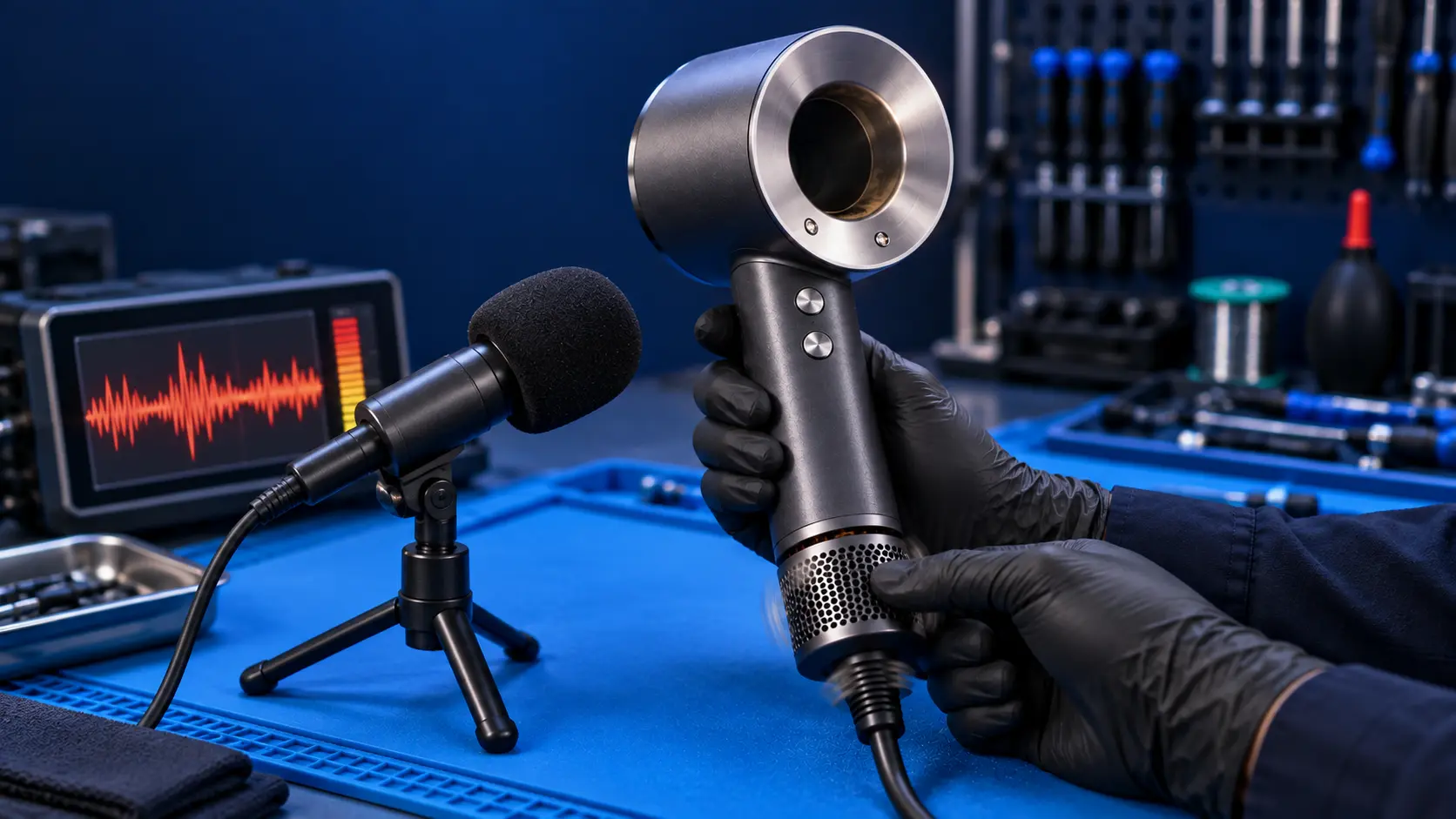
Change the speed setting and listen. Mechanical and airflow noises track the motor — they rise and fall with it. An electrical buzz often doesn't change much at all, which points at the switch or the board instead of anything spinning.
And a caution, because it's the one bit of DIY here that can actually cost you money: don't run it for any length of time with the filter off. A few seconds on a clean surface to compare the sound is fine. Longer than that, in a normal room, and you're inviting dust straight into an impeller turning at 110,000 rpm.
What I do with a noisy one
It comes apart. I look at the impeller for chips and contact marks, check the bearings for play and noise with the motor turning by hand, clear the airway properly, and check the mount. Then it goes back together and I compare both the sound and the airflow against a known-good unit on the bench, because "sounds all right" is not a measurement.
Often they come back to you fixed with nothing replaced — just properly clean and properly reassembled.
When I'll tell you not to bother
If it's a failed bearing on an older HD01 that's already had eight or nine years of use, the honest maths sometimes says no. A used working Supersonic is £90–£115 with no warranty and no history; Dyson's own refurbished one is around £250, when in stock; a new one is £279.99. If a repair on a tired unit is going to cost a meaningful fraction of a replacement, I'll say so rather than take the work.
That's the whole reason the inspection is separate and cheap. You find out what's actually wrong before committing to anything.
Common questions
Is it safe to keep using it while it's noisy?
A mild rattle, yes, for a short while. Grinding, screeching or rhythmic tapping, no — stop. Those are contact and wear noises, and continuing to run it makes the repair bigger.
It got noisy right after I cleaned the filter. Have I broken it?
Almost certainly not. That timing points overwhelmingly at the filter cage not being seated fully. Take it off, put it back firmly, and check again before assuming anything worse.
Can you replace the motor?
Depends on the model and what's available, and I won't pretend otherwise before I've seen it. Some are viable, some aren't. I'll tell you which after the inspection, and if it isn't worth doing you'll hear that from me rather than a quote.
Does a noisy dryer mean weak airflow too?
Often, but not always — and the combination is informative. Noisy plus weak usually means restriction. Noisy with normal airflow points more towards bearings or a mount.
How long does it take?
The current turnaround is shown when you book. If a part needs ordering, I'll tell you as soon as I've diagnosed it and give you a realistic date.
Start with the filter and the cage. It costs nothing, it takes two minutes, and it resolves a genuine share of the noise complaints I get sent — including some that arrive in a jiffy bag having travelled two hundred miles to be clicked back together.
If you've done that and it's still wrong, or if what you're hearing is the grinding sort rather than the rattling sort, send it to me and I'll find out what it is. It starts with a £4.99 assessment. I quote before doing any work, and if you go ahead the £4.99 comes off the repair, which includes a 12-month warranty, a PAT safety test and return postage. If you decide not to, or I can't fix it, I post it back and the £4.99 covers that postage. Every repair is done by me personally, on my own bench, start to finish. And whatever you decide about repairing it: if it's grinding, stop using it today. That one costs you nothing and it's the only advice on this page that gets more expensive the longer you leave it.
The Repair Works is an independent UK repair service, run by me, Paul — 25 years of hands-on repair experience, working by post for customers across the whole country. Not affiliated with or endorsed by Dyson.