A Supersonic in a salon does more work in a month than most domestic ones do in a year. Same motor, same 1,600 watts, same everything under the shell — but running eight hours a day in a room full of hairspray instead of ten minutes a morning in a bathroom.
So they don't fail differently because they're built differently. They fail differently because of what the air going through them is carrying. Almost everything that goes wrong on a Professional edition traces back to that one fact, and almost all of it is preventable.
The filter is the whole story
On a domestic Supersonic the filter is an afterthought. On a Professional it's the single component that decides whether the machine has a long life or a short one.
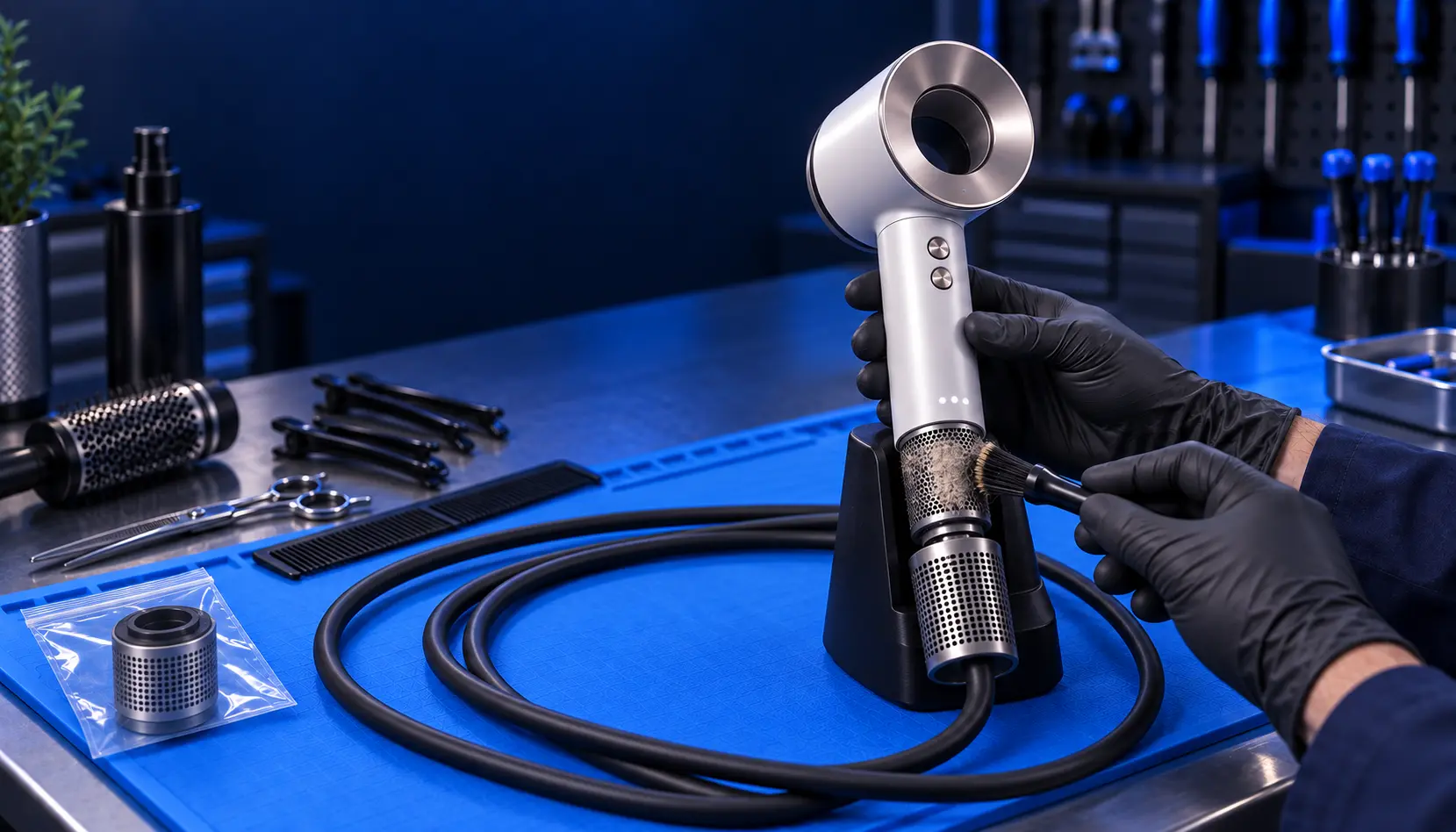
Dyson knew this, which is why the Professional gets a heavy-duty removable filter instead of the consumer model's fixed bottom vent, and why it ships with a cleaning brush and a spare filter in the box. They're telling you something with that.
Here's what happens when it doesn't get done. Hairspray and product mist get pulled through the filter mesh and dry there. Airflow drops. The motor works harder for the same output and the temperature climbs. The dryer starts cutting out mid-blow-dry because the thermal protection is doing exactly what it should. Somebody decides it's broken.
Nine times in ten it isn't broken. It's suffocating.
Dyson's own guidance is to clean the filter monthly, or whenever the three white lights flash continuously — that flashing pattern is the filter warning, and most people I speak to have no idea. If you've been ignoring it, that's your answer, and I've written up how to do it properly.
What else salon use does to them
The motor bearings. Hours of running per day gets you there eventually, even with perfect filter hygiene. It announces itself as a change in pitch — a whine or a rumble that wasn't there before. Caught early it's a service job. Left alone it isn't.
The attachments. The Professional's magnets are stronger than the consumer version's precisely because salon attachments get swapped constantly. Stronger magnets take longer to wear, but they still wear, and a concentrator that drops off mid-style is a nuisance rather than a fault.
The buttons. Thousands of presses a week. They get unreliable long before anything else does, and it's a repairable fault, not a replace-the-dryer one.
The cold shot. Used far more heavily in a salon than at home, and it's usually the first control to go intermittent.
The longer cable is a mixed blessing
The Professional's cable is about 3.4 metres against roughly 2.7 on the consumer model, which is the whole point — you can reach a chair without an extension lead.
But a longer cable in a busy salon gets walked on, rolled over by chairs, wrapped tightly round the handle at close, and yanked from the socket by the flex rather than the plug. All the same failures you see on a domestic Supersonic, arriving several times faster.
The tell is the same one I write about constantly: it works in one position and not another, or it cuts out when you move it. If yours does that, take it out of service. A connection that's breaking down concentrates heat where you can't see it, and that's a mains appliance running all day next to people.
If you bought a consumer Supersonic for a salon, you have no cover
This is the part most salon owners don't know, and it's worth reading twice.
Dyson's consumer guarantee doesn't cover use in a commercial environment, and it doesn't cover use of more than about two hours a day. That's not a technicality someone might overlook — it's the reason the Professional edition exists as a separate product in the first place.
So if you've got consumer Supersonics on your salon floor, you are outside the manufacturer's cover regardless of how new they are. There is no free repair waiting for you at Dyson. An independent is your route, and you may as well know that now rather than after a refused claim.
The Professional edition itself carries a two-year guarantee covering parts and labour, so if yours is inside that, use it — go to Dyson first and come to me second. I'd rather tell you that than take the work.
Worth adding: if you bought as a business rather than as a consumer, your rights against the retailer are different from the ones a domestic customer has. Not absent — different. Worth ten minutes of your accountant's time rather than mine.
Servicing versus replacing, for a salon
The maths is easier here than it is for a domestic customer, because you're not comparing a repair against the thrill of a new one. You're comparing it against a line on the books.
A full strip and clean gets you a machine that moves air like it did when it was new, for a fraction of replacement. If the motor bearings have gone it's a different conversation, and I'll tell you that honestly when I've had it apart rather than after you've committed.
And if you're running several, servicing them on a rotation beats replacing them one at a time as each one dies. Dryers that get serviced don't tend to become emergencies on a Saturday morning.
What I do with one
It comes apart properly. Not a filter rinse — the whole airflow path gets cleaned, because on a salon machine the deposits are well past the filter by the time anyone notices.
A new genuine inner filter goes in. The motor gets checked, including a listen for bearing noise under load. The cable and the connector inside the handle get inspected, since that's where the failures actually are rather than where they look like they are. Then it's run-tested and PAT safety tested before it's packed.
That's the service and deep clean, £49 with nothing else to pay, back by tracked post with a 12-month warranty.
Common questions
How do I know if mine is the Professional edition?
The obvious tells are the white and silver body and the noticeably longer cable. The definitive answer is on the rating label — here's where to find it and what it tells you.
How often should the filter really be cleaned in a salon?
Monthly is Dyson's figure and it assumes normal use. In a busy salon I'd treat monthly as the minimum and weekly as sensible. It takes about a minute.
Can't I just wash the filter myself?
Yes, and you should — it's the single best thing you can do for it. But cleaning the filter is not the same as cleaning the dryer. Once deposits are past the filter and into the airflow path, no amount of rinsing the mesh will get them back out.
Does having it serviced by you affect my guarantee?
If it's a Professional edition still inside its two years, go to Dyson — don't come to me. If it's out of cover, or it's a consumer model being used commercially and therefore never had cover, there's nothing left to affect.
Can you do more than one at a time?
Yes, and it's the sensible way to do it if you've got a few. Send them together and they come back together.
Do you repair the Supersonic r Professional?
No — that's a genuinely different machine and nobody independent can currently repair one. I've explained why here.
Before you do anything else, check two things: whether the three white lights are flashing, and whether it behaves differently when you move the cable. Between them those two account for most of what arrives here labelled "broken".
If it's flashing, clean the filter and see where you are. If it changes with the cable, stop using it. And if it's a Professional edition still inside its two years, ring Dyson before you ring me — that's a free repair and I'd be daft to talk you out of it.
The Repair Works is an independent UK repair service, run by me, Paul — 25 years of hands-on repair experience, working by post for customers across the whole country. Not affiliated with or endorsed by Dyson.