The HD01 is the original. It launched in 2016, which means the one in your hand has had the best part of ten years of being coiled up, yanked out of sockets, wrapped round itself and shoved in a drawer.
That single fact explains most of what I'm about to tell you. The HD01 doesn't fail in mysterious ways. It fails in one predictable way far more often than any other, and it fails that way because of how long it's been in service — not because there's anything wrong with the design.
If you're not certain yours is an HD01, the number is on the base of the handle once you slide the filter cage off — here's where to look and what each model number means.
The cable, overwhelmingly
If an HD01 arrives on my bench, the cable is the first thing I test, because more often than not that's the job.
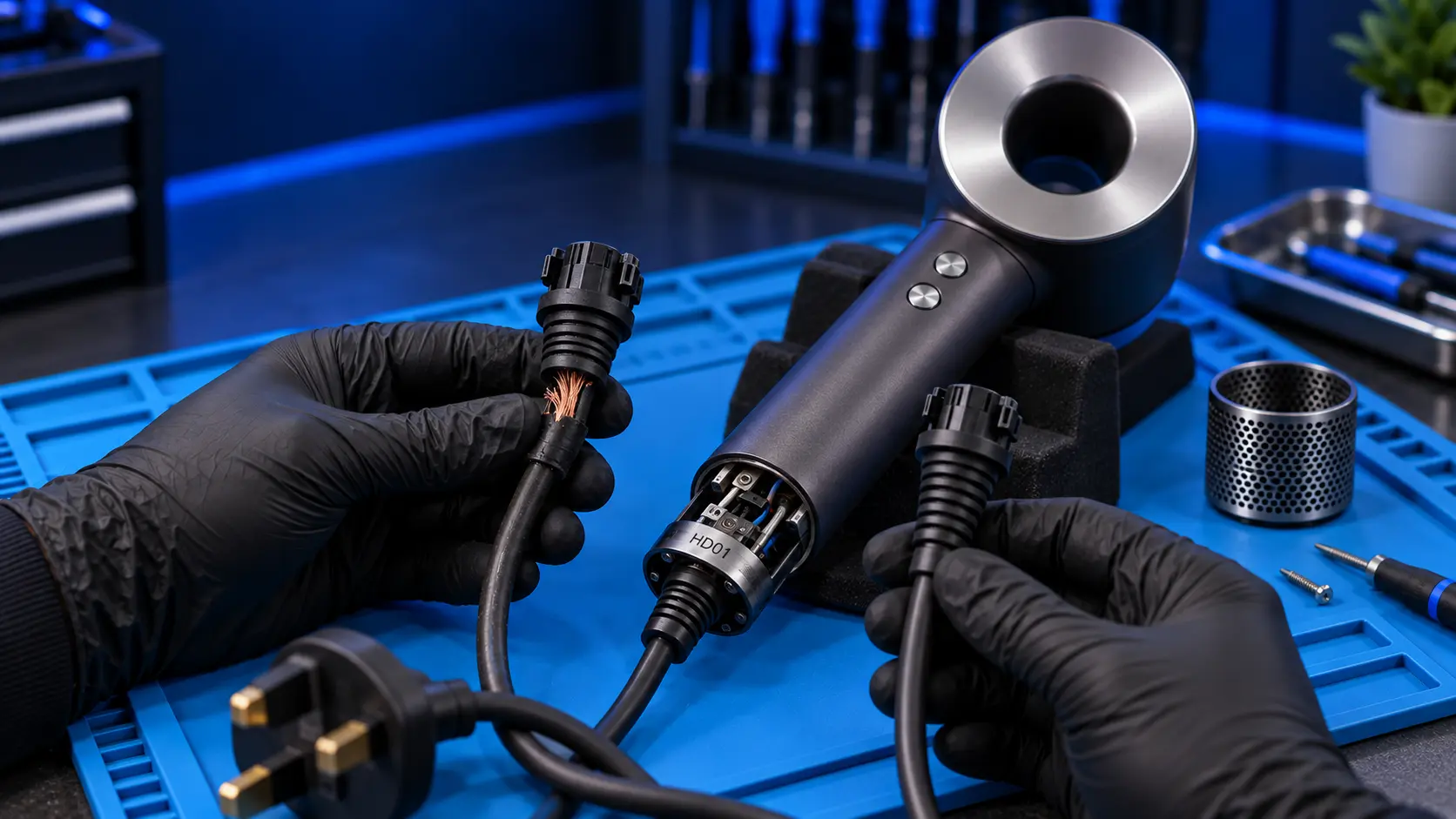
The flex takes the most punishment of anything on the machine and it always fails in the same two places: where it enters the handle, and where it enters the plug. Those are the points that bend, and after ten years of bending, individual copper strands inside the insulation start to break. The outside looks perfect. It usually is perfect. The damage is entirely internal.
What it looks like from your side, in the order it usually progresses:
It cuts out when you move it. Early stage. Enough strands are still intact to carry current most of the time, and the interruption only happens at certain angles.
You find a position that works. This is the point where most people stop worrying about it and start living with it. Don't.
It won't start, or starts then stops immediately. Fewer strands left than the motor needs for its startup surge. The machine has power but can't draw enough of it.
A warm plug, or a warm spot on the cable. This one matters more than the others. Fewer conductors carrying the same current means heat concentrating at the weak point, inside the insulation where you can't see it.
The mechanism is worth understanding properly if you own any Supersonic, and I've written it up in why Supersonic cables fail — including why the damage is always in the same three inches and why wiggling it to keep it going makes it worse rather than better.
The good news: this is entirely fixable, it's a known job, and it doesn't touch the expensive parts of the machine. A cable fault on an HD01 is the best outcome on this page.
What else turns up at this age
Cable aside, an HD01 has had long enough for a few other things to be true.
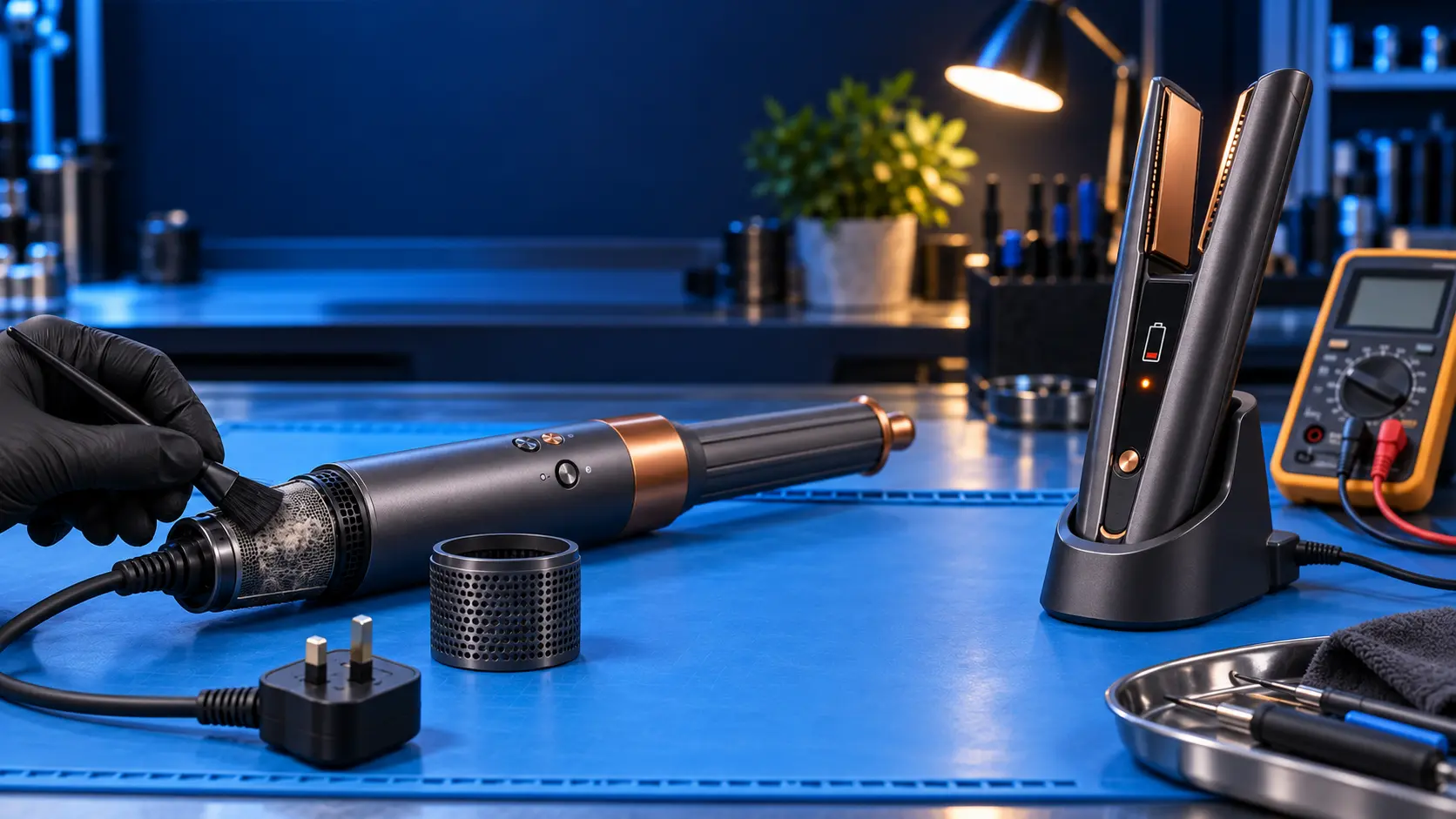
The filter has probably never been properly cleaned. Not a criticism — most people don't know it comes off. Ten years of the finest hair and product residue felted into the mesh restricts airflow badly, which makes it run hot, which ages everything inside it faster. Quite a few HD01s that arrive described as "getting weak" are simply choked.
The bearings have done their hours. The motor spins at around 110,000 rpm and the bearings are the wear part. Most HD01s are fine. Some aren't, and they announce it with a dry, grinding or screeching quality quite unlike a rattle. This is the fault where the answer might be no.
The buttons have had a decade of hairspray. Residue works into the seam around the buttons and they stop registering reliably. It's usually a clean rather than a part.
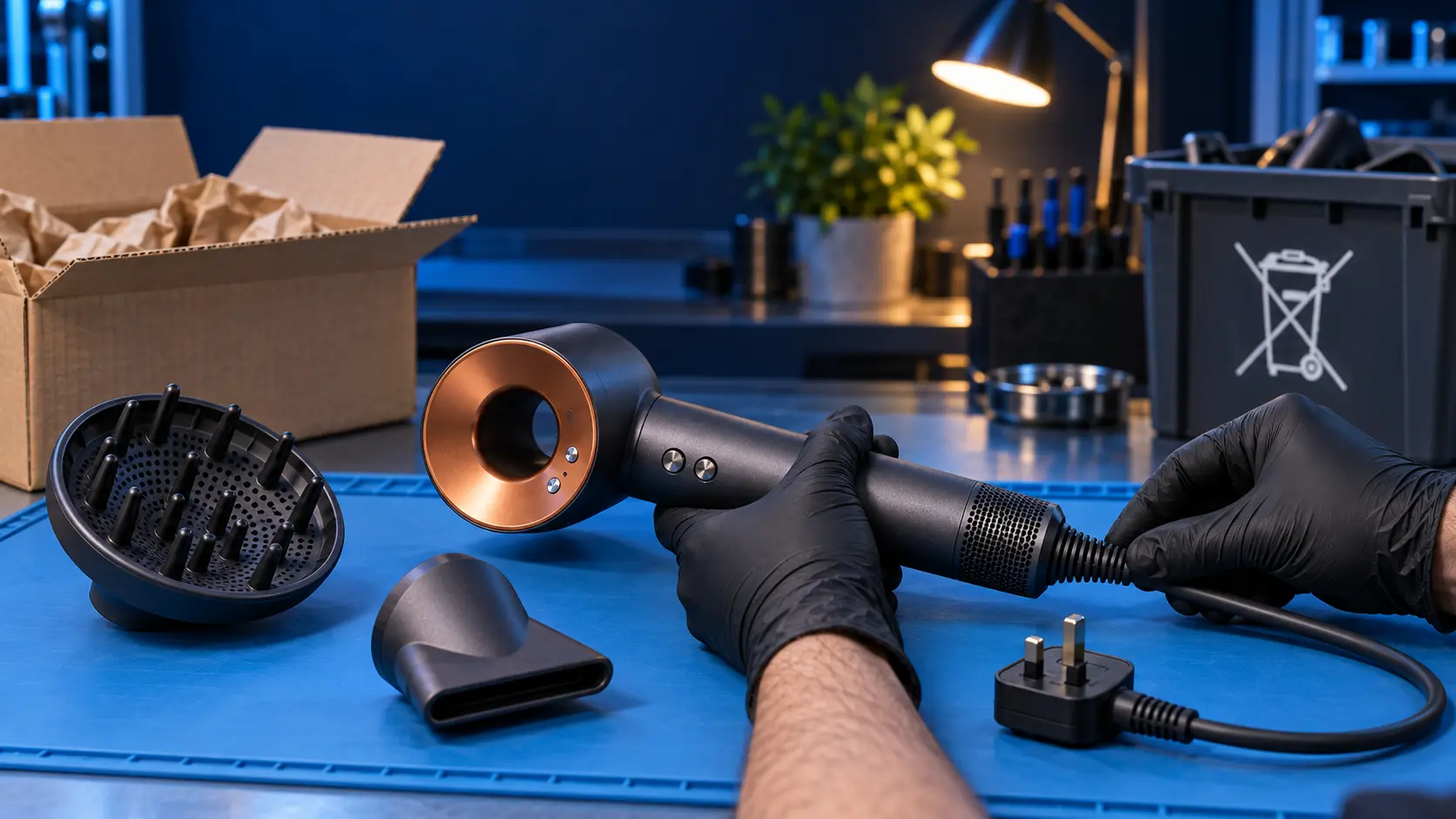
Attachments have loosened. The magnetic fittings wear, and an attachment that doesn't seat properly buzzes and leaks air.
The thing I should be honest about
On a machine this old, there's a reasonable chance of finding a second fault behind the first one.
You send it in for a cable, and while it's apart I can see the bearings are getting noisy, or the filter cage is damaged, or the airway is in a state. That's not upselling — it's what a decade looks like from the inside.
How I handle it: I'll tell you what I found and what it means, including whether it's something you need to act on now or something to be aware of. If your cable repair is sound and the rest of the machine has another few years in it, that's what I'll say, and the job stays a cable repair at the price you booked.
Is a ten-year-old hairdryer worth repairing?
Usually yes, and more clearly than for any other model — but let's do the actual maths rather than assert it.
A cable repair is £79. Against that:
A used "working" Supersonic on eBay is £90–£115. Here's what nobody tells you: at that price it is very likely another HD01 of exactly the same vintage, with exactly the same cable, which has been flexed by someone else for ten years. You'd be paying more than a repair costs to buy somebody else's future cable failure, with no warranty and no idea what's been done to it.
Dyson's refurbished Supersonic is around £210 — nearly three times the repair, though it does come with a guarantee.
A new one is £279.99.
So on a cable fault, repairing an HD01 is not a close call. You keep your own machine, your own attachments, and a known history, for a fraction of any alternative.
Where it changes is a failed motor. If the bearings have gone on a decade-old machine, you're looking at the most expensive repair on the cheapest-to-replace model, and that's the one case where I'll tell you honestly that buying something might make more sense. I'd rather say that than take the work.
What's actually good about the HD01
Worth saying, because this page is mostly a list of things that break.
The HD01 is the most repairable Supersonic there is. It's the model with the longest independent parts history and the most of them in circulation, which means the supply chain for the parts that matter is the healthiest of any generation. Compare that with the newest models, where there's no independent parts route at all and a fault means Dyson or nothing.
And the fundamentals have lasted. A ten-year-old HD01 with a new cable and a proper clean performs essentially like it did new, because the motor is genuinely over-engineered and the design hasn't been superseded in any way that affects how it dries hair.
It's a machine that repays fixing, which is not true of most things that are ten years old.
What I do with one
The cable gets tested along its full length rather than looked at, because the break is invisible under intact insulation.
Then, regardless of what it came in for: filter mesh and cage condition, the airway cleared properly, bearings checked for drag and noise, impeller inspected for chips, buttons and switches tested rather than pressed, and airflow and outlet temperature measured against a known-good reference so I know what I'm sending back rather than assuming.
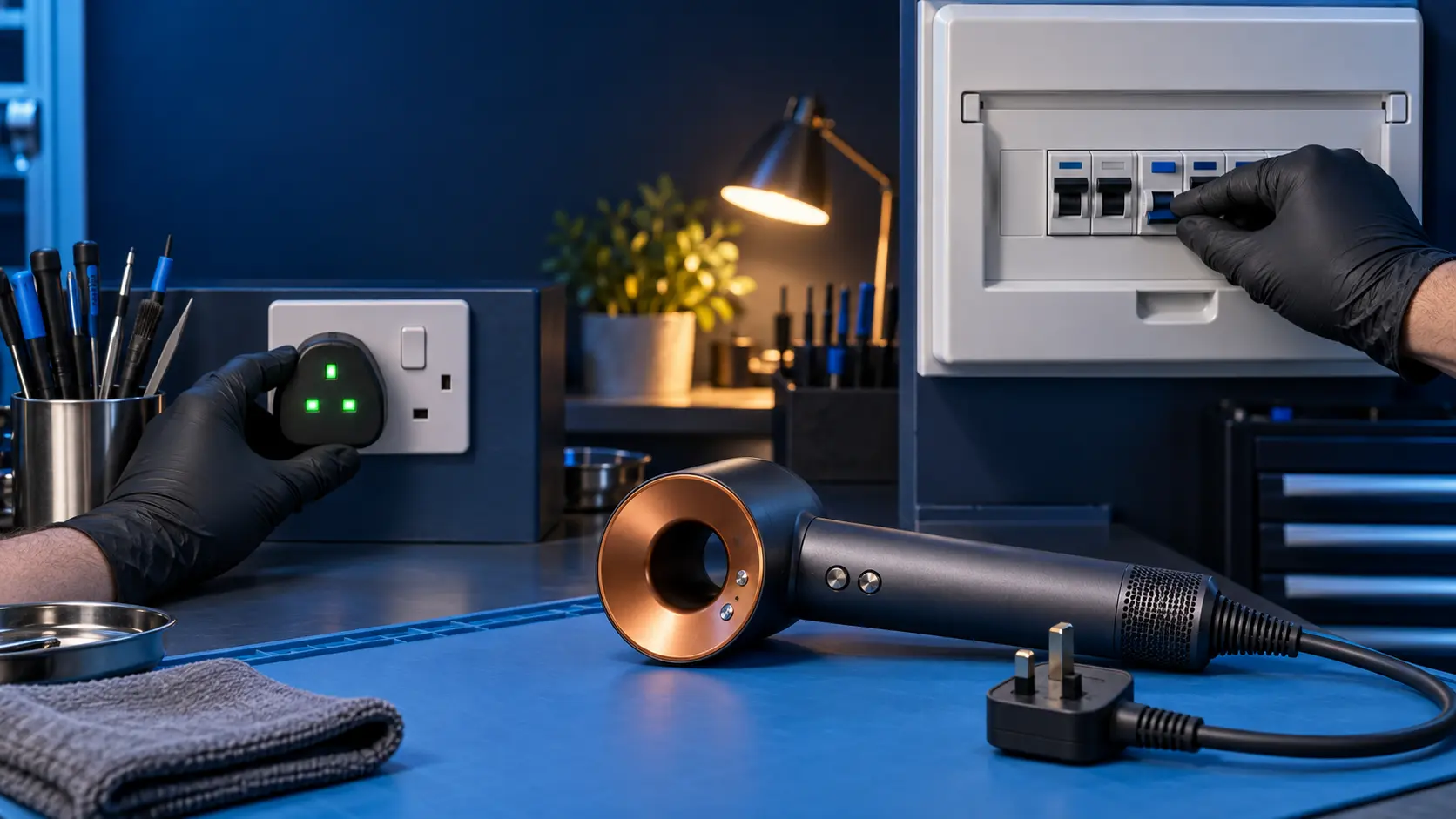
Reassembled, run through every setting, and PAT safety tested before it's packed.
Common questions
How do I know if mine is an HD01 and not an HD03?
The number is printed on the base of the handle — slide the filter cage off and photograph it with your phone. They look similar enough that guessing isn't reliable, though for repair purposes they're treated much the same.
Is an HD01 still safe to use?
If it's working properly, yes — age alone isn't a safety problem. What is a safety problem is a cable fault you're working around, or a plug that gets warm. Those want dealing with rather than living with.
Can the cable actually be replaced, or just repaired?
It's a proper job either way, done so the strain relief is right — because a cable repair that isn't properly relieved recreates the same fault in the same place within a year.
Mine has been in a drawer for two years. Is it worth getting going?
Almost certainly. Sitting unused doesn't hurt these. Give the filter a proper clean before you write it off — a machine that's been stored often just needs that.
How long does it take?
The current turnaround is shown when you book. If a part needs ordering, I'll tell you as soon as I've diagnosed it and give you a realistic date.
Before anything else, take the filter cage off and clean the mesh properly — on a machine this age it's rarely been done, and it fixes a genuine share of the "it's getting weak and hot" complaints on its own. Then check the cable: hold the dryer still and run it, then flex the flex where it meets the handle. If that changes anything, you've found it.
If it's the cable — and on an HD01 it usually is — that's a £79 repair, all in: parts, labour, a 12-month warranty on the work, a PAT safety test before it's posted back, and return postage included. If I can't fix it there's no repair fee — I refund what you paid, less £4.99 return postage to send it back. Every repair is done by me personally, on my own bench, start to finish. And in the meantime, stop using the position that makes it work. A cable that only runs at one angle is a cable that's getting hot somewhere you can't see.
The Repair Works is an independent UK repair service, run by me, Paul — 25 years of hands-on repair experience, working by post for customers across the whole country. Not affiliated with or endorsed by Dyson.