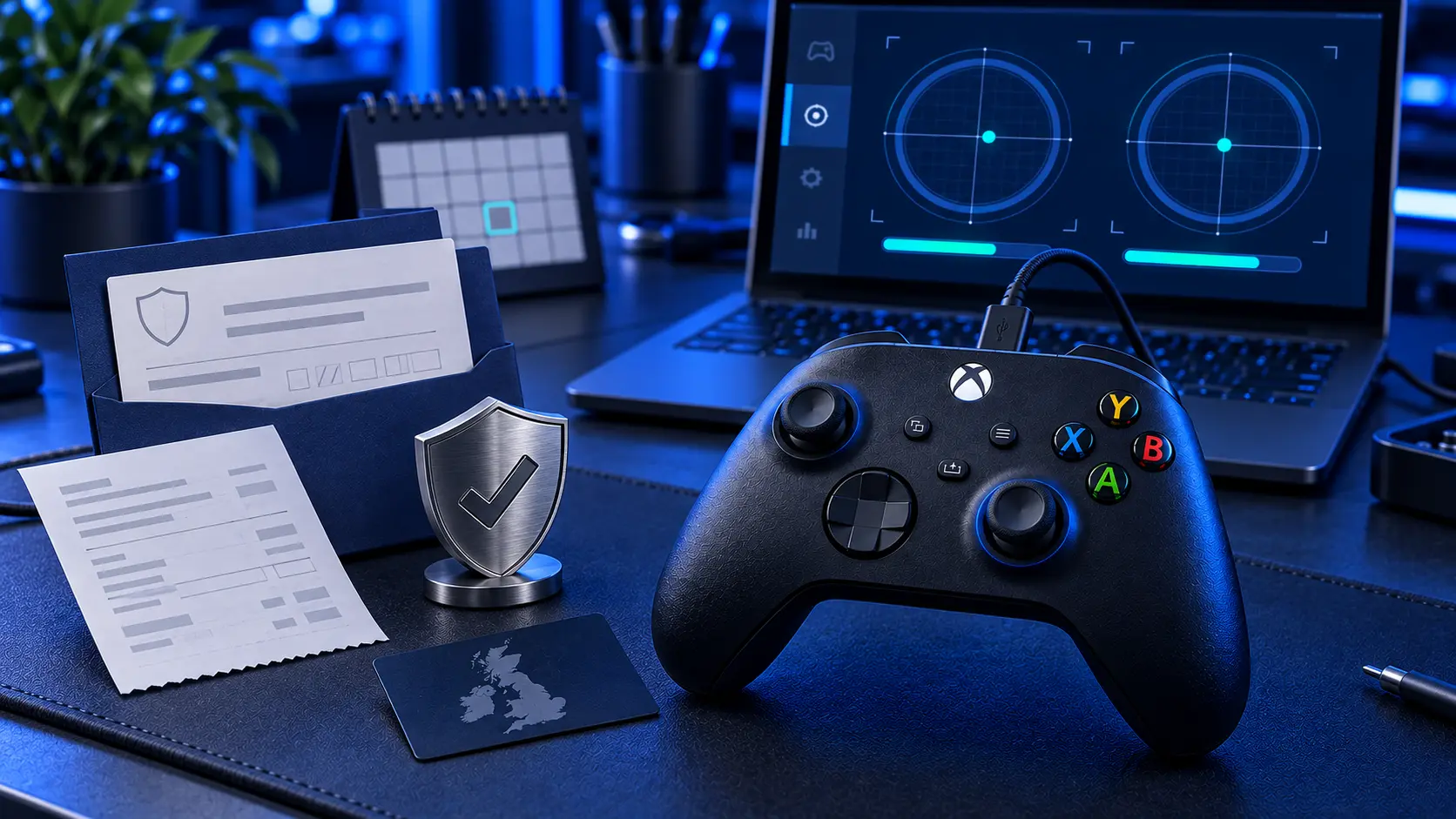
If your Xbox controller is still in warranty, the first thing to do is not book a repair with me. Use the warranty — it costs you nothing, and I'd rather tell you that than take £19.
Here's how that works, what the Elite Series 2 owners among you should know, and what you can still do once the warranty has run out.
Microsoft's own warranty
Microsoft warrant Xbox controllers against manufacturing faults, and the length depends on the product and where you bought it. I'm deliberately not going to quote you a figure, because the terms differ between products and have changed over time, and a wrong number here would cost you money.
What you should do instead is check yours directly. Microsoft's support site will tell you your controller's warranty status from its serial number, and that's authoritative in a way that any repairer's blog isn't.
Where to find the serial. On a standard controller it's inside the battery compartment, on the label under the barcode. The Elite Series 2 has no battery compartment, so its serial is printed on the lower centre of the back, below the paddle mounts.
Keep your proof of purchase either way. Without it a claim is much harder.
Whether drift gets accepted varies. Some people report a straightforward replacement; others are told it's wear and tear rather than a fault. It's worth trying regardless — it costs a few minutes.
The Elite Series 2 has its own history
Worth knowing if that's what you own.
Microsoft extended the Elite Series 2's warranty from 90 days to a full year, and did so after sustained complaints about stick drift and after the controller was named in a drift-related class action in the United States.
That extension is years old now, so a launch-era Elite is long outside it. But if yours is more recent you may be covered, and either way it tells you this is a documented pattern on that controller rather than bad luck. I don't repair the Elite Series 2 myself — here's what your options actually are.
Your rights don't end when the warranty does
This is the part most people don't know, and it matters more than the warranty.
A manufacturer's warranty is something Microsoft offer voluntarily. Separately, under the Consumer Rights Act 2015, you have statutory rights against the retailer who sold it to you — not the manufacturer. Those rights are law, they can't be signed away, and they last longer than any warranty.
The law says goods must be of satisfactory quality, fit for purpose and as described. Something that fails sooner than you'd reasonably expect may not have been of satisfactory quality when sold.
The timings that matter
First 30 days. A short-term right to reject faulty goods and get a full refund from the retailer.
First 6 months. If a fault appears, it's presumed to have been there when you bought it, and the burden is on the retailer to prove otherwise. They get one attempt to repair or replace; if that fails you can claim a refund. This is the strongest window and it's the one worth acting in.
After 6 months. You can still claim — up to six years in England and Wales, five in Scotland — but the burden flips to you to show the fault was inherent rather than ordinary wear.
That last point is where drift claims get difficult. A retailer will usually argue that a stick which lasted a year and then started drifting has worn out through normal use. Whether that's fair for a part that wears this predictably is arguable, and some people have argued it successfully. Most don't try.
Does a third-party repair void anything?
Two separate answers, and they're often conflated.
Your statutory rights: no. Rights under the Consumer Rights Act are against the retailer and can't be removed by what you do with the product afterwards — though in practice, once something has been opened by someone else it becomes much harder to argue a fault was inherent.
Microsoft's warranty: very likely yes. Manufacturer warranties are voluntary and generally exclude products opened or repaired by anyone other than an authorised centre. Opening an Xbox controller also means getting past a screw hidden under the sticker in the battery compartment, which is not an accident of design.
Which gives the only advice that really matters: if it's in warranty, use the warranty first. Once I've opened it, that route is closed. There's no rush and nothing to lose by trying Microsoft before you try me.
If you've been turned down
Three options.
Push back, if you're inside six months. The burden is on them, not you, and saying so plainly sometimes changes the answer. Citizens Advice have template letters and a free consumer helpline.
Escalate, if the retailer won't move. Many belong to an alternative dispute resolution scheme, and there's the small claims route beyond that.
Or get it repaired. At £19 for a single stick it's often less hassle than the dispute, and you end up with a working controller either way.
Once you're past all that
A repair is straightforward economics. A new Xbox controller is around £55; a stick replacement is £19 or £24 with twelve months on the work. If you'd rather not repeat it, the Hall effect upgrade at £34 or TMR at £39 replaces the part that actually wears. Repair or replace works through when each makes sense.
This is general information about UK consumer law, not legal advice. For advice on your own situation, Citizens Advice runs a free consumer helpline.
Check the warranty first, and if you're out of it, book the repair and I'll sort it.
The Repair Works is an independent UK repair service, run by me, Paul — 25 years of hands-on repair experience, working by post for customers across the whole country. Not affiliated with or endorsed by Microsoft.