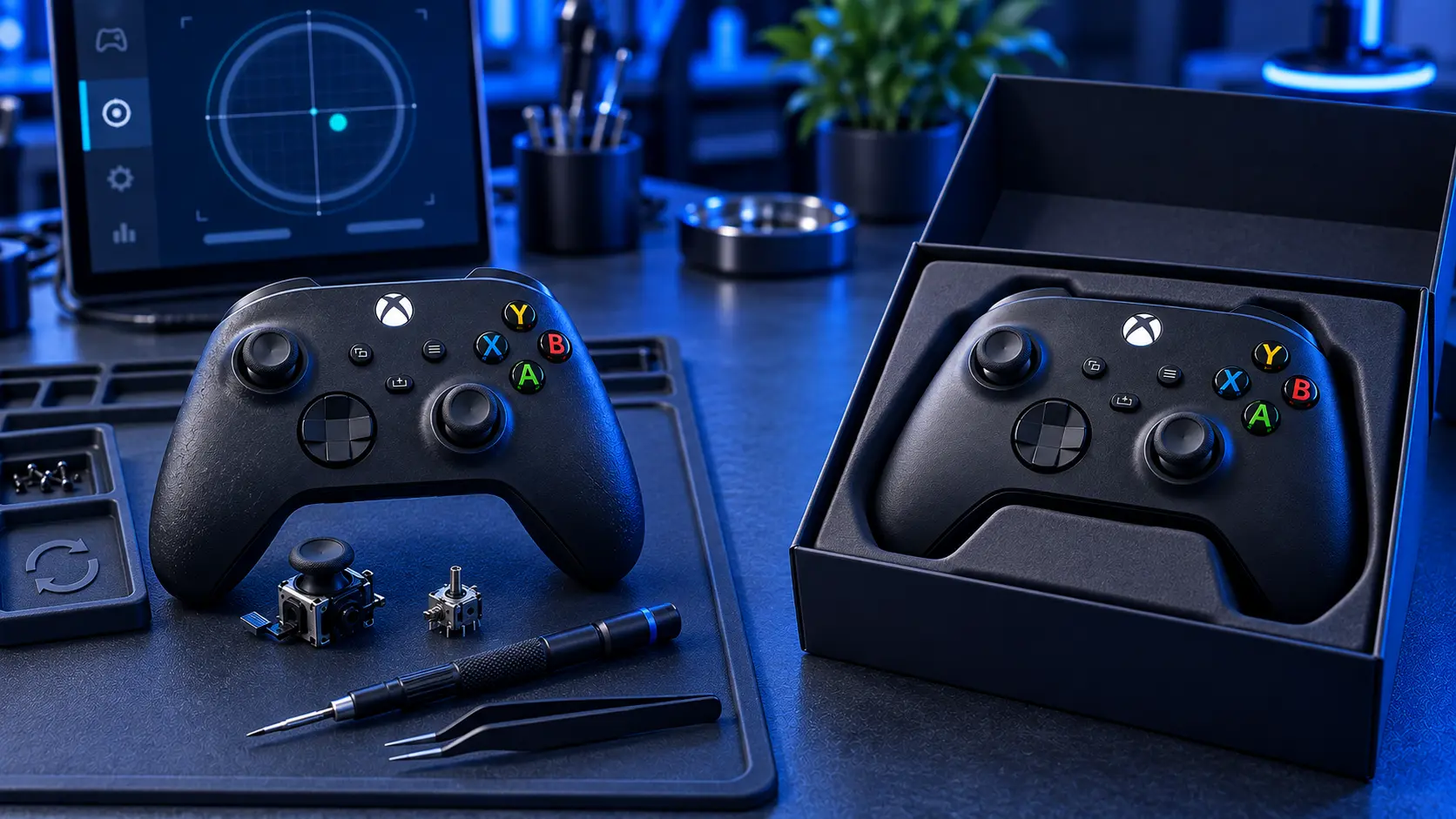
A new Xbox Wireless Controller is £50 to £60 — £59.99 at list price, and widely discounted from there. Fixing a drifting one is £19 for a single stick, £24 for both. On price alone that isn't close.
But price isn't the whole question, so here's the honest version of both sides.
The case for repairing
The obvious one is cost. £19 against £50 to £60 is roughly a third, and the repair comes with a 12-month warranty on the work — the same length of cover you'd get on a brand new pad.
The less obvious one is that a new controller has exactly the same sticks in it. Same design, same wear mechanism, same failure in another few hundred hours of play. Buying new doesn't solve the problem, it resets the clock on it.
There's also the pad itself. If yours has a shell you like, a colour that's been discontinued, a Design Lab build you configured, or you've simply got used to how it feels, a repair keeps it. A replacement doesn't.
And if it's an Xbox One controller, replacing it is harder than it used to be — the current pads are Series X|S, and a like-for-like replacement means the second-hand market. Xbox One controller drift repair goes into that properly.
The case for replacing
There are real ones, and I'd rather set them out than pretend otherwise.
Several things are wrong at once. Drift plus dead bumpers plus a corroded battery contact is a pad telling you something. Fixing the sticks leaves you with the rest, and you'll be back in three months.
The shell is cracked or it's been stood on. Structural damage is a different job and often not an economic one.
It's a spare that lives in a drawer. £19 to fix something you use twice a year is harder to justify than living with it.
It's genuinely ancient and beaten up. At some point a repair is money into something that will fail somewhere else regardless. That's a judgement call, and I'll tell you honestly if I think yours is at that point rather than take the booking.
The option that changes the maths
The comparison above treats a repair as a temporary fix, because with conventional sticks it partly is — you're fitting a new part that wears the same way.
The upgrades don't. Hall effect at £34 and TMR at £39 replace the sticks with contactless magnetic ones, so there's no contact track to wear down and the fault that brought the pad to me has nothing to develop from.
At that point you're not comparing a £19 patch against a £50-£60 replacement. You're comparing a £34 upgrade against a £50-£60 controller that will drift again eventually. Hall effect vs TMR covers which suits which player, and TMR is Series X|S only.
What a new controller actually gets you
Worth being even-handed, because a new pad isn't only a fresh set of sticks.
If you're replacing an Xbox One controller with a current Series X|S one, you also get the Share button, USB-C charging, Bluetooth and better textured grips. Those are real improvements, and wanting them is a purchase decision rather than a repair decision — which is a perfectly good reason to buy one.
What a new controller doesn't get you is sticks that last longer. The current pad uses the same style of analogue stick as the one that just failed you.
The cost over five years
A different way to look at it, and the one I'd use myself.
If you play a lot, a conventional stick wears out every couple of years or so. Replace the controller each time and that's £50-odd a go. Repair it each time and it's £19 to £24. Upgrade it once to contactless sticks and the wear that causes drift isn't there to come back at all.
Over the life of a console those are very different numbers — and only one of the three leaves you with a drawer full of dead controllers.
What I'd do with yours
Not quite a formula, but close.
Drift only, pad otherwise fine, a few hours a week: the standard repair at £19 or £24. Cheapest thing that works properly.
Drift only, you play a lot, it's your main pad: the upgrade. £34 or £39 once, rather than £19 every eighteen months.
Drift plus two or three other faults: replace it, and I'll tell you so rather than take the booking.
A discontinued colour or a Design Lab build you configured: repair it almost regardless. You can't buy that back.
What about buying second-hand?
Worth thinking about, because it's the real alternative for a lot of people rather than buying new.
A used controller is cheaper, has no warranty, no service history, and no way of knowing how many hours are on the sticks. You may be buying somebody else's drift three months before it appears. If you do go second-hand, test both sticks on the dashboard before you hand any money over.
A repaired controller with twelve months on the work is a more predictable purchase than a used one at a similar price.
The environmental bit, briefly
A controller is a few hundred grams of plastic, copper and rare-earth metals, and the part that failed is worth a couple of pounds. Throwing the rest of it away because of that is hard to defend, and it's most of the reason I do this work at all.
But I'd rather make the case on the price, because the price makes it on its own.
The short answer
If drift is the only thing wrong with it, repair it. If several things are wrong, replace it. If you've repaired it once already and it's drifted again, upgrade it and stop paying for the same fault.
See what it costs, or book the repair and post it in.
Most drifting controllers are one worn part away from being fine. At £19 that's rarely a difficult decision.
The Repair Works is an independent UK repair service, run by me, Paul — 25 years of hands-on repair experience, working by post for customers across the whole country. Not affiliated with or endorsed by Microsoft.