The airflow is as strong as it ever was. The motor sounds normal. But your Dyson Supersonic hair dryer is blowing cold air, and drying your hair now takes twice as long.
This is the fault with the widest range of outcomes on a Supersonic. At one end it's a sticky button and costs you nothing. At the other it's the heating element or the control board, which are among the more expensive parts in the machine. Those two possibilities feel identical from where you're standing.
So before anything else, spend five minutes ruling out the free ones. A dryer with this fault doesn't always need a repair at all.
The free checks, in order
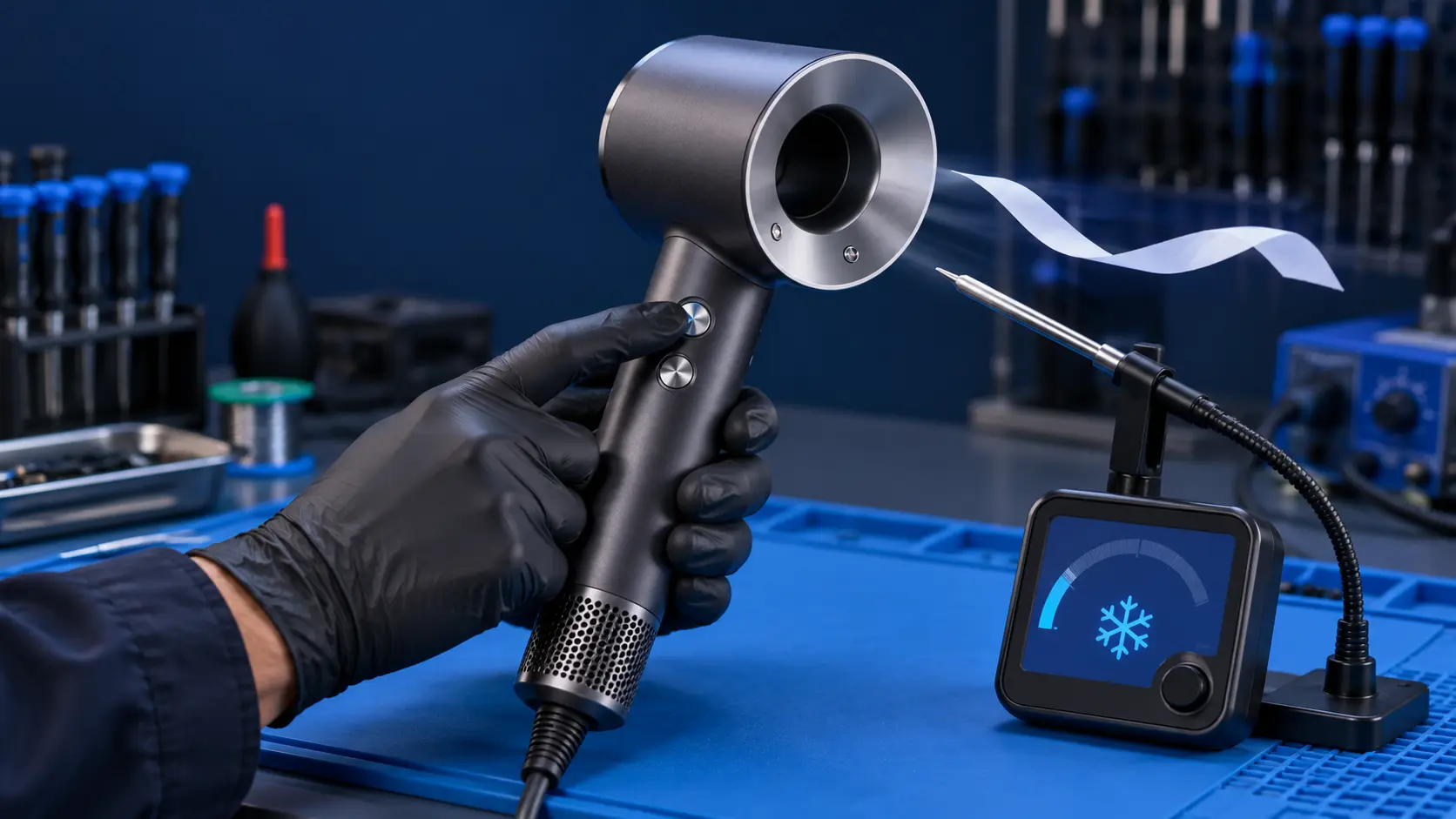
Cycle through the heat settings and watch the lights. The Supersonic has four temperature settings and one of them is a constant cold. It's easier to knock onto that than people expect, particularly if the dryer lives in a drawer or gets handed around the house. Press the heat button and watch the indicator change. If the lights don't respond at all, that tells you something in itself — I've written up what each light pattern means separately.
Check the cold-shot button isn't stuck in. This is the one people miss and it's the most common cheap cause. There's a dedicated cold-shot button on the barrel, and it's designed to give cold air for as long as it's held down. Hairspray, dry shampoo and general product build-up get into the gap around it over the years, and a button that's sticking down means a dryer permanently convinced you want cold air.
Press it a few times and feel for it. It should click cleanly and spring back every time. If it feels mushy, slow to return, or doesn't return at all, that's very likely your whole fault. There's more on that specific one in why a Supersonic cold shot stops working.
Clean around the buttons. With the dryer unplugged, work around the edges of both buttons with a dry soft brush. No liquid, nothing poked into the gaps. You're trying to shift product residue, not flush it further in.
Check the filter. Not because a blocked filter directly makes it blow cold, but because it can. The heater has its own protection, and if airflow over the element drops far enough, that protection cuts the heat while the fan keeps running. The result is a dryer that blows plenty of air with no warmth in it. There's a proper method in my three flashing lights article — and a wipe of the outside of the filter does almost nothing, so do it properly or the test tells you nothing.
Now the question that narrows it down
If the free checks haven't fixed it, this is what I'd ask you on the phone. The answer changes what's likely.
Does it get warm at all, ever?
It goes hot, then cold after a minute or two. That's the heater's protection tripping, and the cause is nearly always airflow. Blocked filter, hair around the impeller, or something restricting the inlet. This is the best of the three outcomes — it's usually a service and clean rather than a parts job, and it's the one where a proper filter clean genuinely might fix it.
It's cold sometimes and fine other times, or it changes if you press or move something. That points at the controls rather than the heater. A worn or contaminated button contact, or a temperature sensor giving intermittent readings. Generally the cheaper end.
It has never been warm since the day it stopped, no matter the setting. That's the one I'd be straight with you about. When the heat is gone completely and permanently, it's the heating element, its thermal cut-out, the temperature sensor, or the control board. Those are real parts and a real repair.
Why I won't guess this one over email
It's a fair thing to ask, and I understand why — you want a number before you post anything.
The problem is that a dead element, a blown thermal cut-out, a drifted sensor and a failed board all produce exactly the same symptom: air, no heat. There's no sound, no light pattern and no behaviour that separates them from outside the casing. Anyone who tells you which one it is without opening it is guessing, and a guess that's wrong costs you either a repair you didn't need or a quote that changes later.
When a heater's thermal cut-out has gone, it usually went for a reason. Airflow dropped, the element ran hotter than it should, and the protection did its job. Replacing the cut-out and posting it back would give you a dryer that works for a fortnight and then does the same thing. Finding out why the airflow dropped is the actual repair, and it's the bit that makes the difference between a fix and a delay.
Stop using it if you get any of these
A burning smell, or the smell of hot plastic
Visible smoke, however faint
The plug, socket or lead getting warm
Crackling or buzzing
It trips your RCD or the sockets in that room
Cold air on its own isn't dangerous. Any of the above is, and none of them is a wait-and-see fault on a 1,600W mains appliance you hold next to your head.
What it costs
Because this fault can land anywhere, it's priced honestly rather than as a flat fee.
It starts with a £4.99 assessment. I open it on the bench, test the element, the cut-out, the sensor and the board, and tell you exactly what's failed and what the repair would cost. You decide from there, with a real number rather than an estimate.
The £4.99 comes off if you go ahead. Most Supersonic repairs land between £49 and £85 all-in, including parts, return postage, a PAT test and a twelve-month warranty. If yours needs more than that — a failed heater assembly is from £129 — I'll tell you before I touch anything, and I'll tell you honestly if I don't think it's worth doing.
If I can't repair it, there's no repair fee. I refund what you paid, less £4.99 return postage.
No open-ended "labour plus parts". No quote that grows once you've committed. Every repair done by me personally.
Common questions
It blows cold on every setting but the airflow is perfect.
That's the classic pattern for a heater-side fault — element, cut-out, sensor or board — because the motor and the heater are separate systems. Good airflow tells you the motor is healthy, which is genuinely good news, since that's the expensive half of the machine.
It was fine, then suddenly cold, with no warning.
Sudden and total usually means something opened electrically — an element or a thermal cut-out. Gradual, or intermittent, is more often a control or a sensor. Not a rule, but it's the way it tends to go.
Can I replace the heating element myself?
Not sensibly. It's inside a sealed airflow path on a Class II mains appliance, and getting to it means dismantling the body properly. If you're qualified you don't need my permission, but the parts aren't sold openly and an untested heater repair on something used in a bathroom isn't a project I'd recommend to anyone who's asking whether they can.
Is a cold Supersonic still safe to use as a cold dryer?
If it's genuinely just not heating, with none of the warning signs above, it isn't dangerous — it's just slow. But if the heat stopped because a protective device did its job, something upstream is wrong and it won't stay stable. I'd get it looked at rather than live with it.
Is it worth repairing, or should I just buy a new one?
A used working Supersonic on eBay is £90 to £115 with no warranty and no history behind it. Dyson's refurbished ones are around £250, when they're in stock. New is £279.99. A repair in the £49 to £85 range with twelve months' cover, keeping your own machine and attachments, is usually the easy call — and the £4.99 assessment means you find out which side of that line you're on before committing to anything.
Start with the cold-shot button and the heat setting. Between them they account for a decent share of the Supersonics that arrive here for this fault, they take five minutes, and they cost nothing. Then do the filter properly, because that one is free too.
If it's still blowing cold after all three, the heat is gone for a reason that's inside the casing, and the only honest way to find out which reason is to open it. You can book a £4.99 assessment here — a proper bench diagnosis, a straight answer on what's failed and what it would cost, taken off the repair if you go ahead, and every repair done by me personally. And if the answer is that it isn't worth fixing, I'll tell you that too. I'd rather lose the job than take money for a machine that isn't worth the parts.
The Repair Works is an independent UK repair service, run by me, Paul — 25 years of hands-on repair experience, working by post for customers across the whole country. Not affiliated with or endorsed by Dyson.