This is one of the few faults on a Supersonic where I can tell you, honestly, that you probably don't need to send it anywhere.
The cold shot button sits in the worst possible place for a button: on a machine you point at your head immediately after spraying product near it. Everything you put on your hair ends up as a fine mist on the barrel, and the one part of the machine where a thin film of residue actually stops something working is a moving button.
So before assuming anything is broken — and it might well not be — here's what's usually going on.
First: it isn't meant to stay on
The single most common "fault" reported with the cold shot isn't a fault at all.
It's a momentary button. Press and hold for cold air; let go and it goes straight back to whatever heat setting you were on. It doesn't latch, it doesn't toggle, and there's no mode to switch into.
If you've been tapping it and expecting it to stay cold, hold it down for a few seconds instead and watch what the air does. A surprising number of "it's stopped working" messages end there, and I'd rather you find that out on this page than after paying postage.
Why it's nearly always dirt
Assuming you're holding it properly and nothing happens, the next thing to suspect is residue — not electronics.
Hairspray, mousse, dry shampoo and heat protectant all aerosolise, and a good proportion of what you spray doesn't land on your hair. It lands on whatever's nearby, which during drying is the dryer. Over months it builds into a slightly tacky film, and around a button it works its way into the gap the button needs to travel through.
The result is a button that feels a bit dead, doesn't quite click, or clicks but doesn't always register. Nobody ever cleans the buttons on a hair dryer, so this builds up unchecked for years.
The free fix:
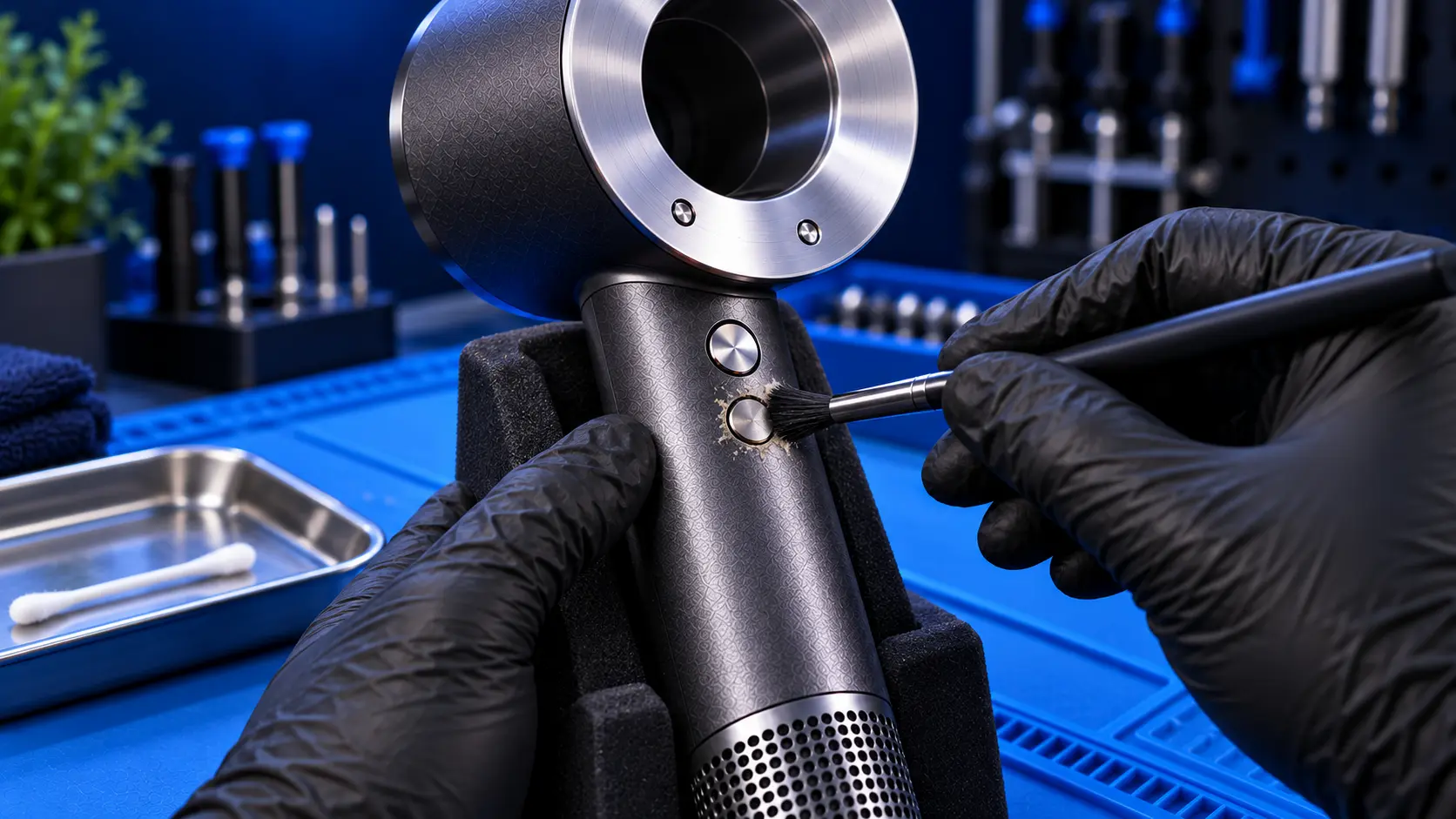
Unplug it. Take a dry, soft brush — an old toothbrush is ideal — and work carefully around the edge of the button to lift out what's sitting in the seam. Then a cotton bud, barely damp with isopropyl alcohol, around the same edge. Barely damp is the operative phrase; you want to dissolve residue, not introduce liquid into a mains appliance.
Then work the button. Thirty or forty presses. What you're doing is breaking up the film that's bridging the gap, and it often frees up noticeably as you go.
Leave it to dry properly — give it an hour, not five minutes — then plug in and test on maximum heat, where the temperature change is most obvious.
That resolves a large share of them.
The reverse fault, which catches people out
Here's the one worth knowing about, because it sends people looking in completely the wrong place.
A cold shot button that's stuck down gives you a dryer that won't heat.
If yours has gone permanently cold — full airflow, no warmth, whatever setting you choose — the natural assumption is a heating fault. Element, thermal fuse, control board: all expensive-sounding, and all things people start researching before they've checked the cheapest possibility on the machine.
Press the cold shot button a few times and feel whether it returns proud and clicks properly. If it's sitting flush, or it feels mushy compared to the other buttons, you may have found your heating fault for the cost of a cotton bud.
It's not the only cause of a Supersonic blowing cold — there's a full rundown of why a Supersonic blows cold air covering the heating element and control board too — but it's the one to rule out first, because it's free and it takes ten seconds.
What "not working" actually means in your case
Three different complaints arrive under the same heading, and they point different ways.
The button does nothing at all. No change in air temperature, on any setting. Residue first, then the switch.
It works sometimes. Intermittent is almost always mechanical — residue or a worn switch — rather than electronic. Electronics tend to fail and stay failed.
The air goes cooler but not cold. That's a different signal. It suggests the button is registering but the element isn't shutting off cleanly, which points at the control side rather than the switch.
And if the cold shot isn't working and you're seeing warning lights, stop troubleshooting the button. Lights mean the machine has detected something and is telling you about it — what the lights on a Supersonic mean covers the patterns and what each one indicates.
When it is actually the switch
Switches wear out. They're rated for a certain number of operations and the cold shot gets used hard by some people and never by others.
A failed switch is a genuine repair rather than a clean, but it's a small one — it's a component, not an assembly, and the work is in getting to it rather than in the part itself. It's at the cheap end of what goes wrong on these.
I would still rather you tried the clean first, and I'd rather say that publicly than quietly take the work. A button I could have talked you through cleaning isn't a repair I want to be paid for.
What I do with one
It comes apart properly, which is the bit that isn't worth attempting at home — these need specific tools to open without damage, and it's a mains appliance with a motor spinning at around 110,000 rpm inside it.
The switch and its housing get cleaned properly rather than superficially, the switch is tested electrically rather than by feel, and I check the surrounding board for any residue that's tracked in past the button. Back together, tested on every setting, and PAT safety tested before it's packed.
Is it worth repairing just for the cold shot?
Honest answer: that depends on whether you use it.
If everything else about the dryer is fine and you never use the cold shot to set a style, it is entirely reasonable to leave it. I'm not going to tell you a working hair dryer needs fixing.
Where it changes is if the button is stuck and costing you your heat, or if you actually rely on the cold shot — in which case it's usually one of the cheaper repairs, and it's a long way from the cost of replacing a machine that's otherwise perfectly good.
Common questions
Is the cold shot supposed to stay on when I let go?
No. It's press-and-hold on the Supersonic — release it and you're back on your previous heat setting. That's designed behaviour, not a fault.
Can I take the button off and clean underneath it?
Not without opening the machine, and I'd advise against attempting that. Surface cleaning around the button edge is safe and effective; going further isn't a home job on a mains appliance built the way this one is.
My dryer has gone completely cold. Is that this fault?
It might be, and it's the cheapest possibility, so check the button first. If it returns cleanly and the air is still cold on every setting, the cause is elsewhere.
Will cleaning it stop this happening again?
It helps. What helps more is a wipe-down every so often — the machine picks up everything you spray near it, and a minute with a dry cloth after a few weeks keeps residue off the buttons before it sets.
How long does it take?
The current turnaround is shown when you book. If a part needs ordering, I'll tell you as soon as I've diagnosed it and give you a realistic date.
Hold the button rather than tapping it, then clean around the edge with a brush and a barely-damp cotton bud and work it a few dozen times. That's free, it takes ten minutes including drying time, and it fixes most of these. If your dryer has gone permanently cold, check the button is returning properly before you go looking for anything more expensive.
If you've done all that and it's still not right, send it to me and I'll find out why. It starts with a £4.99 assessment. I quote before doing any work, and if you go ahead the £4.99 comes off the repair, which includes a 12-month warranty, a PAT safety test and return postage. If you decide not to, or I can't fix it, I post it back and the £4.99 covers that postage. Every repair is done by me personally, on my own bench, start to finish. And if it turns out the cold shot is the only thing wrong and you never use it, I'll tell you that too, because a dryer that does everything you actually ask of it isn't broken.
The Repair Works is an independent UK repair service, run by me, Paul — 25 years of hands-on repair experience, working by post for customers across the whole country. Not affiliated with or endorsed by Dyson.