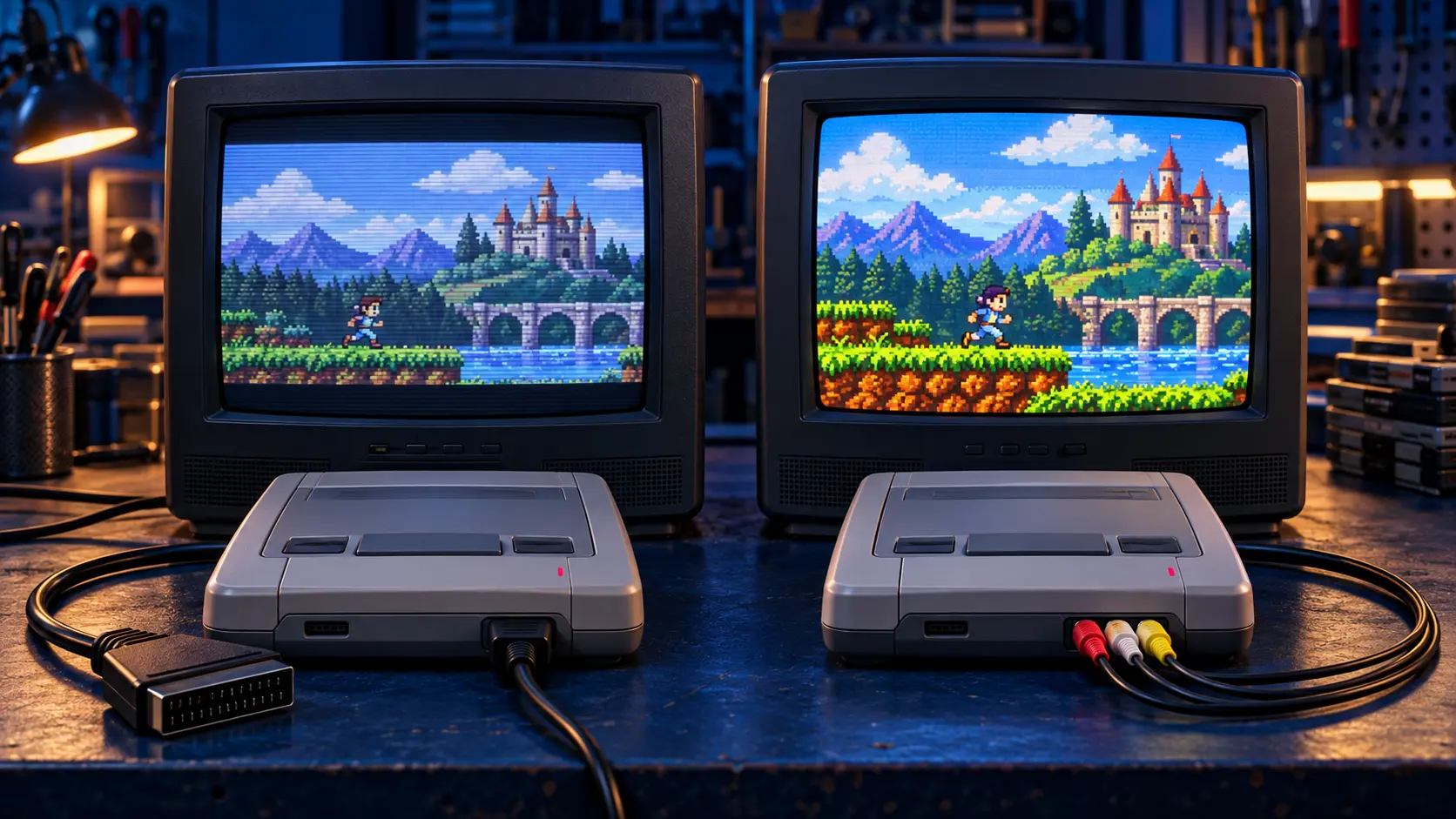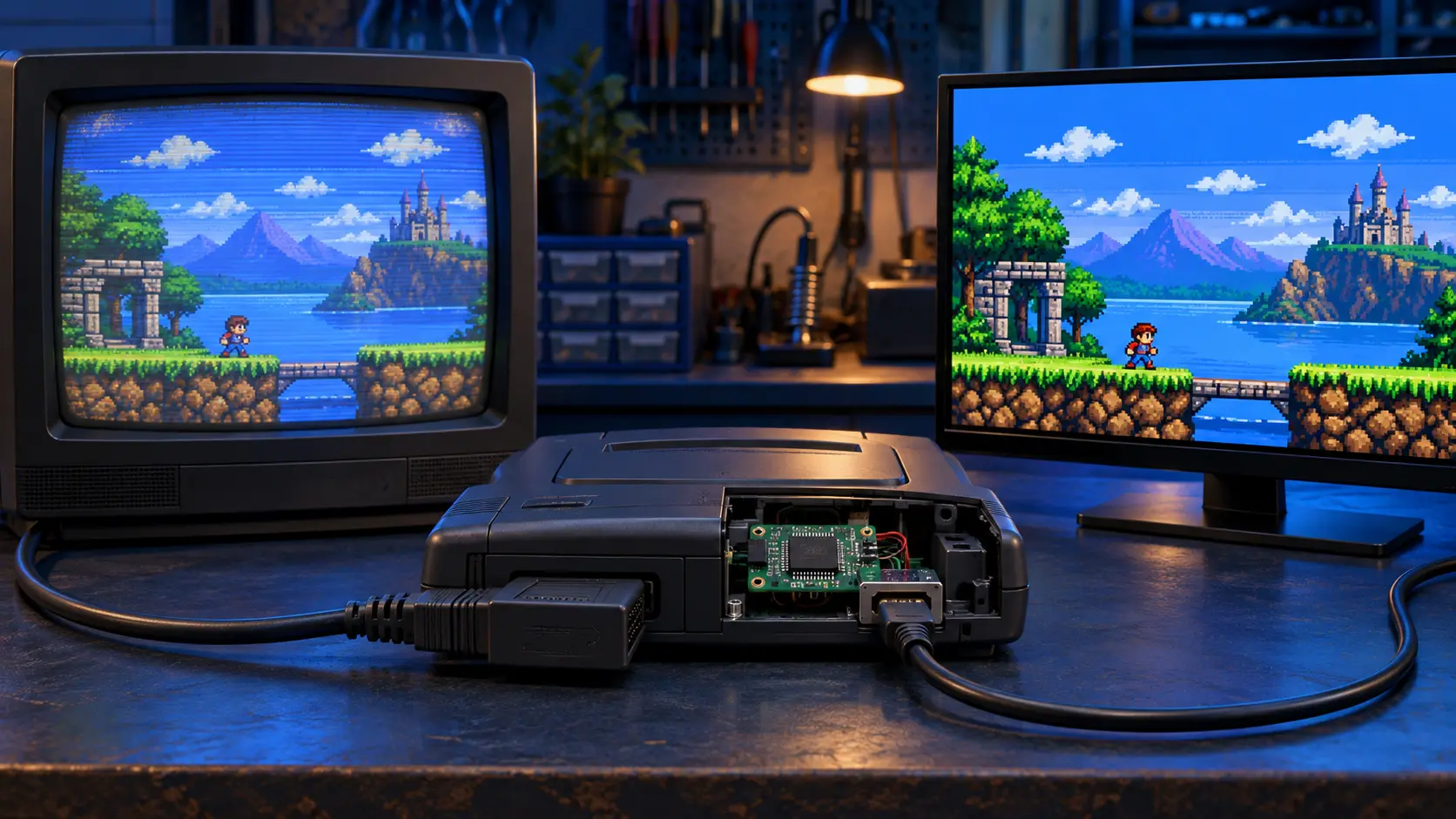
RGB SCART is the cheaper, reversible option, and it keeps a console untouched, which matters for collectors. An HDMI mod costs more and changes the console, but gives the cleanest picture on a modern TV with a single lead. If your TV has SCART and the console outputs RGB, start there. If it doesn't, or you want the simplest setup, an HDMI mod is worth considering.
Quick definitions
- RGB carries the red, green and blue colour signals separately. It's much sharper than composite, the yellow plug.
- SCART is the wide socket that UK TVs traditionally used for RGB. Many new TVs no longer have one.
- An HDMI mod fits a board inside the console that outputs digital video straight to HDMI. The board I fit is the Retro GEM by PixelFX.
Cost
RGB SCART is usually the cheaper way in. If your TV has a SCART socket, a decent RGB SCART cable may be all you need. If your TV has no SCART, add the cost of a converter or upscaler. Basic converters are cheap; dedicated retro upscalers cost noticeably more.
Some consoles need work before they give good RGB. The SNES RGB picture fix is £45, and the Mega Drive RGB mod with a Triple Bypass board is £85.
An HDMI mod costs more up front because the board is included. The N64 HDMI mod is £179, and the PS1 and PS2 HDMI mod is £189. Against that, you don't need a converter, an upscaler or special cables.
So the honest answer on cost: SCART is cheaper if your TV already has the socket. If you'd need a good upscaler anyway, the gap narrows, especially if you only want one console on HDMI.
Picture
A good RGB signal through SCART into a TV that handles it well looks sharp and clean. Through a basic converter, results vary, and the picture can be softer or laggier than you'd hope.
An HDMI mod takes the video digitally from inside the console, so there's no analogue step in the chain. The Retro GEM also has scaling and filter options, so you can choose a crisp look or something closer to an old tube TV. On a large modern screen, an HDMI mod should give the cleanest result that console can manage.
One console where the choice is simple: the PAL N64 doesn't output RGB without a mod. For a modern TV, HDMI is the practical upgrade.
Collector value
This is where SCART wins clearly. An RGB cable plugs into the console's existing AV port and changes nothing. You can sell the console later exactly as it was.
Any internal mod changes the console. Rare or boxed consoles lose collector value when modded, so if you own something special, think carefully. For a well-used console you just want to play, that matters less. Some owners keep an untouched console for the shelf and a modded one for playing.
Convenience
An HDMI mod is the easy one to live with: one ordinary HDMI lead into any modern TV, no extra boxes, and no hunting for a SCART socket. The Retro GEM gets firmware updates over Wi-Fi as well.
RGB SCART means keeping specific cables for each console, and, on a new TV, a converter or upscaler with its own power lead and settings. It's more to manage, but many enthusiasts are happy with that, particularly if one upscaler serves several consoles.
Summing up
Go with RGB SCART if:
- your TV still has a SCART socket, or you already own an upscaler;
- the console is rare, boxed or collectable;
- you want the lowest cost.
Go with an HDMI mod if:
- your TV has no SCART and you don't want extra boxes;
- you have a PAL N64, a PS1 or a PS2 you play regularly;
- you want the cleanest picture on a big screen.
For a wider look at every option, including composite, read how to connect a retro console to a modern TV. If PAL and NTSC differences are part of your decision, see PAL vs NTSC retro consoles.
Every mod on the retro console repairs page is tested on my bench before it goes back, with a 12-month warranty and an insured, tracked return. If I can't complete the job, it's no fix, no fee.
Frequently asked questions
Can an HDMI mod be removed later?
It's an internal board fitted to the console, so treat it as a change to the hardware. If keeping the console original matters to you, RGB SCART is the safer choice.
Is RGB SCART good enough on a modern TV?
It can be very good, especially with a dedicated upscaler. The result depends on your TV and whatever sits between the console and the screen.
Can I get an HDMI mod for my Mega Drive or SNES?
The Retro GEM board I fit supports the N64, PS1, PS2, GameCube, Wii and Dreamcast. For the SNES and Mega Drive, the RGB route is the one I offer.