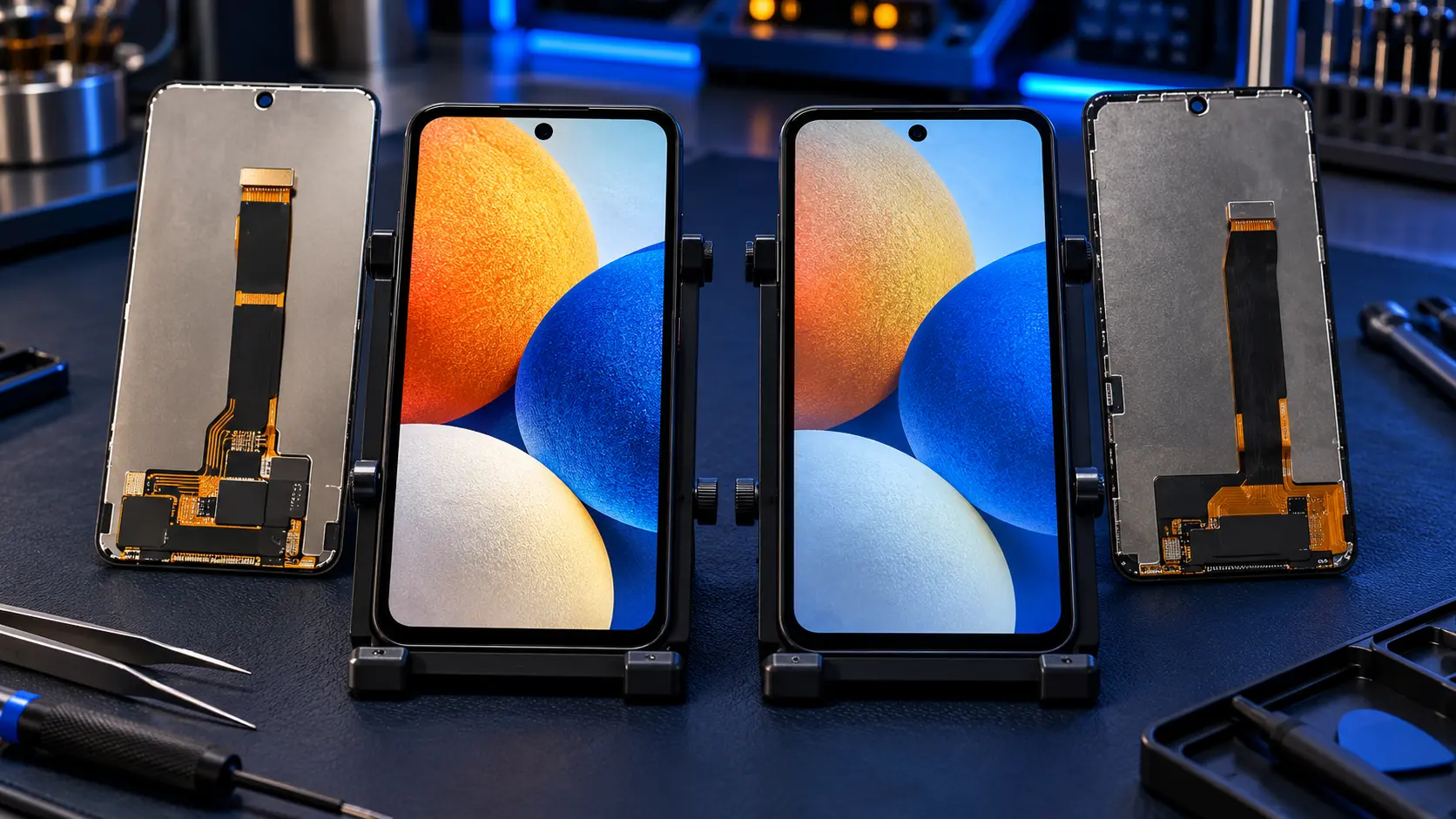
A genuine Samsung screen is the part Samsung makes for your phone, usually supplied as a service pack with its own Samsung part number. An aftermarket screen is a copy made by another manufacturer. Some copies are decent, but many swap the phone's AMOLED panel for a cheaper LCD one, which looks greyer, can be dimmer and can use more battery. On Galaxy A models with an under-screen fingerprint reader, an LCD copy can stop the fingerprint reader working altogether.
I only fit genuine Samsung screens, so I'm not neutral here. But copies exist for a reason, and it's worth knowing exactly what you're giving up.
The three kinds of replacement screen
Genuine Samsung service pack
Made by Samsung and supplied for repairs. For most Galaxy A models it comes as a complete assembly: display, touch layer and glass already fitted in the phone's front frame, with a Samsung part number starting GH82 or GH81. It's the same screen the phone was built with.
Aftermarket OLED
A copy that still uses an OLED panel. The picture can be close to the original, though colour, brightness and touch response vary between suppliers, and quality isn't consistent from one batch to the next.
Aftermarket LCD (often called "incell" or "TFT")
The cheapest option. An LCD panel made to fit a phone designed for AMOLED. It's what makes the lowest quotes possible, and it's where most of the problems are.
What changes with an LCD copy
- Blacks look grey. AMOLED switches pixels fully off for black; an LCD has a backlight that's always on, so dark scenes look washed out.
- Brightness and colour are often lower and less accurate.
- Battery life can suffer, because a backlit LCD uses power even for a dark screen.
- The under-screen fingerprint reader on the A33, A34, A35, A36, A53, A54, A55 and A56 reads your finger through the display using light. An LCD copy doesn't let it work the way the original screen does, so the fingerprint reader may fail completely.
- Always On Display is less practical on an LCD, because the whole backlight has to stay on.
- Thickness and fit can differ slightly, which can leave gaps or pressure points.
How to tell if your screen is genuine
- Look at black. Open a completely black image in a dark room. On a genuine AMOLED screen, black looks truly black. A grey glow means an LCD.
- Check the fingerprint reader on the under-screen models. If it stopped working after a screen repair, the screen may be a copy, or the sensor wasn't calibrated.
- Compare colour and brightness with another phone of the same model, if you can.
- Ask for the part number. A repairer fitting a genuine screen can tell you its Samsung part number.
Questions to ask before a screen repair
- Is it a genuine Samsung screen, and what's the part number?
- Is it AMOLED, like the original? (Every Galaxy A from the A15 upwards has an AMOLED screen; the A13 and A14 have LCD screens.)
- On an under-screen fingerprint model: will the fingerprint reader be calibrated afterwards?
- What warranty comes with it?
When a copy might make sense
If a phone is old, worth very little and you just need it working as a spare, a copy screen can be a reasonable choice, as long as you know what you're getting. On an LCD model like the A13 or A14, the gap between genuine and copy is smaller, because the original is an LCD too. Where it matters most is on AMOLED models, and above all on the ones with an under-screen fingerprint reader.
What I fit
Every screen I fit is a genuine Samsung part. Prices start at £79 on the A13, A14, A15 and A16. This guide lists every model's price, including Samsung's own. On the models with an under-screen fingerprint reader, this guide explains the calibration issue. For example, see the Galaxy A15 and Galaxy A16 pages, or every model on the Samsung Galaxy A repair page.
Frequently asked questions
Is an aftermarket Samsung screen bad?
Not always. Good OLED copies can look close to the original. LCD copies are where the compromises are: greyer blacks, lower brightness, and an under-screen fingerprint reader that may not work.
Why won't my fingerprint work with a new screen?
On under-screen fingerprint models, either the sensor wasn't calibrated after the new screen, or the screen is an LCD copy that the optical sensor can't read through properly.
Is a "refurbished" screen genuine?
It can be. Some are genuine Samsung panels with replaced glass. Ask the repairer exactly what it is, and whether the touch layer and panel are original.