Most noises a hair dryer makes are mechanical. Something is spinning, something is loose, something needs cleaning — annoying, sometimes expensive, rarely dangerous.
Clicking and buzzing are the two exceptions. They're the sounds most likely to be electrical rather than mechanical, and electrical noise in a mains appliance is a different category of problem. Not always serious. But it's the one type of noise where "I'll keep using it and see" is the wrong instinct.
This page is about telling the two apart, and there's one test that does most of the work.
The test that splits it
Change the speed setting and listen carefully.
If the noise rises and falls with the motor — gets faster, higher or louder as the speed goes up — it's mechanical or it's airflow. Something is spinning, resonating or being blown past.
If the noise stays essentially the same regardless of the setting, it's electrical. Mains-driven noise runs at its own frequency and doesn't care how fast the motor is turning.
That single observation puts you in one of two halves of this page, and it's worth doing carefully rather than quickly. Run it on every setting, twice.
If it tracks the speed
Then it's mechanical, and this isn't really the page you need.
Debris, a filter cage that isn't seated, a loose attachment, a damaged impeller, worn bearings — these all make noise that follows the motor. I've covered the full range of mechanical sounds and what each one points at in what a loud noise from a Supersonic actually means, including how to tell a rattle from a bearing.
Come back here if it turns out the noise doesn't change with the speed. That's the interesting case.
Clicking
A single click when you switch it on or off is normal. That's switching, and it's supposed to happen. If it's always done it, it isn't a fault.
A rhythmic click while it's running — a regular tick, in time with the motor — is mechanical. Something is making contact once per revolution. Stop using it; at that rotational speed, whatever is touching is wearing.
An irregular, occasional click that doesn't keep time with anything is the one to pay attention to. That pattern points at a switch or a connection making and breaking, and if it comes with any interruption to the power — even a flicker — it wants looking at rather than living with. A dryer that clicks and briefly cuts is telling you something is loose in the circuit.
If yours is actually shutting off and restarting rather than just clicking, that's a distinct fault with its own causes, covered in why a Supersonic turns on then straight back off.
Buzzing
A buzz that changes with the speed is vibration. Usually a panel, the filter cage, or an attachment resonating at a particular frequency. Reseat everything and it often disappears entirely. Harmless.
A steady buzz at a constant pitch, unchanged across all speeds, is electrical. Mains hum. On its own, and if it's quiet and has always been there, it may be nothing — some units are simply noisier than others. What matters is whether it's new.
A crackling, fizzing or frying buzz — intermittent, irregular, rough-edged — is the one this page exists for. Stop using it.
Why crackling is different
That rough, intermittent, frying sound is the signature of arcing: current jumping a gap where there should be a solid connection.
It matters because of what's happening at that gap. Arcing generates intense, localised heat at a single point — far more than the surrounding parts are designed to handle. It doesn't stay the same, either. The heat degrades the connection further, which widens the gap, which makes the arcing worse. It's a fault that accelerates.
The signs that usually travel with it:
A crackle or fizz that comes and goes rather than holding a steady note
Any flicker or momentary drop in power
A plug or a section of cable that's warm to the touch
A faint smell of hot plastic or ozone
If you have any of those alongside the noise, unplug it and leave it unplugged. That's not me being cautious to cover myself — arcing is the mechanism behind a meaningful share of electrical fires, and a hair dryer draws around 1600 watts through a flex that gets bent every single time it's used.
If there's an actual burning smell rather than just a noise, treat that as more urgent again.
Where electrical noise usually comes from
Usually, it's the cable.
The flex on a Supersonic is worked harder than almost any other part of the machine. It's coiled, uncoiled, wrapped round the body for storage, tugged from the socket, and bent hardest right where it enters the handle and right where it enters the plug. Copper that's flexed enough times work-hardens and starts to break strand by strand. Fewer strands carrying the same current means more resistance, more heat, and eventually a poor connection that can arc.
A useful check: after five minutes of use, unplug it and feel the plug and the first few inches of cable. Warm is fine. Noticeably hot at one specific spot is not, and a hot spot on a cable is worth acting on whether or not it's making a noise.
The other common source is the switchgear — the buttons and the contacts behind them, where residue and wear can both cause an imperfect connection.
The free checks
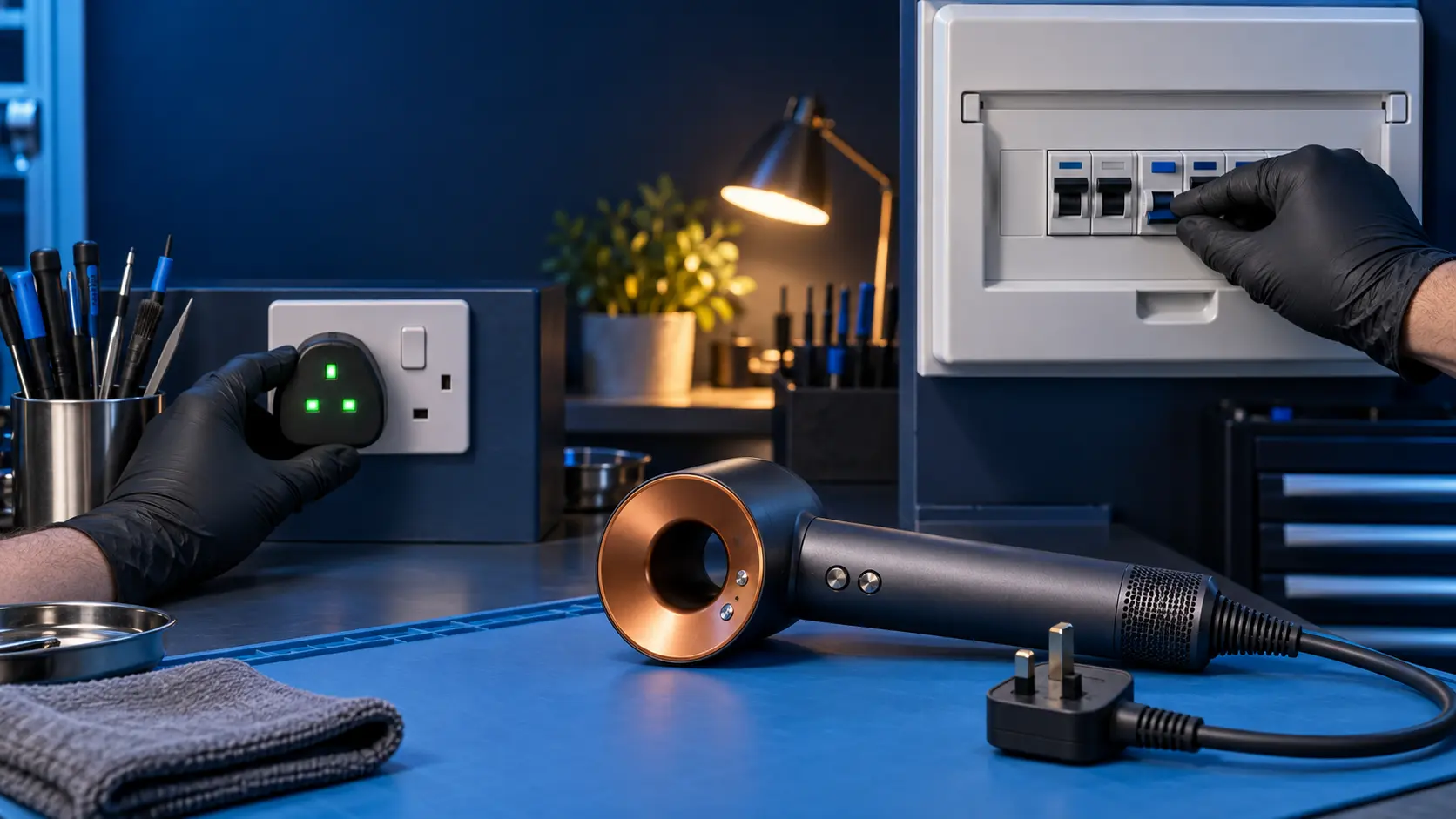
Try a different socket, ideally on a different circuit. It rules out the socket and the plug fuse, and it costs nothing.
Reseat the filter cage and take the attachments off. If the buzz vanishes, it was resonance, and you're done.
Run the speed test properly — every setting, twice — because it's the whole diagnosis.
And the one thing not to do: don't keep using it to see whether it settles down. Mechanical noises sometimes do. Electrical ones essentially never do, and the failure mode isn't "it stops working".
What I do with one
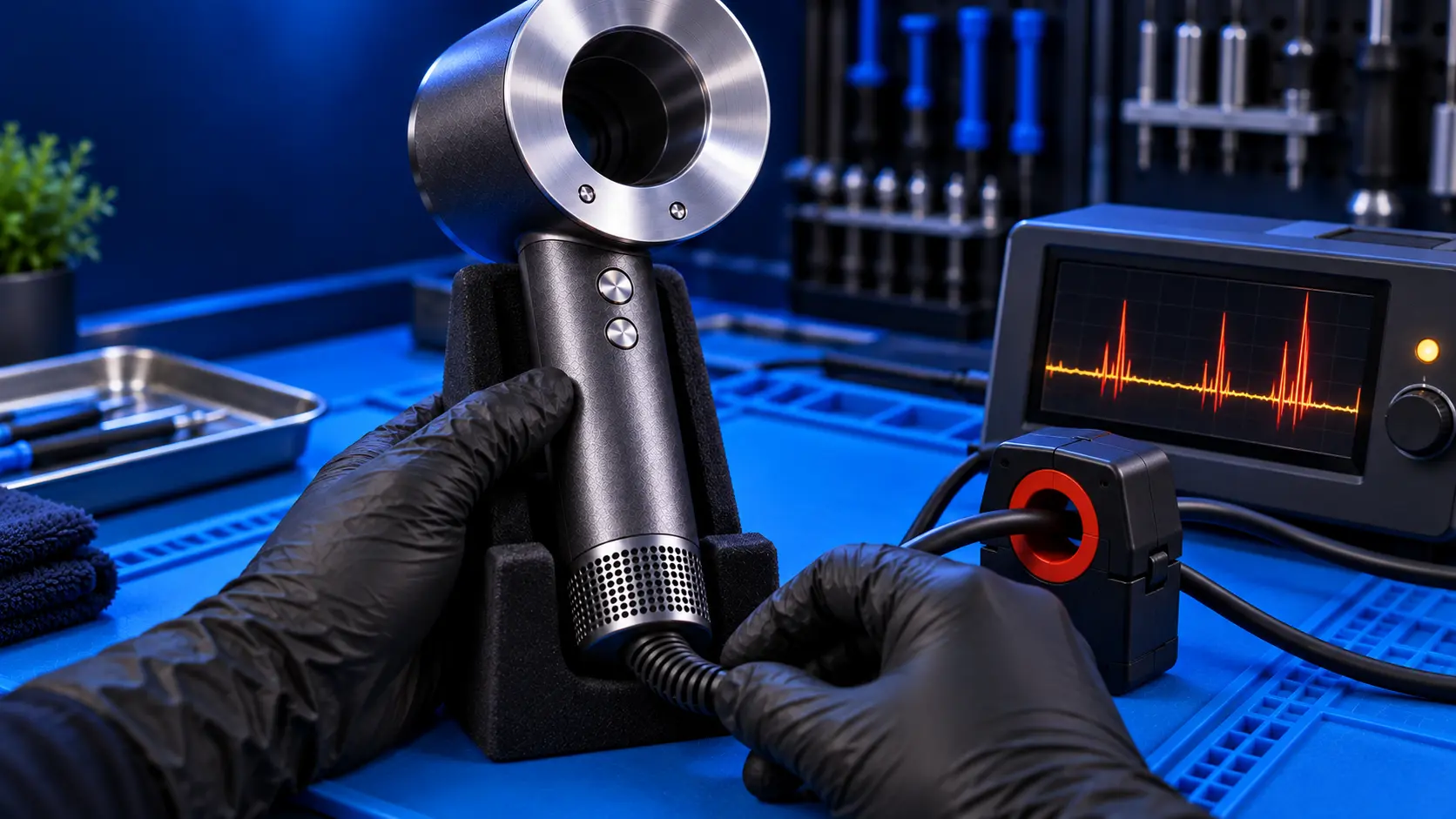
I listen to it, then I measure it, because "sounds electrical" isn't a diagnosis.
The cable gets tested along its length rather than just looked at, because the break that causes arcing is usually invisible under intact insulation. The switch contacts get tested rather than pressed. The board gets inspected for heat marking and tracking — the discoloured paths that show where current has been going somewhere it shouldn't, which is often the clearest evidence of what's been happening. And the machine gets a PAT safety test before it's packed, which on this particular fault is the part that matters most.
If I find arcing damage, I'll tell you exactly what I found. This is not a fault where I'd patch something up and send it back hoping.
Common questions
It's always made a slight buzz. Is that a fault?
Probably not. What matters is change. A buzz that's been there since it was new is characteristic; a buzz that's appeared recently is a symptom.
It clicks once when I turn it on. Normal?
Yes. A single click at switch-on or switch-off is the machine doing what it's designed to do.
Can I just replace the cable myself?
I'd strongly advise not. It's a mains appliance running a motor at around 110,000 rpm, the cable is retained inside the handle, and a cable repair that looks fine but isn't properly strain-relieved recreates exactly the fault you were trying to fix — only this time without anyone testing it afterwards.
How urgent is it really?
Depends entirely on which noise you've got. A speed-dependent buzz is a resonance and you can carry on. A constant electrical hum that's new is worth getting looked at soon. Crackling or fizzing means stop today.
How long does it take?
The current turnaround is shown when you book. If a part needs ordering, I'll tell you as soon as I've diagnosed it and give you a realistic date.
Run the speed test first, because it costs nothing and it does most of the diagnosis. If the noise follows the motor, it's mechanical and you've got time. If it doesn't change at all — and especially if it crackles rather than hums — unplug it and stop there.
If you're in that second group, send it to me and I'll find out what's going on. It starts with a £4.99 assessment. I quote before doing any work, and if you go ahead the £4.99 comes off the repair, which includes a 12-month warranty, a PAT safety test and return postage. If you decide not to, or I can't fix it, I post it back and the £4.99 covers that postage. Every repair is done by me personally, on my own bench, start to finish. And whatever you decide about repairing it: if it crackles, don't plug it back in to check one more time. That's the check that occasionally answers itself in a way nobody wants.
The Repair Works is an independent UK repair service, run by me, Paul — 25 years of hands-on repair experience, working by post for customers across the whole country. Not affiliated with or endorsed by Dyson.