If you've searched for someone local to fix a drifting Xbox controller, you've probably found a phone repair shop, a general electronics place, or nothing at all.
That's worth thinking about before you drive anywhere, because controller repair is a specific skill and a shop that mainly does phone screens may or may not have it.
What you'll actually find
Three kinds of place tend to come up.
Phone and tablet repair shops. Plenty of them will take a controller. Some are genuinely good at board-level work; some will take it, send it to somebody else, and add a margin. Neither is obvious from the shopfront.
General computer repair. Similar picture. A controller isn't a laptop, and the board is smaller and less forgiving than most electronics.
Specialist console repairers. Fewer of them, and the good ones are worth knowing about. If there's one near you who does consoles day in and day out, they'll be quick and they'll be right.
The trouble is telling which is which from a website, which is why the questions below matter more than the distance.
Three questions to ask anyone local
Do you replace the stick module, or the whole board? Some places swap the entire mainboard, which costs far more than the fault needs and is a heavier-handed fix than the problem deserves. The answer you want is that they replace the stick module.
Do you solder it? On every Xbox controller the sticks are soldered to the board — this isn't a plug-in part. If someone describes it as a simple swap, they're describing a different controller.
What's the price, and is that the final price? A lot of local shops quote after inspection, which means you find out the cost after you've already made the trip. Ask before you go.
If the answers are good and the price is fair, use them. Local is genuinely convenient when it works.
Why posting works for this particular item
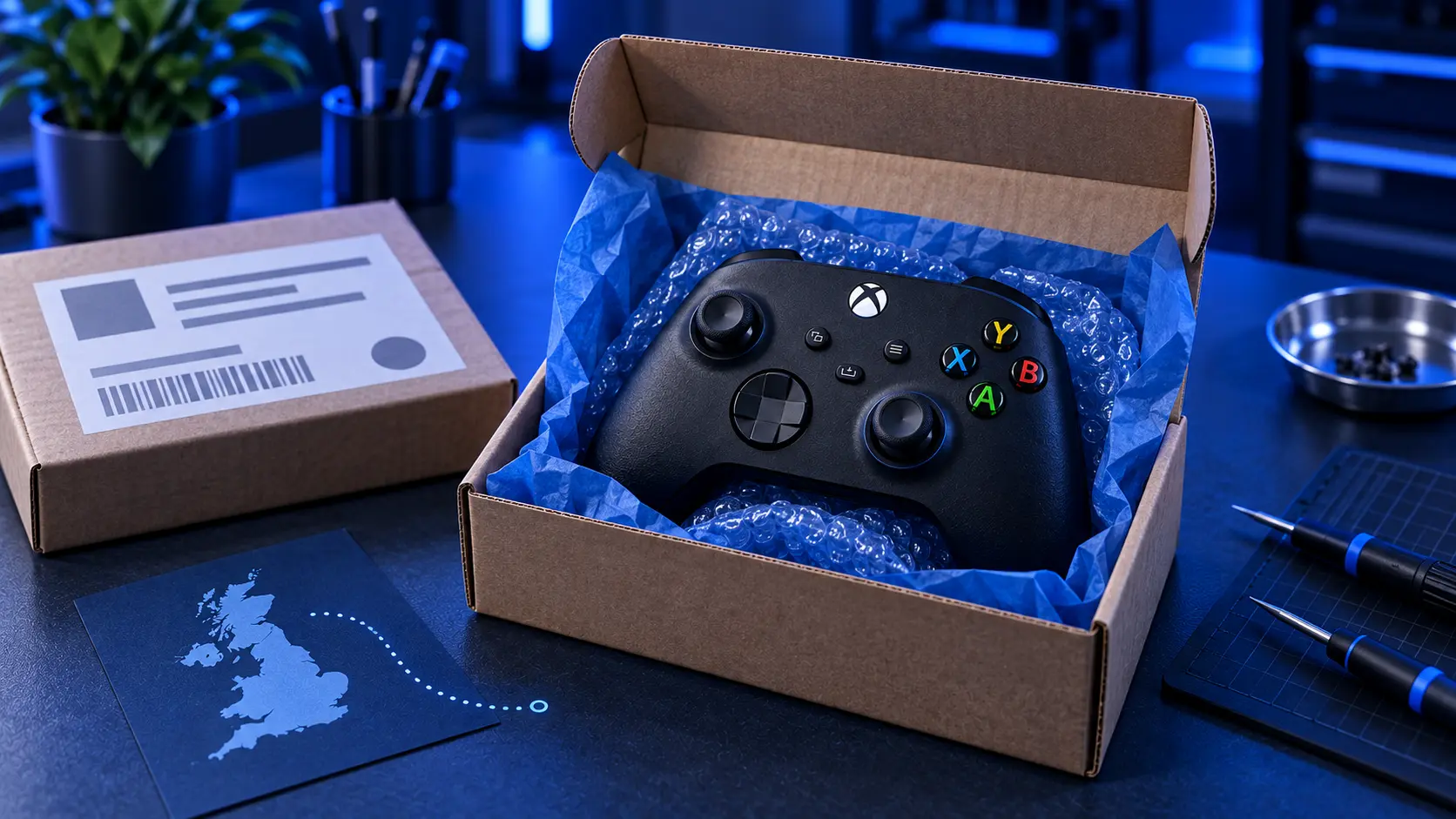
A controller weighs a few hundred grams and fits in a padded envelope. That's most of the argument.
No driving, no parking, no second trip to collect it. You book online, you know the price before you commit, and it comes back tracked. For something small and light, the postage economics work in a way they wouldn't for a washing machine or a television.
There's a second argument, which is repetition. Someone replacing controller sticks regularly is faster and more reliable at it than a generalist doing one occasionally — and on a board where a slip lifts a copper pad, that matters more than it sounds.
What about the chains?
Worth ruling out, because they come up in local searches.
The game and tech resale shops on most high streets buy and sell controllers, and some will take a broken one off you for a few pounds. What they generally don't do is board-level repair — to them a drifting pad is stock to be traded, not a job to be done.
That's a legitimate option if you just want rid of it. It isn't a repair, and you'll be buying a replacement afterwards.
Can I drop it off instead?
No, and I'd rather be clear about that than vague.
I work from a bench at home, on my own, which is a good part of why the prices are what they are. There's no counter and no opening hours, so everything comes and goes by post. If handing it to someone matters to you, a local specialist is genuinely the better fit and I'd say so rather than talk you out of it.
How long will you be without it?
The current turnaround is shown on the booking page for whichever repair you choose, so you'll know before you commit rather than after.
If a part needs ordering I'll tell you as soon as I've diagnosed it, with a realistic date, instead of leaving you wondering. And it goes back by tracked post with an email when it's on its way.
What it costs and how it works
£19 for one stick, £24 for both, £34 for the Hall effect upgrade, or £39 for TMR on a Series X|S pad. Every price includes parts, labour and tracked return postage, with a 12-month warranty and no fix, no fee.
Full pricing, including how it compares with buying new, is in what Xbox controller drift repair costs.
You book the specific repair, post the controller with the packing guidance I email you, and it comes back tested. Board-level work, done in-house, by one person — there's no counter staff and no queue behind a phone screen.
What happens while I've got it
I email you when it arrives, so you know it got there. If I find anything beyond what you booked, you hear about it before I do anything, not after.
Then it's repaired, calibrated, bench-tested across both sticks and every button, packed and posted back tracked, with another email when it's on its way.
Most of the anxiety about posting something is not knowing where it is. That's the bit I try to remove.
Before you send it anywhere
Two things worth doing first, whether you use me or someone down the road.
Check the warranty. If the controller is recent it may be covered, and that costs you nothing. Warranty and your UK rights sets out where you stand, including after the warranty runs out.
Try the free fix, if your pad supports it. Microsoft's recalibration tool covers Series X|S controllers and clears some faults outright. The calibration guide walks through it and says plainly when it won't help.
If the drift comes back within days of that, the stick is worn and it's a repair.
If there's a good specialist near you, use them. If there isn't — and for most people there isn't — a padded envelope and £19 is a shorter route than it looks.
The Repair Works is an independent UK repair service, run by me, Paul — 25 years of hands-on repair experience, working by post for customers across the whole country. Not affiliated with or endorsed by Microsoft.