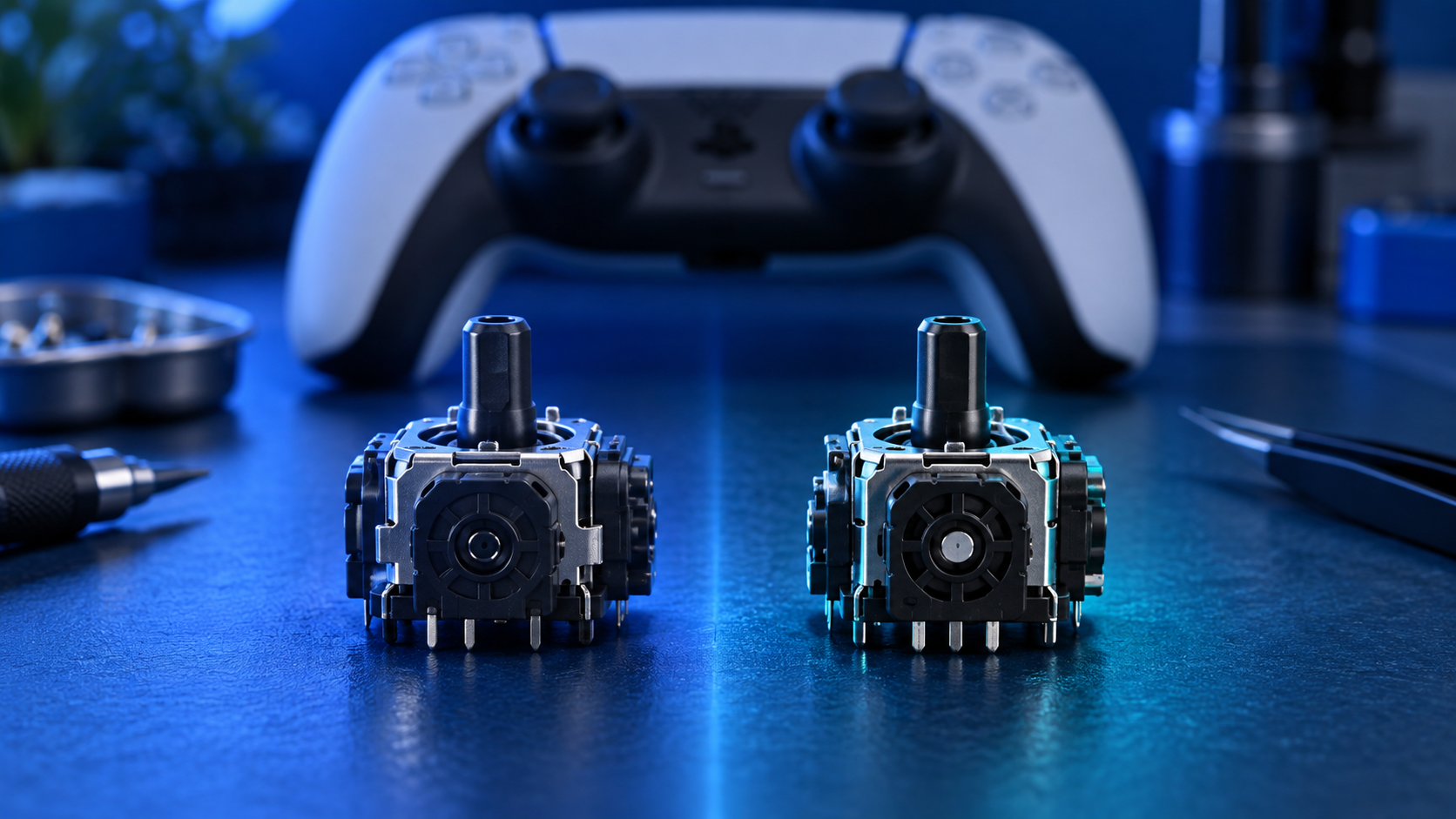
If you've gone looking at anti-drift stick options you'll have found two: Hall effect, and TMR. TMR is usually sold as the premium tier, at a premium price.
Both remove the wear that causes drift, for the same underlying reason. The difference between them is real but smaller than the marketing suggests — and here the gap is £5, which changes the answer.
Here's the honest version.
What they have in common
Both are magnetic. Instead of a contact arm sweeping a resistive track — which is what wears out and causes drift on a standard stick — there's a magnet on the stick shaft and a sensor reading the magnetic field as it moves.
Nothing touches anything, so there's no wear surface for drift to develop from. That's the whole mechanism and both technologies share it.
Which means the headline question — will this stop my controller drifting? — has the same answer for both. Yes, as far as wear goes. There's more on why in does Hall effect stop drift permanently.
What's different
They use different physical effects to read the field.
Hall effect sensors produce a voltage across a conductor when a magnetic field passes through it. It's a well-established technology, it's been in industrial and automotive sensors for decades, and it's reliable and cheap.
TMR — tunnel magnetoresistance — uses a layered structure whose electrical resistance changes with the magnetic field. It's a more sensitive effect, which in principle means finer resolution, and it typically draws less power.
On paper TMR is the better sensor. Higher sensitivity, better signal-to-noise, less power draw.
Whether you'd notice
This is the part that usually goes unsaid.
The PS5 reads stick position as an 8-bit value per axis — 256 steps from one extreme to the other. Both Hall effect and TMR sensors resolve far more finely than that, which means both are already more precise than the console can make use of.
So the extra sensitivity is real at the sensor and largely invisible by the time it reaches the game. In blind use, most people can't tell a good Hall effect module from a TMR one.
What you can sometimes feel is the module itself — spring tension, how smooth the travel is, how the stick returns to centre. That varies more between manufacturers than between the two sensing technologies, and a well-made Hall effect module will feel better than a cheap TMR one.
The power draw difference is genuine but small in this context. It's meaningful in a device running from a coin cell for years; in a controller you charge every few days, it's not something you'd notice.
So who is TMR actually for
At £5 between them, more people than when TMR was a specialist order.
Competitive players who want every marginal gain available and will take a theoretical improvement on principle. That's a legitimate reason and I'm not going to talk anyone out of it.
People who've already got Hall effect sticks and specifically want to try the other thing.
And people who simply want the best available part in their controller regardless of whether they'll perceive the difference. Also fine.
If you've got a drifting £60 controller, Hall effect at £34 already removes the wear that caused it. TMR at £39 is £5 more for a finer sensor and lower battery draw — worth having if you play wireless or want the finest control, and not a mistake either way.
If you want TMR
I fit TMR sticks as a listed upgrade for PS5 DualSense and Xbox Series X|S controllers, at a fixed price with return postage included. See the PS5 TMR upgrade or the Xbox TMR upgrade.
Each stick repair page has a table comparing the standard repair, Hall effect and TMR side by side, so you can pick on price and on what matters to you.
And if you're just trying to stop the drift
Then the choice is simpler than this article makes it sound. The standard repair is £19 for one stick or £24 for both. Hall effect at £34 and TMR at £39 both replace the part that wears.
The full comparison is in Hall effect vs standard sticks, and prices are in what drift repair costs.