If you've read anything about Hall effect sticks you'll have seen them described as drift-proof. It overstates things, but the reasoning behind it is sound, and there's enough missing from the whole story that it's worth being precise.
So: yes, a Hall effect upgrade removes the wear that causes stick drift. Here's why that's true, and what it doesn't cover.
Why wear-related drift shouldn't come back
Drift on a standard stick is wear. Inside each axis there's a resistive track and a contact arm sweeping across it. The arm is physically touching, so every hour of play removes a little material. Eventually there's a worn patch, the readings stop settling at centre, and the console sees input you didn't give it.
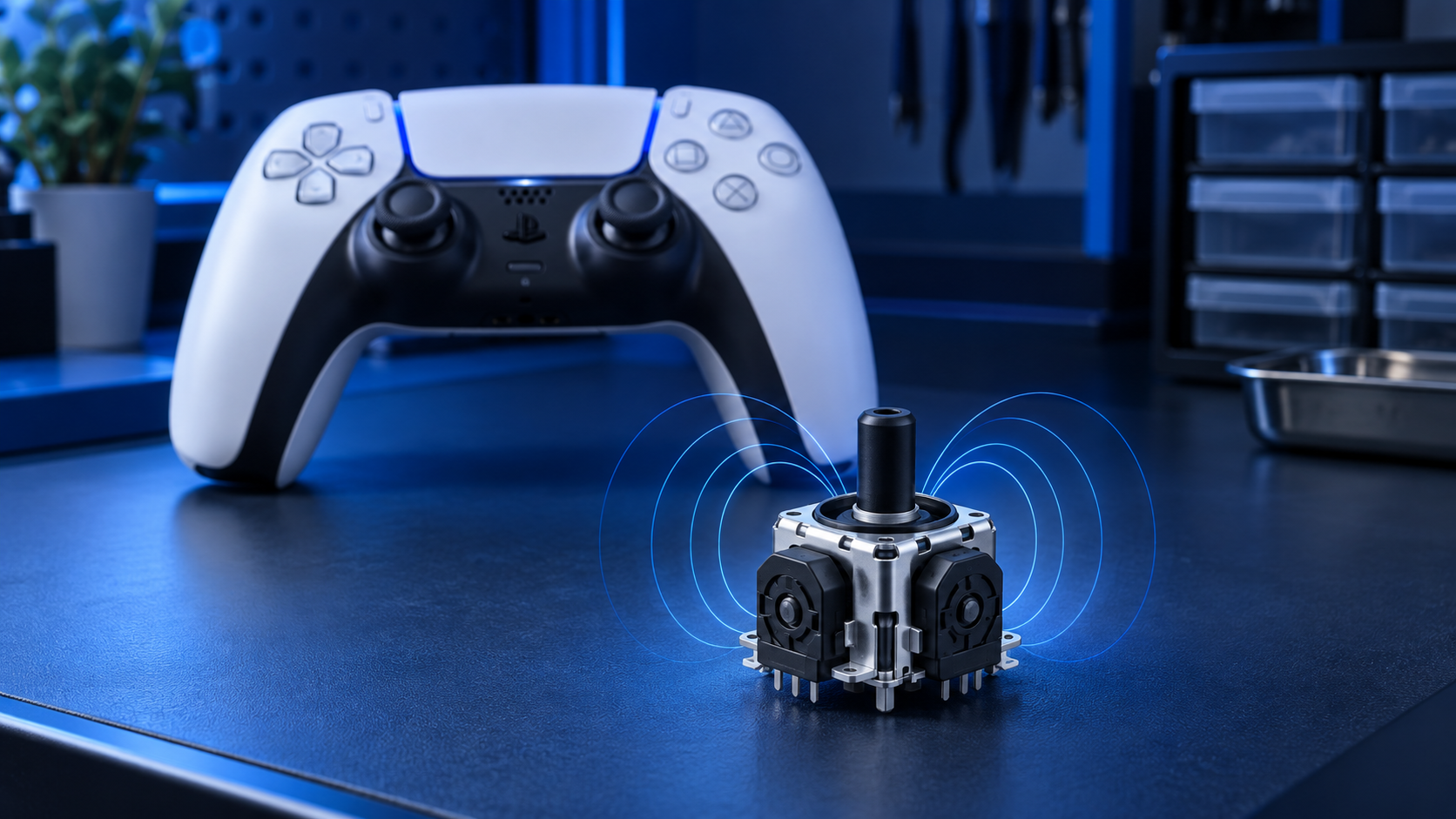
A Hall effect stick has no contact. There's a magnet on the stick shaft and a sensor on the board, and the sensor reads the magnetic field as the magnet moves near it. Nothing rubs against anything.
That's not an improved version of the same mechanism — it's a different mechanism that doesn't wear the way a potentiometer does. The sensing has no contact surface wearing away, and that wear is what causes drift in a standard stick.
This is also why Hall effect sticks are common in flight sim controls and high-end arcade sticks, where people expect hardware to last years of heavy use.
What a Hall effect upgrade does and doesn't fix
Here's where I'll be more careful than the marketing usually is.
The sensing doesn't wear out. The magnetic reading doesn't degrade with use.
The mechanical parts still wear. A stick module isn't only a sensor. There's a gimbal, a return spring, a shaft and bushings, and those are physical parts that move. They wear far more slowly than a resistive track, and when they do wear the symptom is different — a stick that feels loose or notchy rather than one that reports movement on its own. It's not drift, and in practice it takes far longer.
Nothing else changes. Sticky buttons, worn triggers, a failing battery, a damaged USB-C port, a cracked shell — Hall effect sticks have no bearing on any of them. You're replacing the sticks, not the controller.
So it deals with the wear behind drift. It doesn't stop the rest of the controller ageing: buttons, triggers and the battery still wear normally.
Can Hall effect sticks drift at all?
They can read slightly off-centre, which isn't the same thing and is worth explaining because it gets confused.
A Hall sensor reads a magnetic field, and the relationship between that field and the reported position has to be calibrated. If a module is fitted without being properly calibrated afterwards, the controller can report a small permanent offset — a stick that sits at 0.04 rather than 0.00.
That looks like drift and isn't. It's a calibration issue, it's fixed by recalibrating, and it doesn't get worse over time the way wear does. It's also why calibration is part of the job and not an optional extra — every upgrade I do is calibrated and bench-tested before it goes back.
Do they feel different?
A bit, and most people prefer it.
Hall effect modules tend to be smoother through their travel because there's no contact arm dragging across a track. Some have slightly different spring tension to the originals, so the sticks can feel marginally lighter or firmer than a standard DualSense.
It's a small difference and it stops being noticeable within an hour.
They're also more accurate, for the same reason they don't wear — a magnetic reading has no mechanical noise in it, so small movements resolve more cleanly. That matters if you play anything that rewards fine aim.
Is it worth £34?
Against a £19 standard repair, you're paying £15 more for sticks that don't wear the way the originals do.
If the controller has drifted once and you play a few hours a week, the standard repair is a fair call and it comes with the same 12-month warranty. If it's drifted twice, or it's your main pad and you play a lot, £34 is the sensible call — or £39 for TMR, which adds a finer sensor and lower battery draw.
The full comparison is in Hall effect vs standard sticks, and prices are in what drift repair costs.
What you get
Both sticks replaced with Hall effect modules — they're fitted as a matched pair, there's no single-stick version — soldered, calibrated and bench-tested. £34 all in, including return postage, with a 12-month warranty and the no-fix-no-fee promise.
Book the upgrade, or get in touch if you want to talk through whether it's the right call for your pad.