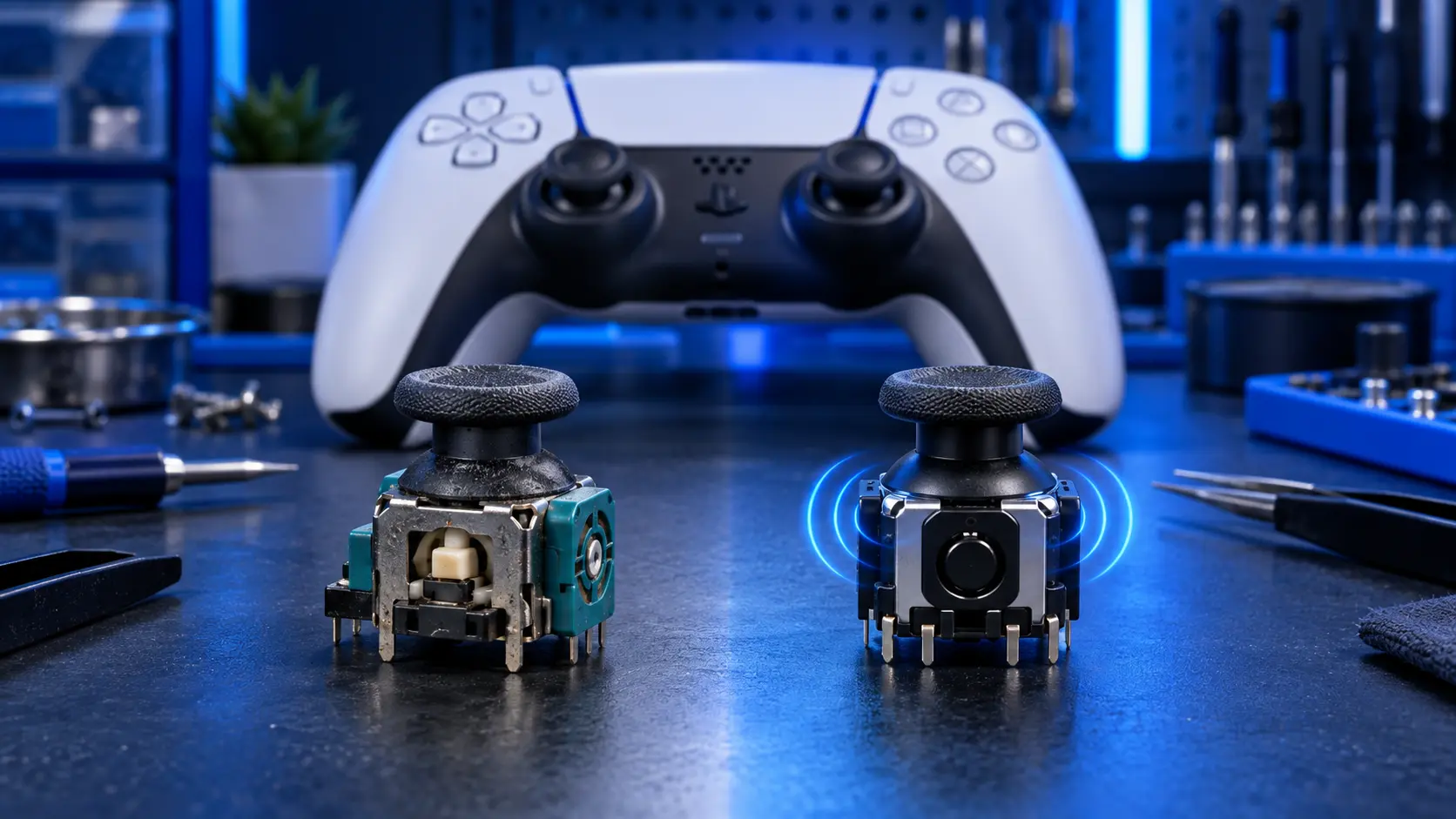
There are three ways to fix a drifting DualSense, and they're not the same repair with different price tags. One replaces a worn part with an identical part. The other two replace it with sticks that don't have the wearing part at all.
Why standard sticks drift in the first place
A normal analogue stick works mechanically. Inside each axis is a potentiometer — a small resistive track with a contact arm sweeping across it. Push the stick, the arm moves, the resistance changes, and the console reads that as movement.
The problem is that the arm is physically touching the track. Every hour of play wears it fractionally. After a few hundred hours the track has a worn patch, the readings stop returning cleanly to centre, and the game sees input you didn't give it. That's drift, and it is wear, not a glitch.
Which means a standard repair — fitting a new potentiometer module — genuinely fixes it, and also starts the same clock again. New part, same wearing mechanism, same eventual outcome.
What Hall effect does differently
A Hall effect stick has no contact at all. There's a small magnet on the stick and a sensor on the board, and the sensor reads the magnetic field as the magnet moves. Nothing touches anything.
No contact means no wear surface, which means no worn patch — so the usual cause of drift isn't there. It's not a better version of the same thing — it's a different mechanism that doesn't have the failure mode.
That's why the upgrade is a one-off cost rather than something you'd expect to pay again in two years.
So which should you get?
Get the standard repair at £19 or £24 if the controller has drifted once, you play a few hours a week, and you want the cheapest thing that works properly. It's a proper repair with a 12-month warranty and for a lot of people it's the right call.
Get the Hall effect upgrade at £34 if any of these apply:
You've had this pad repaired before and it's drifted again
You play a lot — competitive shooters, long sessions, anything stick-heavy
It's your main controller and you'd rather not deal with this twice
You want longer-lasting sticks without paying for TMR
The gap is £10 to £15 depending on whether you'd otherwise book one stick or two. For a controller you use every day, that's a small premium for sticks that don't wear the way the originals do.
The honest limitations
Hall effect fixes drift. It doesn't fix anything else. Sticky buttons, a failing battery, a damaged USB-C port, worn triggers — all still possible, all unaffected by what the sticks are made of. There's more on that in does Hall effect stop drift permanently.
The modules are also fitted as a matched pair. There's no single-stick Hall effect option — mixing one magnetic stick with one potentiometer stick gives you two sticks that feel different, which nobody wants. So £34 covers both, always.
And the third option: TMR at £39
TMR sticks work the same way as Hall effect — a magnet and a sensor, with nothing touching — so they remove the same wear. The difference is that TMR reads the stick's position at a finer resolution and draws less power, closer to the original sticks, which matters on a wireless controller.
At £39 it's £5 more than Hall effect. Worth it if you play wireless or want the finest control for slow, precise aiming; Hall effect at £34 is the cheaper way to end the same wear. There's a full comparison in TMR sticks vs Hall effect, and every stick repair page has a table comparing all three side by side.
What both repairs include
Parts, labour, tracked return postage, a 12-month warranty and the no-fix-no-fee promise. Full prices are in what drift repair costs.
Still not sure? Send it in and tell me how you use it — I'll tell you which one your pad actually needs rather than which one costs more.