You blew compressed air round the stick, maybe put some contact cleaner in, and the drift went away. Then a few days later it came back. Or it never went at all. Or — the one nobody expects — it's now noticeably worse than before you touched it.
All three outcomes tell you something specific, and none of them mean you did it wrong.
What cleaning actually does
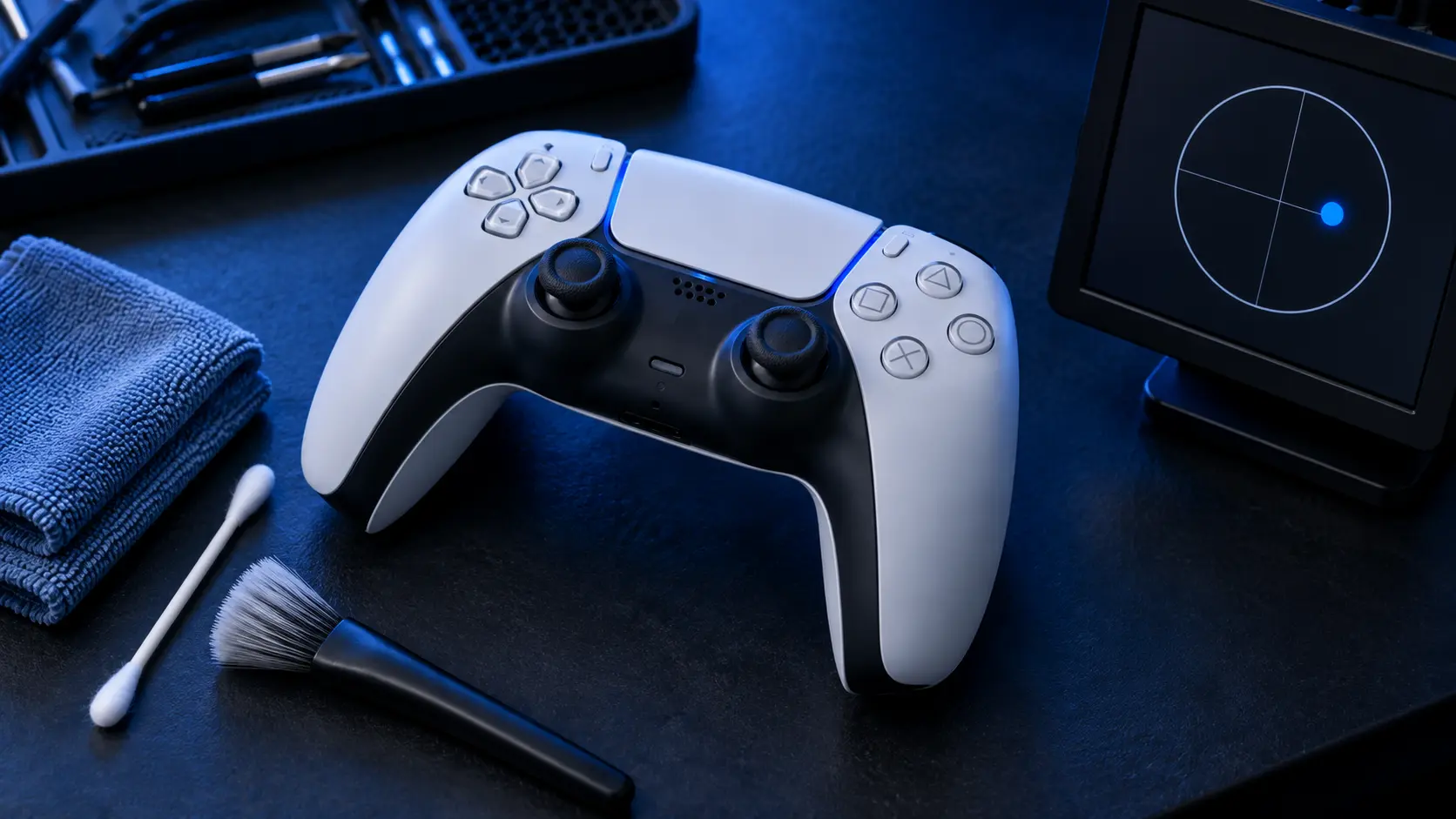
Inside each stick axis there's a resistive track and a contact arm sweeping across it. Cleaning addresses one thing: muck sitting between the two. Dust, skin oil, crumbs, the general debris that finds its way into a controller that lives on a sofa.
If contamination is what's breaking the contact, removing it restores a clean signal and the drift stops. That does happen, and when it does you've fixed it for free.
What cleaning cannot do is put material back onto a worn track. If the arm has physically ground a groove into the resistive surface over a few hundred hours of play, the track is thinner there and its resistance has changed permanently. Nothing sprayed into the gap alters that.
"It worked for a few days"
This is the most common outcome and it's the most informative one.
What's usually happened is that the cleaner has temporarily improved contact across a worn section — wetting the surface, filling the groove slightly, or just shifting the arm's resting position a fraction. The readings settle, the drift disappears, and for a few days everything is fine.
Then the solvent evaporates or redistributes, the arm returns to its worn path, and you're back where you started.
Each time you repeat it you get a shorter reprieve, because the underlying wear keeps progressing while you're masking it. If you're on your third clean and the good spell is down to a day, that's the answer: the stick is worn and cleaning is only delaying the repair.
"It's worse than before"
This catches people out and it's almost always contact cleaner.
Stick modules are assembled with a small amount of lubricant on the track — it's there to slow the wear down. Most electronic contact cleaners are solvents, and solvents dissolve lubricant. Flood a stick with cleaner and you wash out the grease that was protecting it.
The controller often feels great for a week, because the track is clean and the contact is excellent. Then the arm is running dry on an already-worn surface and it degrades faster than it ever did before.
So: better briefly, then noticeably worse. If that's the pattern you've seen, that's why.
It's also why, if you're going to try cleaner at all, you use almost none of it — a trace on a cotton bud rather than a burst from the can.
"It never went away"
The simplest one. If cleaning made no difference at any point, contamination was never the problem and the track was already worn when you started.
Nothing lost — you've ruled out the free fix in five minutes, which is worth doing.
Liquid where it shouldn't be
One thing worth checking before you go further. If cleaner ran down inside the shell rather than staying around the stick, it can reach the board.
Most electronic cleaners evaporate without leaving residue and do no harm. Some leave a film. And if you used something that wasn't designed for electronics — WD-40, brake cleaner, a household spray — that can sit on the board and cause problems that have nothing to do with the sticks: buttons behaving oddly, the touchpad misreading, intermittent faults that come and go.
If other things started misbehaving after you cleaned it, say so when you send it in. It changes what I look at first.
Where that leaves you
If cleaning bought you days rather than weeks, or nothing at all, the stick is worn and the fix is a new module.
That's £19 for one stick, £24 for both, including parts, tracked return postage and a 12-month warranty. If you'd rather not be doing this again, the Hall effect upgrade at £34, or TMR at £39, uses contactless magnetic sticks — no contact arm, no track, nothing to wear or contaminate, so there's nothing to clean in the first place.
Before you book, test it properly so you know which stick and which axis. And if you tried a stick swap yourself and it went wrong, that's fixable too.
Book the repair and tell me what you cleaned it with — it genuinely helps.