There's no official figure, and anyone quoting you one confidently is guessing.
What there is: a wear mechanism that's well understood, and a handful of things that make it happen faster or slower. That's more useful than a number anyway, because it tells you whether yours failed early and what you can do about the next one.
What actually wears out
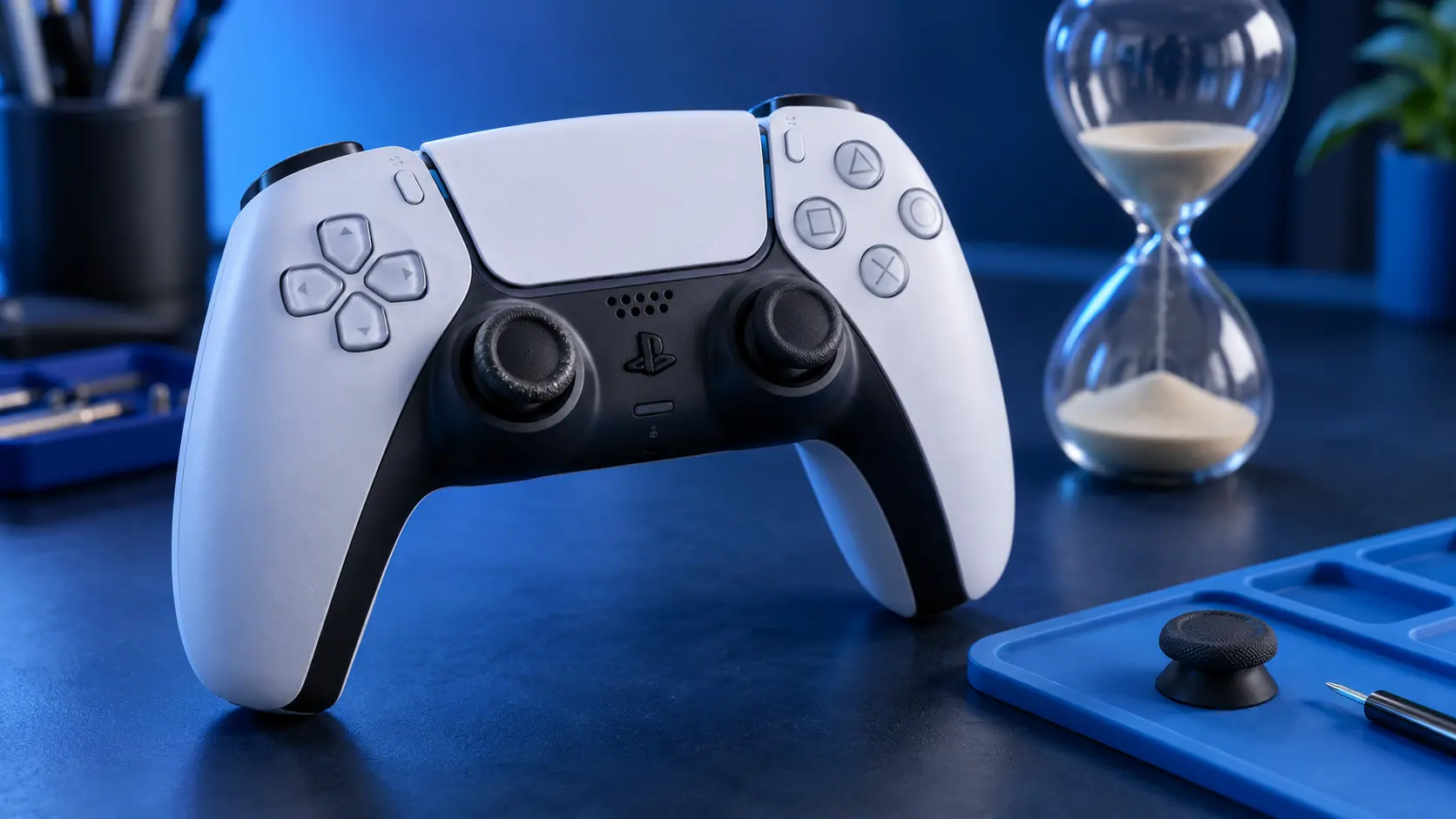
Each analogue stick has two potentiometers, one per axis. Inside each is a resistive track and a contact arm that physically sweeps across it as you move the stick.
That contact is the whole problem. Every movement removes a microscopic amount of material from the track. Do it for a few hundred hours and there's a worn patch where the arm sits most — which is around centre, because that's where the stick returns to every time you let go.
Once that patch exists, the stick can't report a clean centre any more. The console reads the noise as input. That's drift.
It's ordinary mechanical wear, which is why it's so hard to predict: it depends entirely on how much the part is used and how hard.
Why yours might have gone early
Several things speed it up, and most of them are about how you play rather than anything you've done wrong.
Hours. The obvious one. A pad used four hours a day wears roughly four times faster than one used an hour a day. Shared controllers in a family house rack up hours fast.
Game type. Shooters and anything with constant fine aim keep the sticks moving near centre almost permanently, which is exactly the area that wears. Turn-based and menu-heavy games barely touch them.
Grip pressure. Holding the sticks hard pushes the contact arm harder into the track. Players who grip tightly in tense moments — which is most competitive players — wear sticks faster.
Dust and environment. Grit in the mechanism accelerates wear, because you're effectively lapping the track with an abrasive. A controller that lives on a carpet or gets used while eating collects more of it.
Manufacturing variation. Two identical controllers off the same line can wear at noticeably different rates. Some of it is luck.
Can you make them last longer?
A bit. None of it is dramatic.
Keep them out of dust when you're not using them — a drawer or a shelf beats the floor. Don't eat over them. Ease off the grip if you notice you're white-knuckling it. Don't store them anywhere hot, because heat is unkind to the lubricant on the track.
What won't help is preventative cleaning. There's nothing to clean until there's contamination, and solvents strip the lubricant that's slowing the wear down. Leave a working controller alone.
The honest conclusion
All of that buys you time, not immunity. A potentiometer stick has a wear surface and wear surfaces wear out. If you use a controller heavily, it will drift eventually — it's a question of when, not whether.
Which is why the Hall effect upgrade is worth understanding. Hall effect sticks read position magnetically with nothing touching, so there's no wear surface at all. It's not a better version of the same part; it's a part without the failure mode.
At £34 for both sticks, or £39 for TMR, on a pad you use every day, it's money spent on the part that actually wears.
If yours is already drifting
Test it to confirm which stick, then either the standard repair at £19 or £24, or the Hall effect upgrade. What it costs has the full pricing, and repair or replace covers whether it's worth fixing at all.
If it's under a year old, check your warranty first — don't pay me for something Sony might cover.