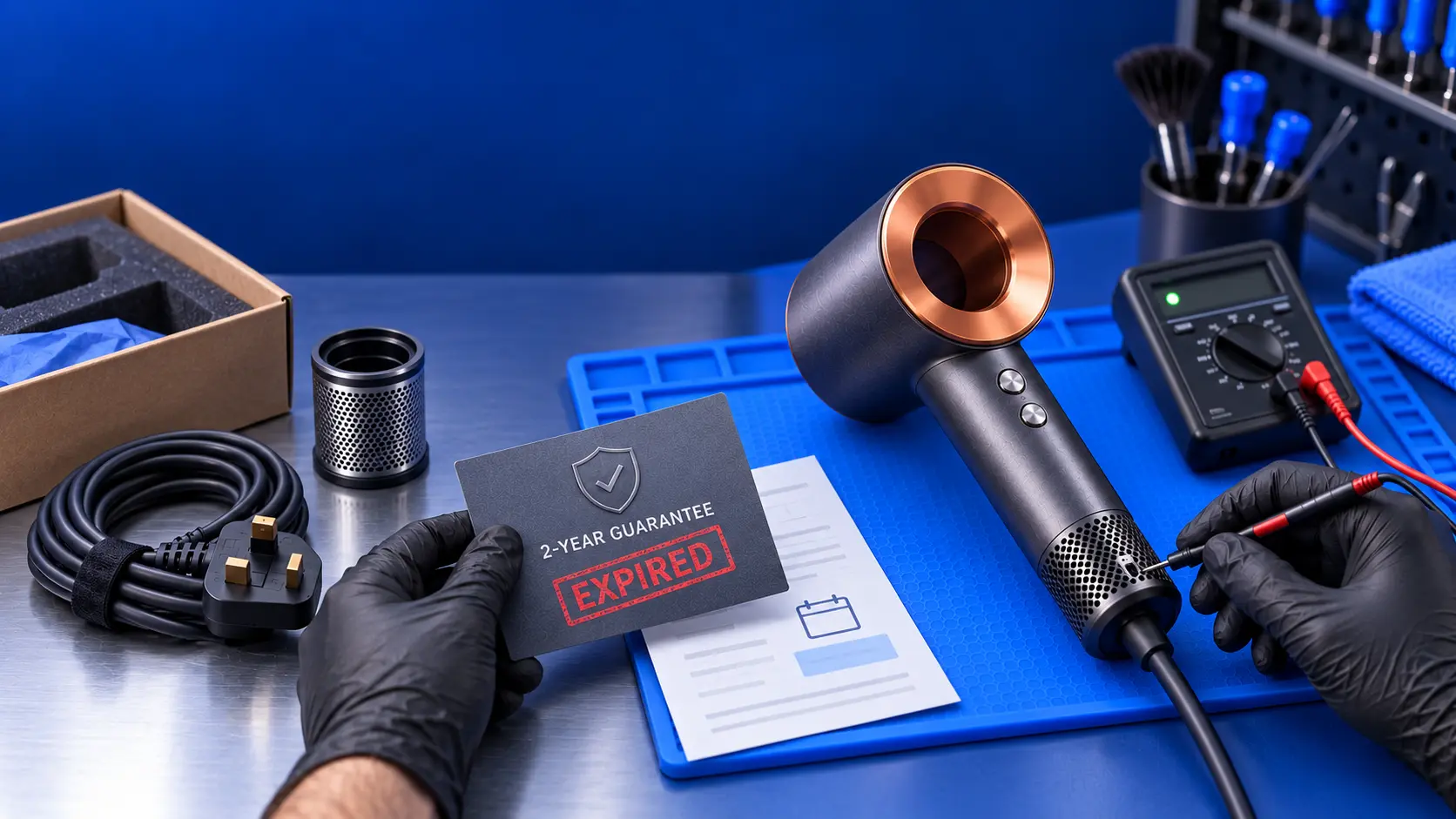
Finding out you're out of warranty tends to arrive at a bad moment — the dryer's dead, you've dug out the receipt, and the date is four years ago.
The good news is that you have more options than most people realise, one of them outlasts the guarantee entirely, and being out of warranty on a Supersonic matters much less than it would on most appliances. The less good news is that being in warranty is also less of a guarantee than people assume, and that's worth understanding either way.
What the guarantee actually is
Dyson's UK guarantee on hair care is two years, and it covers repair or replacement if the machine breaks down in normal use. Genuine parts, and if it can't be repaired it gets replaced.
It runs from the date of purchase, or the date of delivery if that's later. Not from when you registered it, not from when you first used it.
You don't need to have registered it. This is the one that causes unnecessary panic. Registration gets you a My Dyson account with your guarantee tracked and guides to hand, which is useful, but it is not a condition of the cover. If you never registered yours and you're inside two years, you're still covered — you just need to prove the purchase date yourself.
What the guarantee doesn't cover, which surprises people
Here's the part nobody mentions, and it changes the picture for the most common Supersonic fault.
The guarantee excludes, in Dyson's own terms: normal wear and tear including filters, accidental damage, blockages — explicitly described as the user's responsibility, damage caused by improper maintenance or not following the instructions, and negligent or careless use.
Read that against how these actually fail. The single most common reason a Supersonic cuts out is restriction — a filter that's never been cleaned and an airflow path loaded with product. Dyson publish filter-cleaning instructions and recommend doing it monthly. A dryer that's overheating because nobody ever did that is, on the face of those terms, a blockage caused by not following the maintenance instructions.
I'm not saying Dyson refuse those claims. I've no idea how they handle them in practice and it would be unfair to guess. What I am saying is that "it's in warranty so it'll be free" isn't a safe assumption for a restriction fault, and it's worth going in knowing that.
The other one to be aware of: the guarantee applies to normal domestic household use only. If yours has been working in a salon, you may never have had cover at all, whatever the date says.
How to check where you stand
In rough order of how easy each is:
Your order history. Bought direct from Dyson, it's in your My Dyson account. Bought from Amazon, Boots, Argos, John Lewis or similar, it's in your account with them — retailers keep order history for years and it's the fastest proof of purchase there is.
Bank or card statement. If you know roughly when, you can find the transaction, and that's a purchase date.
The retailer's records. Some will look it up from a loyalty card or the card you paid with. Boots Advantage, Nectar, John Lewis accounts.
The box. Rarely kept, but if you've got it there's often a date.
Dyson support. They can tell you what they have on file against your serial number, which is on the rating label on the machine.
If you genuinely can't establish a purchase date and you didn't buy it direct, assume you're out of cover and plan from there.
What you've still got when it's expired
Dyson's own out-of-warranty repair: £99 listed for "all machines". Their repairs page asks hair care owners to contact them for a price, so confirm it covers your Supersonic. If it does, it's a serious option, not a consolation prize, and for an expensive internal fault it's better value than an independent can usually manage.
An independent repair. Generally cheaper on the common faults. Mine are £49 for a service and clean, £79 for a cable or a dead unit, £85 for cutting out, and a £4.99 assessment if you just want to know what's wrong first — full price list here.
Your rights against the retailer, which can outlast the guarantee. See below, because this is the one people don't know about.
A refurbished machine from Dyson. Around £250 with a one-year guarantee, when in stock.
The free things. Clean the filter properly, and do the ten-second cable test — switch it on, hold the dryer still, flex the cable at the handle. Between them those two account for most cases, and both cost nothing.
Nothing at all. If the motor has failed on a 2016 HD01, doing nothing and buying a newer dryer is a legitimate answer and I'd say so.
The option that outlasts the guarantee
This is the useful bit.
Dyson's guarantee is a voluntary promise from the manufacturer. Separately from that, UK consumer law gives you rights against whoever sold you the product — and those rights are not the same length as the guarantee, don't depend on registration, and aren't affected by Dyson's terms at all.
Broadly: goods have to be of satisfactory quality and last a reasonable time, and if they don't, your claim is against the retailer rather than the manufacturer. The window for bringing that sort of claim is considerably longer than two years, and what counts as "a reasonable time" for a £300 hair dryer is not the same as for a £15 one.
That won't always get you anywhere, and the further you are from the purchase the harder it gets. But it costs nothing to raise with the retailer, and people routinely don't try because they assume the manufacturer's guarantee was the whole of their protection. It isn't.
I'm a repairer, not a lawyer, so that's the general shape rather than advice on your situation. Citizens Advice have proper guidance on it and it's free.
What being out of warranty doesn't mean
It doesn't mean the dryer is finished. On a Supersonic in particular it means much less than it would on most appliances, because the expensive part — the motor — is the part that almost never fails. A four-year-old Supersonic with a bad cable is a good motor with a worn-out flex, and that's an £79 problem rather than a £280 one.
It doesn't mean parts are unavailable. Cables, filters and the common failure parts are available for the mainstream models and have been for years.
And it doesn't mean you have to decide today. A dryer that's cutting out should come out of service, but there's no clock running on the decision.
Common questions
I never registered it. Have I lost the warranty?
No. Registration isn't a condition of the guarantee — it just makes proving the purchase date easier. Find the order history or the card transaction instead.
How long after purchase can I claim?
Two years for Dyson's guarantee. Your rights against the retailer run longer than that, though they get harder to enforce with time.
Does Dyson still repair the old HD01?
Their £99 covers "all machines" as published, but the HD01 dates from 2016 and manufacturers do eventually stop supporting things. Worth ringing to confirm rather than assuming — and if the answer is no, the common HD01 faults are all ones an independent can do. What actually goes wrong on the older ones.
Mine's been used in a salon. Where does that leave me?
Outside Dyson's consumer guarantee from day one, because it covers domestic use only. Out of warranty is out of warranty — so the options above apply regardless of the date, and independents are the practical route.
It's just out of warranty by a couple of months. Is it worth asking anyway?
Yes, ask. Manufacturers do sometimes exercise discretion just outside the window, especially for a clear component failure rather than wear and tear. Nothing lost by asking politely.
Should I buy an extended warranty on the next one?
That's a personal call on risk, and I'd only point out that the failure these actually suffer — the cable, after years of flexing — is the kind of thing that wear-and-tear exclusions are written to exclude. Read what you'd be buying before you buy it.
Find the purchase date first, because everything else follows from it. Order history is the quickest route and card statements are the backstop.
If you're inside two years, go to Dyson — but don't assume a restriction fault will be free, given what the terms say about blockages. If you're outside, you've got Dyson's £99 if it applies, an independent at less than that for common faults, and a conversation with the retailer that most people never have.
The Repair Works is an independent UK repair service, run by me, Paul — 25 years of hands-on repair experience, working by post for customers across the whole country. Not affiliated with or endorsed by Dyson.