There's no badge on the side saying which one you've got. The box went years ago, the receipt went with it, and Cloud Nine don't publish a "find your model" guide anywhere.
It matters for one practical reason: some Cloud Nine irons can be repaired independently and some can't. Knowing which one you're holding tells you whether you're looking at a repair, a warranty claim or a replacement — before you spend anything on postage finding out.
The good news is that you can identify yours from things you can see and do, without hunting for a code.
Start with what's in front of you
Work through these in order. The first one that matches is your answer.
Is it cordless? If there's no cable at all, you have the Cordless Iron. It's the easiest one to identify and the one I can't help with — the battery is bonded in, and replacing it isn't work I'd put a twelve-month warranty behind.
Is it noticeably small? If the plates are markedly shorter than a normal iron — the sort of thing sold for travel or for fringes and short layers — you have the Micro Iron. Also one I decline, on parts availability.
Are the plates curved? Look along the plate edge rather than at the face. If the plates have a rounded profile designed for waves and curls rather than a flat straightening surface, that's a Contouring Iron. I repair these.
Does it switch on by touch, with two fixed temperatures? If there's no conventional power button and no adjustable temperature — you hold or tap a panel to wake it, and it offers two settings rather than a range — that's the Touch Iron. Another one I decline.
If none of the above, you have one of the mainstream irons: the Original, the Wide, the Slim or the Pro. These are the bulk of what's out there, and they're all repairable.
Telling the mainstream irons apart
Three things separate them, and none require you to find a code.
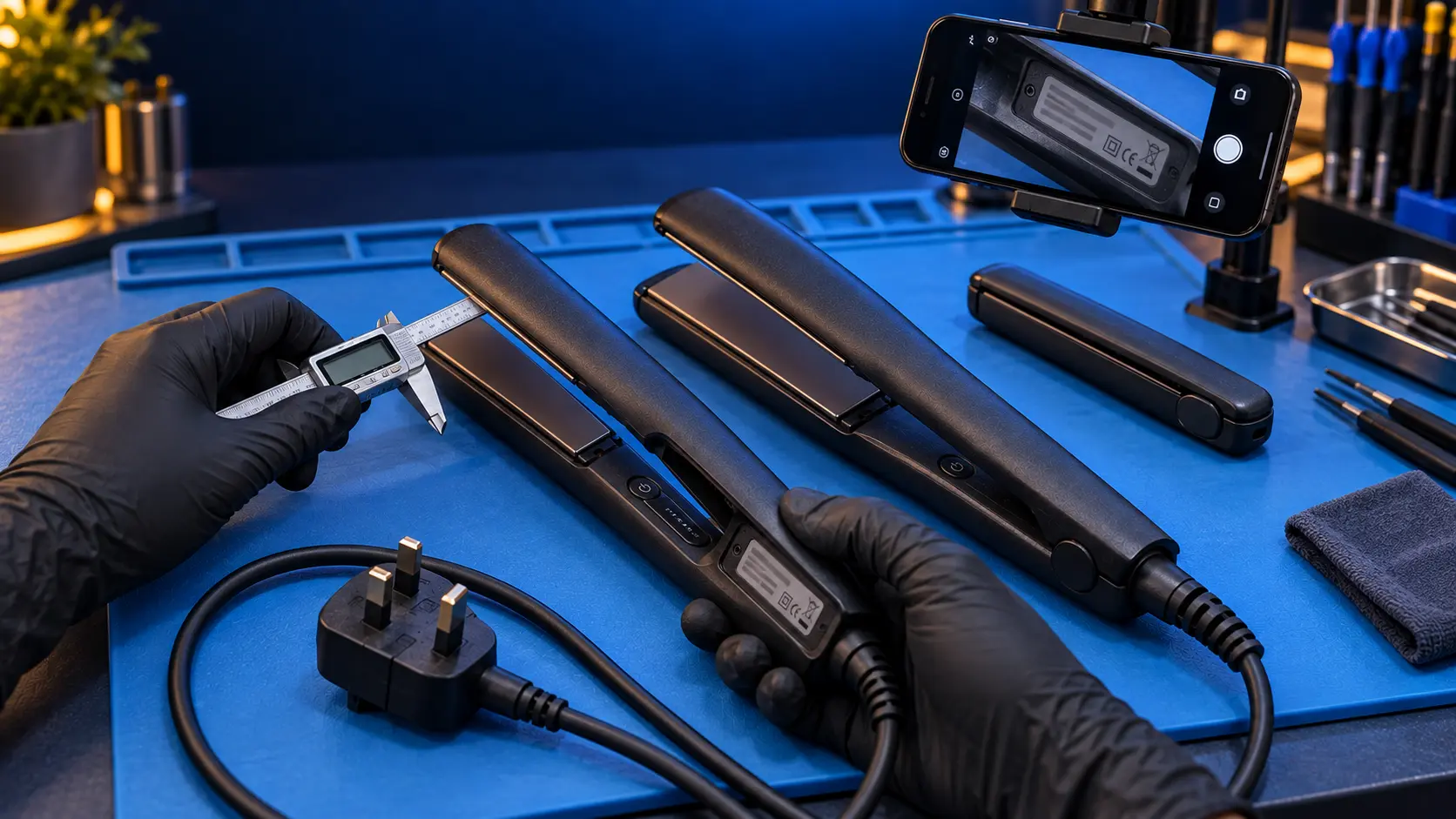
Plate width. The Wide has a visibly broader plate than the Original — designed for long or thick hair, and obvious once you've seen the two side by side. The Slim is narrower again. If you've only ever owned the one iron, the honest answer is that width alone can be hard to judge without a comparison.
The control interface. A multi-step digital temperature display is the more recent generation. Older irons have simpler controls.
A Revive Mode badge. If the iron mentions Revive Mode but doesn't have the multi-step digital display, that points to a Pro, which adds a vibration mechanism the standard irons don't have.
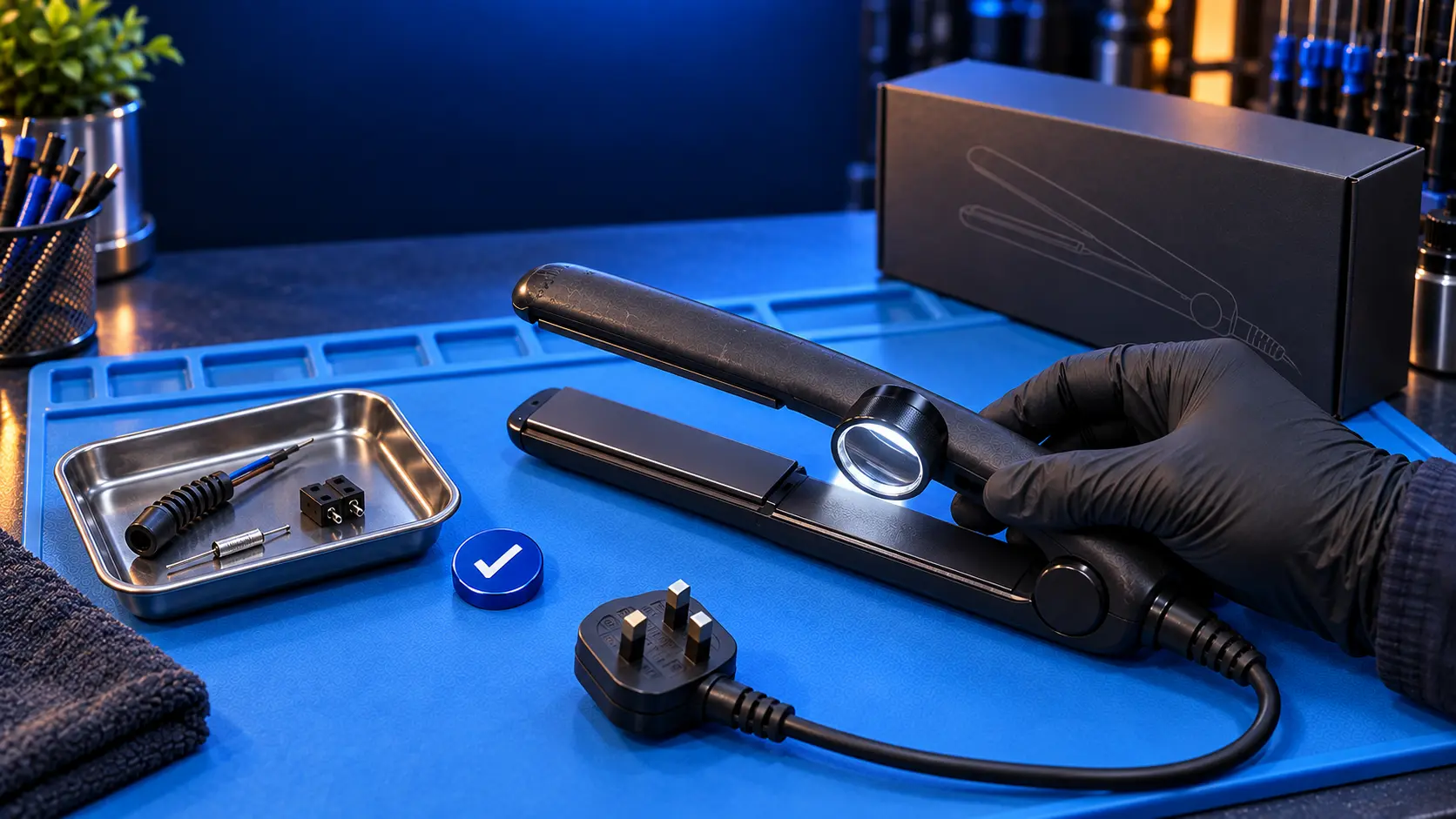
And here's the reassuring part: for repair purposes, the difference between an Original, a Wide, a Slim and a Pro barely matters. They share their architecture and they share their faults. If you can tell me "it's one of the standard corded ones", that's usually enough to get started, and I'll confirm exactly what it is when it's on my bench.
About the code on the label
Cloud Nine irons carry a rating label with a model code on it, beginning C9-. The repair trade works in those codes rather than the marketing names, and parts are listed against them.
I'm going to be straight with you about the limits of what's publicly known here. There is no official published list mapping the marketing names to the C9 codes, and the label position varies between generations. Plenty of sites will hand you a confident-looking table. Most of it is inference, and I'd rather not add to that until I've verified it against enough physical labels to stand behind it.
So: if you can find a code on your iron, take a photo of it and send it to me. That's more reliable than any table, and it's what I'd work from anyway. If you can't find one, the visual checks above will get you close enough.
Which ones I repair
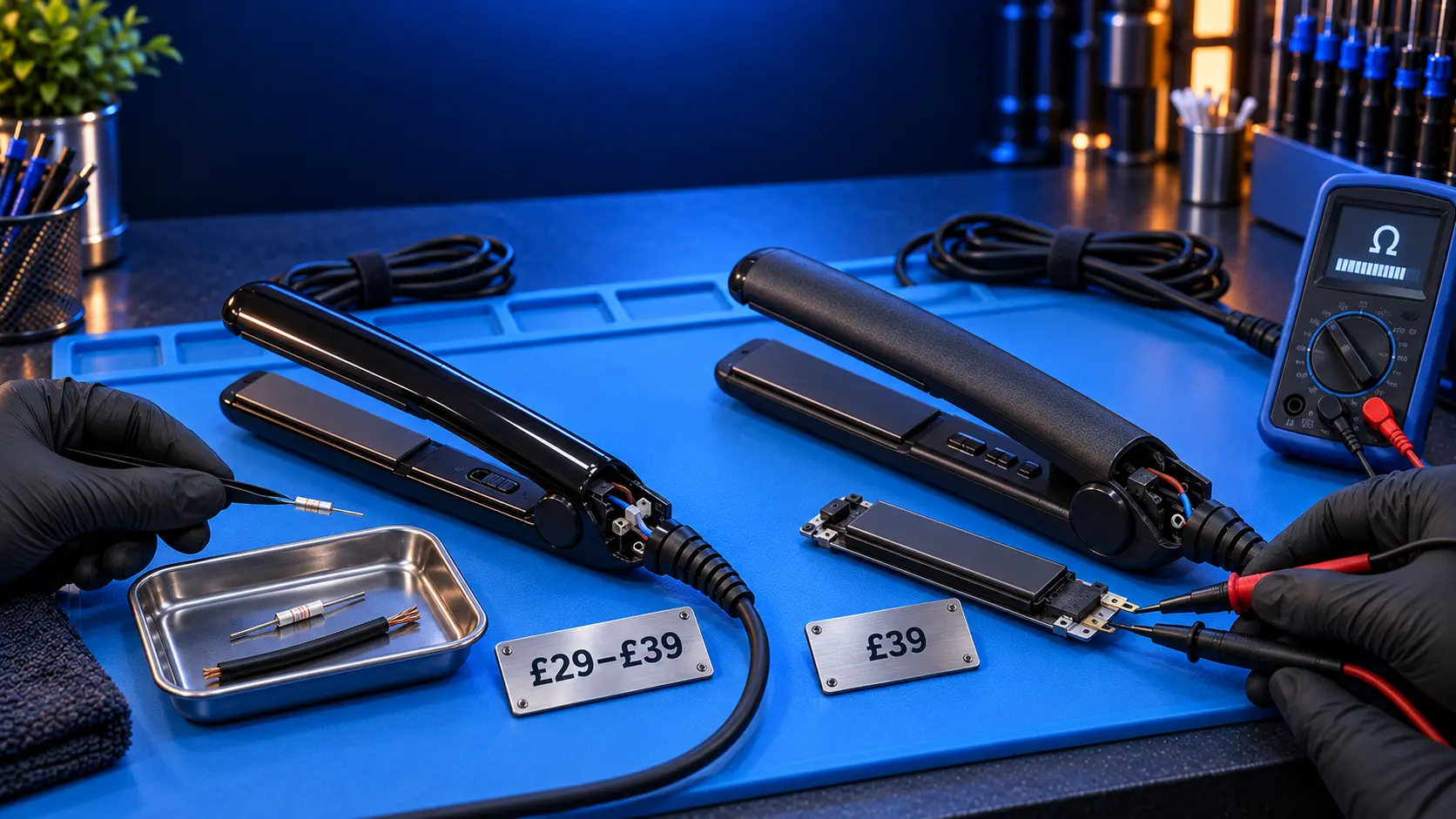
I repair: the Original, Wide, Slim, Pro and Contouring irons — flat £39 all in, whatever the fault.
I don't repair: the Touch Iron, the Micro Iron or the Cordless Iron.
That second list isn't me being fussy. On each of those the parts position means I can't do a job I'd put a twelve-month warranty behind, and a repair I can't warrant isn't a repair I want to sell you. The Touch in particular is the one people are most disappointed about, because Cloud Nine's own £99 service is then the only route — and I'd rather tell you that here than have you pay to post it, only for me to tell you the same thing.
The full list of models I cover is on the repair page, and there's a model selector there that walks you through it and tells you the answer before you book.
If you genuinely can't tell
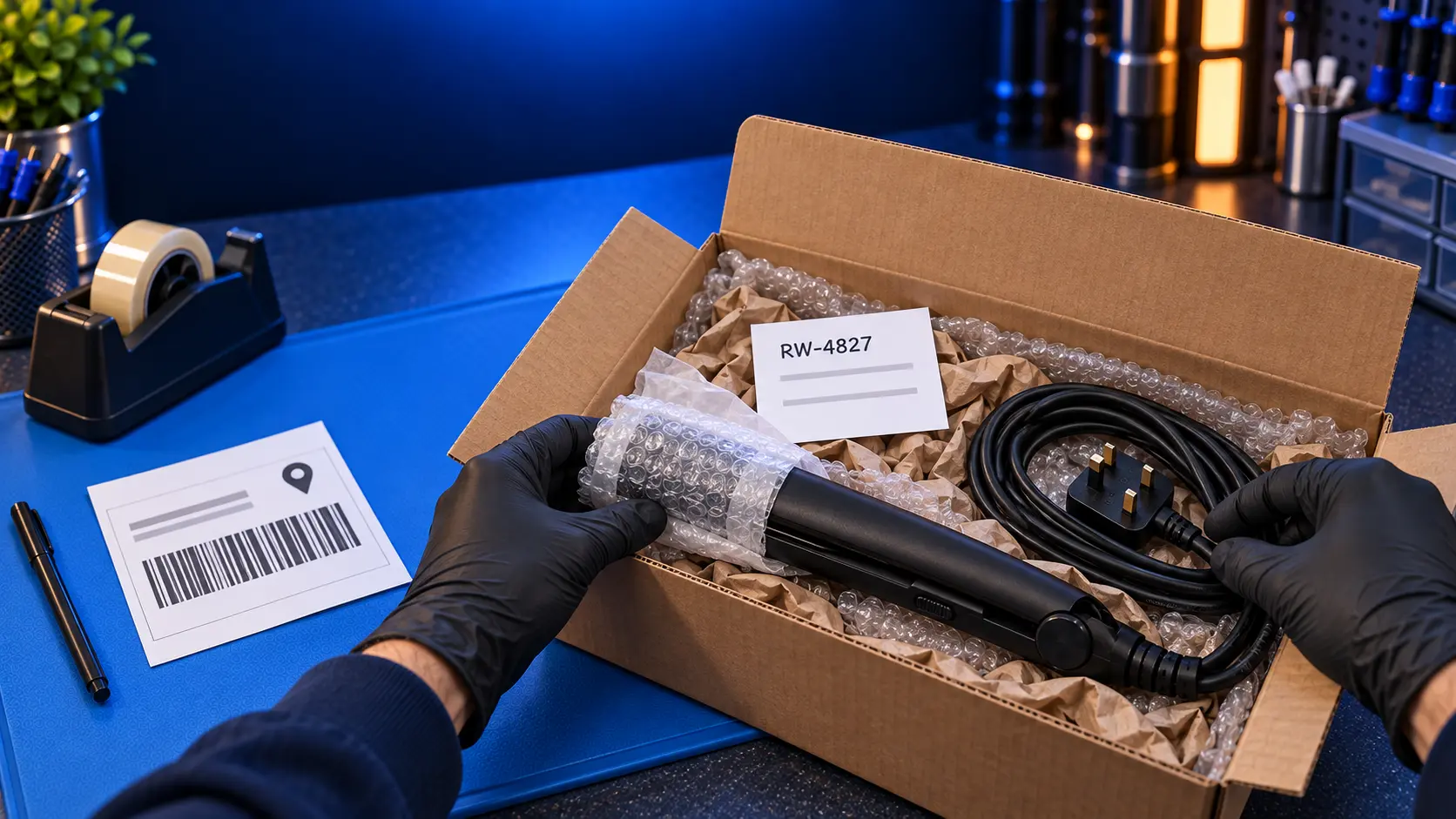
Send me a photo. Message or email one of the whole iron, plus the label if you can find one, and I'll tell you what you've got and whether I can help. It takes me a minute, it costs you nothing, and it's considerably better than posting an iron on a guess.
I'd far rather spend a minute looking at a photo than have you pay postage on something I'm going to have to send straight back.
Common questions
Is the model name written on the iron anywhere?
Not as a name. There's a rating label with a code on it, but nothing that says "Original" or "Wide" in plain English.
Does the model change what a repair costs?
No. Every iron I accept is the same flat £39, whatever the fault and whichever model it is.
My label has worn away completely. Can you still help?
Almost certainly. Between the shape, the plates, the controls and the presence or absence of a cable, the visual checks above place nearly every iron. Send a photo and I'll confirm.
I think mine's a Touch. Is there anything at all that can be done?
Not by me, and I'd rather say so plainly. Cloud Nine's own repair service is your route.
Are old Cloud Nine straightners still worth repairing?
Generally yes — they're well built and they last, which is exactly why fixing one at £39 makes more sense than replacing it at well over a hundred.
How long does a repair take?
The current turnaround is shown when you book. If a part needs ordering, I'll tell you as soon as I've diagnosed it and give you a realistic date.
Start with the three questions that need no code at all: does it have a cable, are the plates curved, and does it switch on with a button or a touch panel. Those three place most irons in under a minute, and between them they identify every model I can't help with — which is the part worth knowing before you spend anything on postage.
If it turns out to be one of the mainstream corded irons, have a look at what I charge: £39 all in, whatever the fault, including parts, return postage, a PAT safety test and a twelve-month warranty, with a full refund less £4.99 return postage if I can't fix it. Every repair is done by me personally, on my own bench, start to finish. And if you're at all unsure which one you've got, send a photo before you send the iron — that's free, and it can save you a wasted parcel.
The Repair Works is an independent UK repair service, run by me, Paul — 25 years of hands-on repair experience, working by post for customers across the whole country. Not affiliated with or endorsed by Cloud Nine.