Posting something you paid two hundred pounds for to someone you've never met is the point where people hesitate, and fair enough.
This takes ten minutes and a cardboard box. Here's exactly what I'd do.
Book first, then pack
Do it in that order. Booking gives you a reference number, and that reference is how I match a parcel to a person when it lands on the bench. A parcel can arrive with no note in it, and then I'm working out whose iron I'm holding.
You'll get a confirmation email with your reference and the address to send it to. The address is in that email rather than on this page — check your spam folder if it hasn't arrived within a few minutes.
If you're not sure whether I can repair your model, check that before you book rather than after you've paid postage.
What to send
Just the iron and its cable. That's it. The cable is attached anyway, and it's the part most likely to need work.
Don't send the heat mat, the pouch, the original box, the styling guide or any accessories. They add weight and cost, they don't help me diagnose anything, and every extra item is one more thing that can go astray between two houses. Keep them at home.
Let it cool, then give it a wipe
Make sure it's been unplugged and cold for a good while before it goes anywhere near a box.
A quick wipe of the plates and body is welcome but not required — it won't change what I charge or how I treat it. Build-up from styling products is normal on a well-used iron, so there's nothing to worry about.
Wrapping it
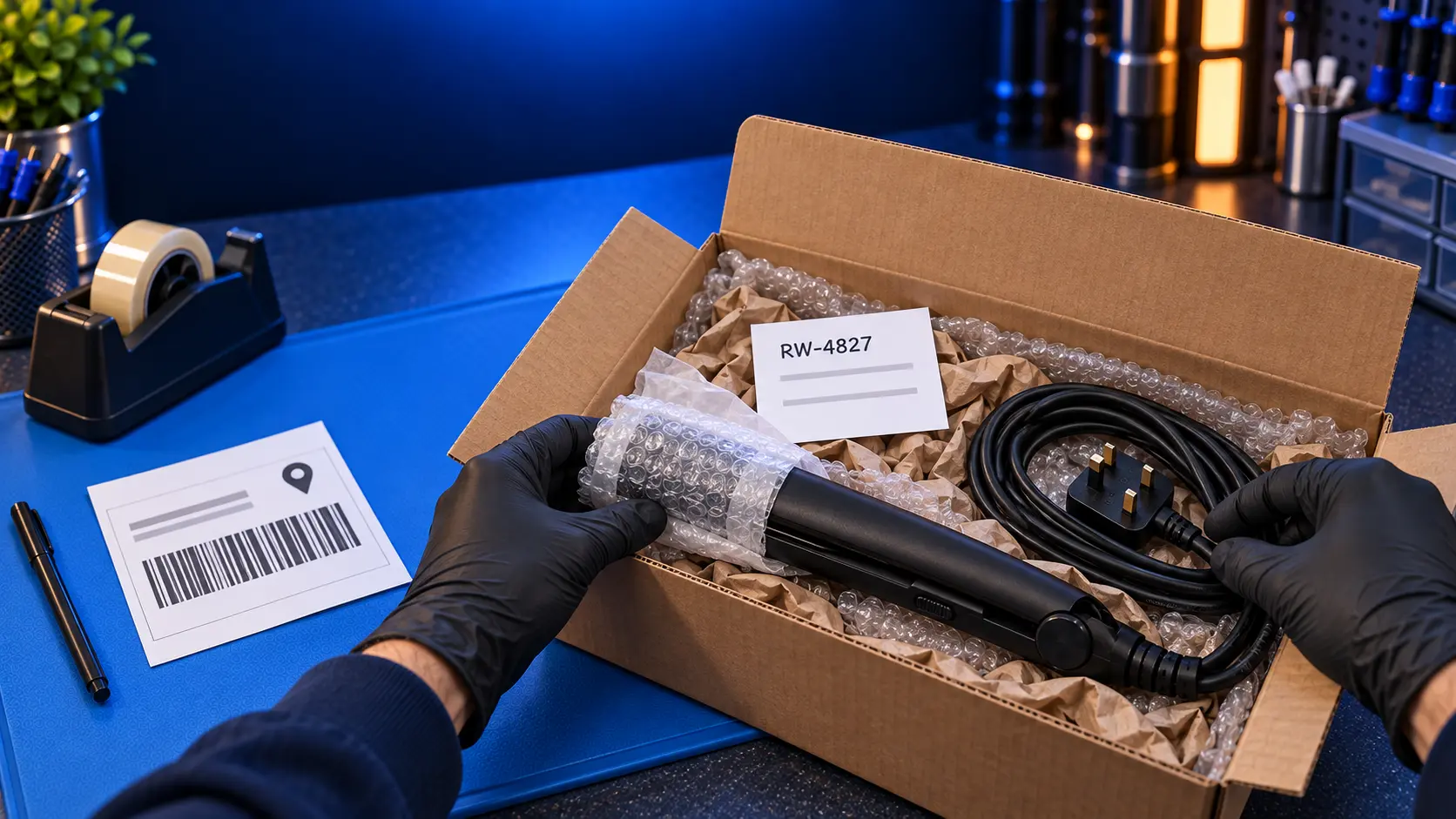
Pad the plates. Bubble wrap, a few layers of kitchen roll, a folded tea towel — anything that stops the plates knocking against the inside of the box. The iron itself is robust; it's the plate surfaces that mark.
Coil the cable loosely and tuck it alongside. Don't wind it tightly around the iron. That habit is a genuine cause of cable failure — it's how a lot of cable faults start in the first place — and it's a shame to do more damage on the way to having one fixed.
Use a box if you've got one. A small, sturdy cardboard box with padding around the iron is ideal. A well-padded jiffy bag will do at a push, but straighteners are heavy for their size and have hard edges that burst thin envelopes. If the iron can move around when you shake the parcel, add more padding.
Put a note inside with your reference
The single most useful thing you can do.
Write on a piece of paper:
Your reference number (RW-something)
Your name
What the iron does, in your own words
That last one matters more than people expect. "Beeps and won't heat" and "cuts out when I move the cable" point at different faults, and your description of what you've noticed is often better evidence than anything I can reproduce on the bench — particularly with intermittent faults, which have a habit of behaving perfectly when I'm watching.
Which postage service
Send it tracked. That's the one firm recommendation.
Worth knowing before you choose: Royal Mail's standard tracked services compensate up to £75 if a parcel goes missing, and a Cloud Nine iron costs considerably more than that to replace. If you'd rather be covered for the full value, Special Delivery carries higher compensation for a few pounds more. Most people send tracked and it's fine — but you should make that choice knowingly rather than find out afterwards.
I don't provide prepaid labels. Postage to me is yours; return postage is included in the £39.
Expect to pay somewhere around four or five pounds for a tracked service on a parcel this size.
What happens when it arrives
I email you the day it lands so you know it's here and booked in.
The current turnaround is shown when you book. If a part needs ordering, I'll tell you as soon as I've diagnosed it and give you a realistic date.
It comes back PAT safety tested, with a twelve-month warranty on the work, and you'll get the tracking number by email when it's on its way.
Common questions
Can I send more than one iron in the same parcel?
Yes, and you should — it saves you a postage. Book each one separately so each has its own reference, and put a note with both references inside.
I've lost my reference number. What now?
Put your name, email address and phone number on the note instead and I'll find you. It's a minor nuisance rather than a disaster.
Do you need the plug?
Yes — send the whole cable with the plug attached. Don't cut anything off.
Should I take the plates off first?
No. Send it as it is.
What if it gets damaged in the post?
Pack it properly and use a tracked service, and this very rarely happens. If a parcel does go missing or get damaged, the claim is with the carrier, which is why the compensation limit above is worth a moment's thought before you choose a service.
Can I drop it off instead of posting it?
I work by post, UK-wide, rather than running a shop counter. Posting it in is the way it works.
How do I know you'll send it back?
Fair question to ask of anyone. You'll get an email when it arrives, the repair carries a twelve-month warranty, and it comes back by tracked post with the number emailed to you. If I can't fix it, there's no repair fee — I refund what you paid, less £4.99 return postage.
The two things that make this go smoothly cost nothing: book first so you have a reference, and put a note inside the parcel with that reference and a line about what the iron does. Everything else is a box and some bubble wrap.
When you're ready, book the repair and I'll send you the address. £39 all in, whatever the fault — parts, labour, return postage, a PAT safety test and a twelve-month warranty — with a full refund less £4.99 return postage if I can't fix it. Every repair is done by me personally, on my own bench, start to finish. Pad the plates, coil the cable loosely, and send it tracked. That's the whole job.
The Repair Works is an independent UK repair service, run by me, Paul — 25 years of hands-on repair experience, working by post for customers across the whole country. Not affiliated with or endorsed by Cloud Nine.