I repair both brands on the same bench, with parts from the same suppliers, so this is a comparison I can make from measurements rather than from a press release.
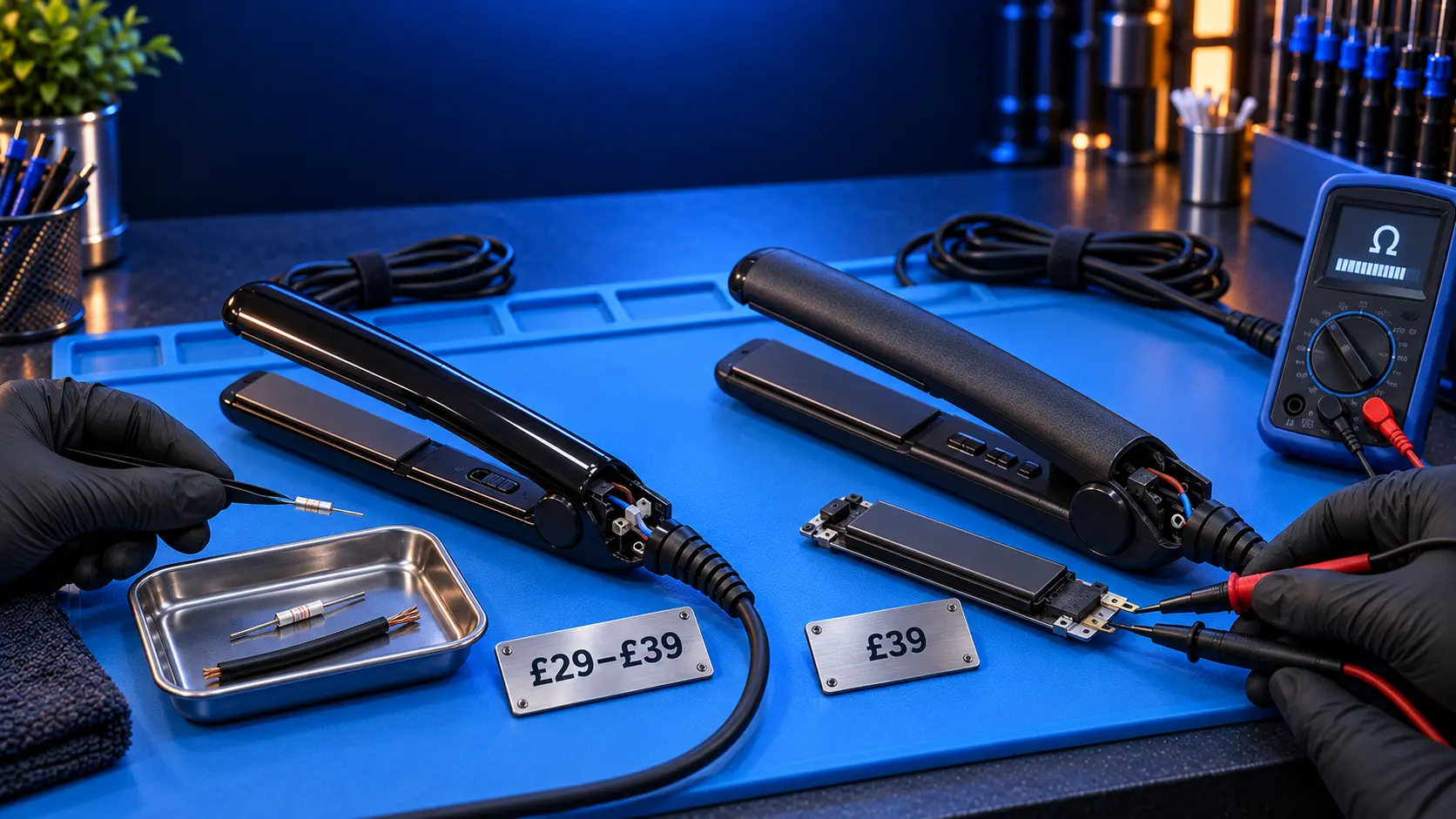
The headline is that they're close. GHD straighteners are £29 or £39 depending on model. Cloud Nine straighteners are £39 flat. On a repair that's a tenner in it, on irons that cost £150 to £250 to replace.
But the price isn't the interesting difference. The interesting difference is what happens when you go to the manufacturer.
GHD don't repair anything
This is the part most people don't know, and it's stated plainly in GHD's own returns policy: "As ghd do not operate a repair service, should a manufacturing fault be detected you would receive a replacement product."
Under warranty, that's arguably a better deal than a repair — a fault gets you a new iron rather than a mended one.
Out of warranty, it means something quite different. There is no manufacturer route at all. No £99 service, no send-it-back option, nothing. An out-of-warranty GHD owner has exactly two choices: an independent repairer, or a new iron.
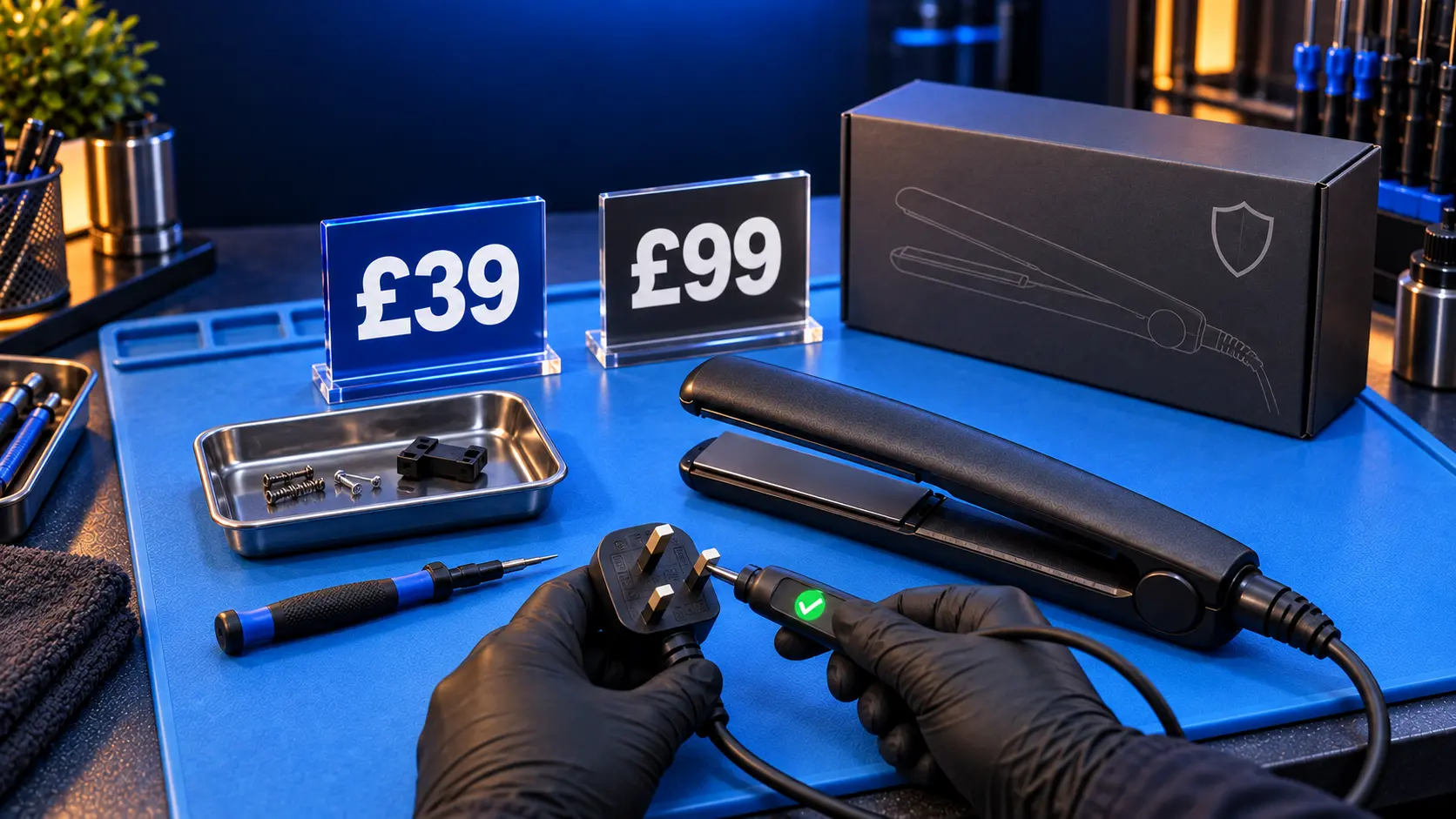
Cloud Nine, by contrast, do run a repair service, at £99, covering the Original, the Wide and the Touch Iron. So a Cloud Nine owner with one of those three models has a manufacturer option that a GHD owner simply doesn't.
Why the repair prices differ
The £10 gap between the brands is real and it comes from the work, not from what the market will bear.
GHD's classic fault is cheap to fix. The thermal fuse is the failure that dominates, and the part itself costs pennies. It's a well-understood repair with a well-understood part.
Cloud Nine parts cost materially more. Heaters, cables and connectors for these irons are simply dearer than the GHD equivalents. That's most of the difference on its own.
And Cloud Nine repairs carry an extra step. Their heaters come in several different resistance values, and nothing on the outside of the iron tells you which one it takes. Fit the wrong one and the iron heats, then fails again a few months later. So every Cloud Nine heater job includes measuring a known-good heater and matching it — a step that has no GHD equivalent, and one that's the difference between a repair that holds and a repair that comes back.
That's the honest accounting: dearer parts, plus a measurement step, equals ten pounds.
Where each brand is harder to fix
Both have a category of repair nobody can do, and they're different categories.
GHD's limitation is sealed models. Some GHD irons are built as sealed units that can't be opened at all. On those, the mains cable is effectively the only serviceable part — if the fault is anywhere else, that's the end of it, for any repairer.
Cloud Nine's limitation is structure. Heaters, fuses, cables, connectors and switches are all available. Arms and hinges are not, to anybody, at any price. So a Cloud Nine with a snapped arm is unrepairable in the UK, however healthy its electronics are.
Neither of those is a mark against the brand — they're facts about how the irons are built, worth knowing before you spend money on either.
Which is cheaper to own?
If you want a straight answer: close enough that it shouldn't decide which iron you buy.
Over an iron's life you might pay for one repair. Ten pounds' difference on one repair, against a purchase price in the hundreds, isn't a meaningful ownership cost. Both brands are well built, both last, and both fail in ways that are usually fixable.
What would change the maths is buying a model that can't be opened, or one with no manufacturer repair route and no independent one either. That's worth checking before you buy, and it's a question almost nobody asks in a shop.
What I'd actually check before buying either
Looking at how they fail rather than how they're marketed, three questions worth asking about any straightener:
Can it be opened? Sealed-for-life construction is fine right up until something fails.
Are parts available to independents? Heaters, cables and fuses being on general sale is what makes a brand repairable at sensible money.
Does the manufacturer repair, or only replace? Replace is better inside warranty. Repair is better outside it. Most people own their irons far longer than the warranty lasts.
Both Cloud Nine and GHD score well on the first two for most of their range. They differ on the third, in opposite directions depending on whether you're in cover.
What I charge
GHD — £29 for the standard models, £39 for Gold, Max, Platinum+, Mini and Curve. Full details on the GHD page.
Cloud Nine — £39 flat across the Original, Wide, Slim, Pro and Contouring. I don't take on the Touch, Micro or Cordless.
Both prices include parts, labour, return postage, a PAT safety test and a twelve-month warranty on the work, with a full refund less £4.99 return postage if I can't fix it.
For context, Cloud Nine give six months on their own repairs and other independents typically give three. GHD give nothing on repairs, because they don't do them.
Common questions
Are GHD and Cloud Nine parts interchangeable?
Largely not, though the two brands are served by the same specialist spares suppliers, and there's at least one part reported to cross over. Don't plan around it.
Is one brand more reliable than the other?
They tend to fail in broadly similar ways — cables, heaters and thermal protection. The differences are in how the failures present.
Which fails at the cable more?
Both do, but differently. On GHD the failure is more often the cable itself; on Cloud Nine it's more often the connector inside the handle, which means a perfect-looking cable can still be the fault.
My GHDs are out of warranty. Will GHD fix them?
No. They don't repair at all, in or out of warranty — under warranty you get a replacement, outside it you're on your own. That's the single biggest practical difference between the two brands.
I've got one of each and both have stopped. Cheaper to send them together?
Yes — send them in the same parcel and you save a postage. Each repair is priced separately, but there's no reason to post two boxes.
Is it worth repairing either, or should I just replace?
At £29 to £39 against £150 to £250 for a new iron, repairing is straightforwardly the better decision on any iron with a sound body.
How long does a repair take?
The current turnaround is shown when you book. If a part needs ordering, I'll tell you as soon as I've diagnosed it and give you a realistic date.
Whichever brand you own, check the warranty before you pay anybody. GHD will replace a faulty iron under warranty rather than repair it, and Cloud Nine's cover runs to three years if the iron was registered within 14 days of purchase. Both are free routes that beat any price on this page, and both take one phone call to establish.
Out of warranty, send it to me and I'll fix it — £29 or £39 depending on the brand and model, twelve months on the work, and a full refund less £4.99 return postage if I can't. Every repair is done by me personally, on my own bench, start to finish. And if you own a GHD that's out of cover, it's worth knowing there's no manufacturer option at all: an independent is the only thing standing between a fixable iron and a new one.
The Repair Works is an independent UK repair service, run by me, Paul — 25 years of hands-on repair experience, working by post for customers across the whole country. Not affiliated with or endorsed by Cloud Nine or ghd.