It works, then it doesn't, then it does again. Sometimes it comes back on its own. Sometimes you put it down, pick it up and it's fine. It hasn't died, so it's easy to put off doing anything about it.
Intermittent faults are the ones people live with longest, and they're the ones I'd most like to see early — for a reason I'll come to.
The good news is that this fault sorts itself into two clear groups, and the thing that tells them apart is when it happens.
The two-second diagnosis
If it cuts out when you move it — when you change the angle, reposition the cable, or lift it off the side — that's the cable circuit.
If it cuts out after a few minutes of use, fairly consistently, regardless of how you're holding it — that's thermal protection doing its job.
Those are different faults with different causes. Almost everyone already knows which one theirs is; they've just never had a reason to separate the two.
Group one: it cuts out when you move it
This is the cable circuit, and it's the more common of the two.
Somewhere in the path from the plug to the board, a connection has become intermittent. When the iron sits at one angle the circuit is made and everything works. Move it, and the connection opens.
The instinct is to blame the visible cable, and sometimes that's right — a split, a hard kink, a section that feels soft or lumpy where it enters the handle. But on Cloud Nine irons the more common failure is further in, at the connector inside the handle, which you can't see at all. A cable in perfect condition doesn't clear the cable circuit.
This fault only goes one way. Intermittent becomes position-dependent, position-dependent becomes "only works if I hold it just so", and then one day it doesn't work at all. If you've read that an iron that won't turn on is usually the connector, this is that same fault a few weeks earlier.
And there's a reason not to wait it out. An intermittent connection in a mains circuit isn't just inconvenient. A joint that's making and breaking under load generates heat at that point, and in the worst case it arcs. I'm not trying to frighten you — most of these are simply annoying — but "it only works if I wiggle it" is a fault worth dealing with rather than working around. If the plug or the base of the handle ever feels warm, stop using it and deal with it now.
One thing I'd rather you didn't do: deliberately flex the cable while it's plugged in to reproduce the fault. You'll see that suggested plenty of places. If there's a genuine break in the conductor, bending it about under mains voltage is the moment it's actually dangerous. If you've noticed the pattern in normal use, you already have your answer.
Group two: it cuts out after a few minutes
This one behaves differently. It works properly from cold, gets up to temperature, does its job — and then, some minutes in, stops. Often it'll come back after it's cooled down, and then do exactly the same thing again.
That's protection tripping. The iron is designed to shut its heating down if the circuit runs hotter than it should, and something is pushing it over that threshold: a sensor reading incorrectly, a heater circuit that's degrading, or protection that's become marginal with age and now trips at a lower point than it used to.
The key detail is the consistency. Cable faults are erratic and tied to movement. Thermal faults are tied to time and temperature: roughly the same number of minutes, every time, whatever you do with it.
It's a genuine fault rather than something you can adjust around, and it doesn't fix itself. It usually gets worse — the cut-outs come sooner each time.
Two things that aren't faults
Worth ruling out before you send anything.
The auto-off. Cloud Nine irons switch themselves off after a spell of inactivity, by design. If it goes off while you're doing something else and you have to switch it back on, that's the iron behaving correctly, not cutting out.
A dodgy socket or extension lead. Try it on a different socket, once. If it misbehaves on one socket and not another, the problem isn't the iron.
And if it beeps when it cuts out
Different fault again. A beep means the board has spotted a problem in the heating circuit and shut down deliberately — there are four causes and they're all repairable. If yours cuts out silently, you're in the right place here.
Which models I can repair
The Original, Wide, Slim, Pro and Contouring irons. Intermittent faults on any of those are standard work — and often among the more satisfying repairs, because a customer who's been putting up with it for months gets an iron back that simply works.
I don't take on the Touch, Micro or Cordless. The parts position won't let me stand behind a twelve-month warranty on those.
What it costs
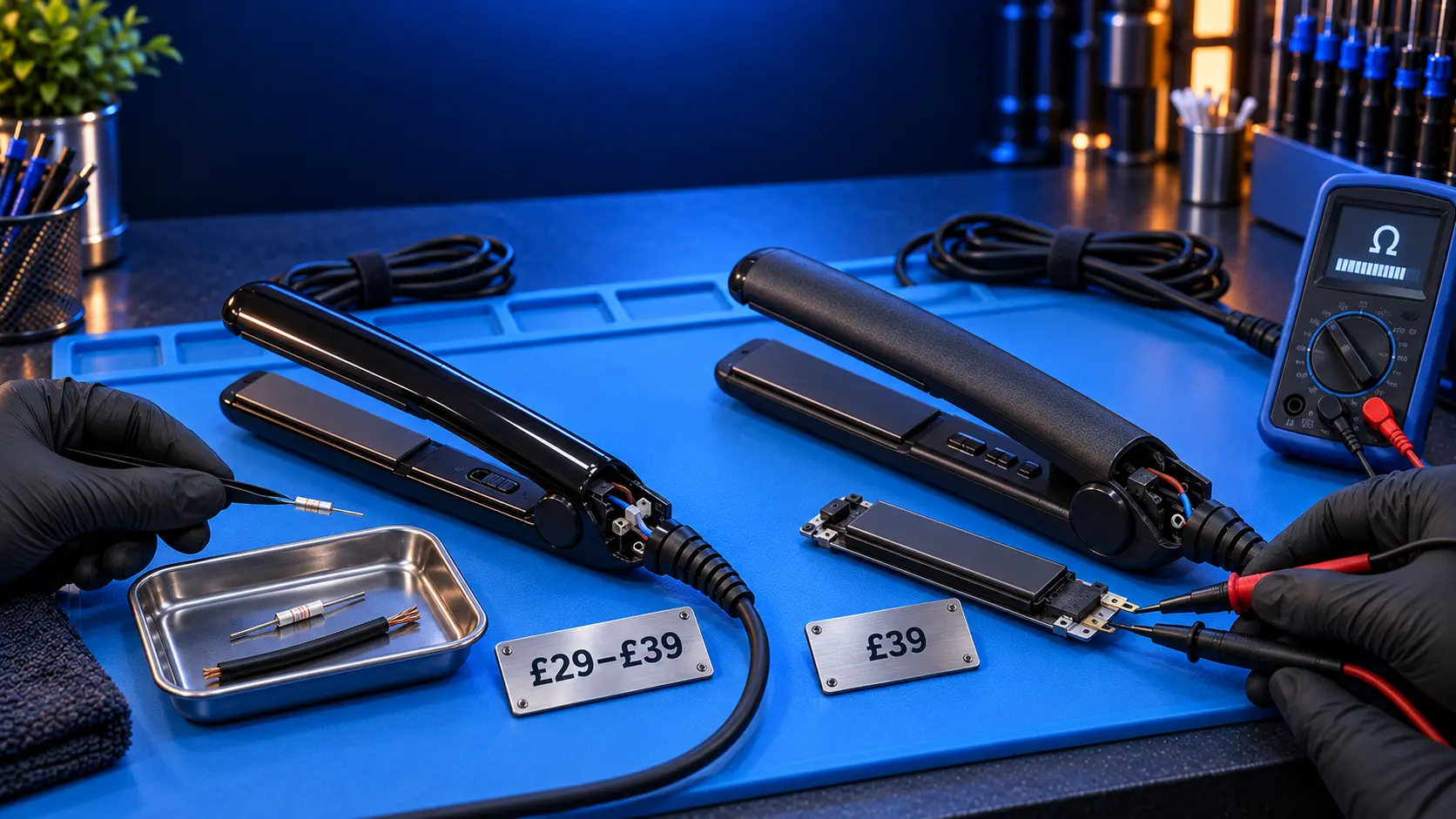
£39, all in, whether it's the cable circuit or the thermal side. Parts, labour, return postage, a PAT safety test and a twelve-month warranty on the work. No diagnosis fee, no second bill.
Intermittent faults are exactly why I charge a flat price. A fault that only appears when the iron is held a certain way, or ten minutes into use, takes longer to pin down than a dead one — you have to reproduce it before you can fix it, and then prove it's gone afterwards. Charging by what's wrong would mean charging more for the fiddlier job, which seems a strange way to reward someone for bringing me a harder problem.
That PAT test matters more on this fault than most. An intermittent mains connection is precisely the kind of thing a proper safety test is designed to catch, and nothing leaves here without passing one.
If I can't fix yours, there's no repair fee: I refund what you paid, less £4.99 return postage to send it back.
Common questions
It's only occasional. Can I just live with it?
You can, and plenty do. But it will get worse, and an intermittent mains connection is the one fault I'd genuinely rather you didn't sit on — particularly if anything feels warm.
It cuts out and comes straight back on. Is that the same thing?
Usually the cable circuit, yes — the connection breaks and remakes as the iron moves or settles.
Can you fix it if it won't do it on your bench?
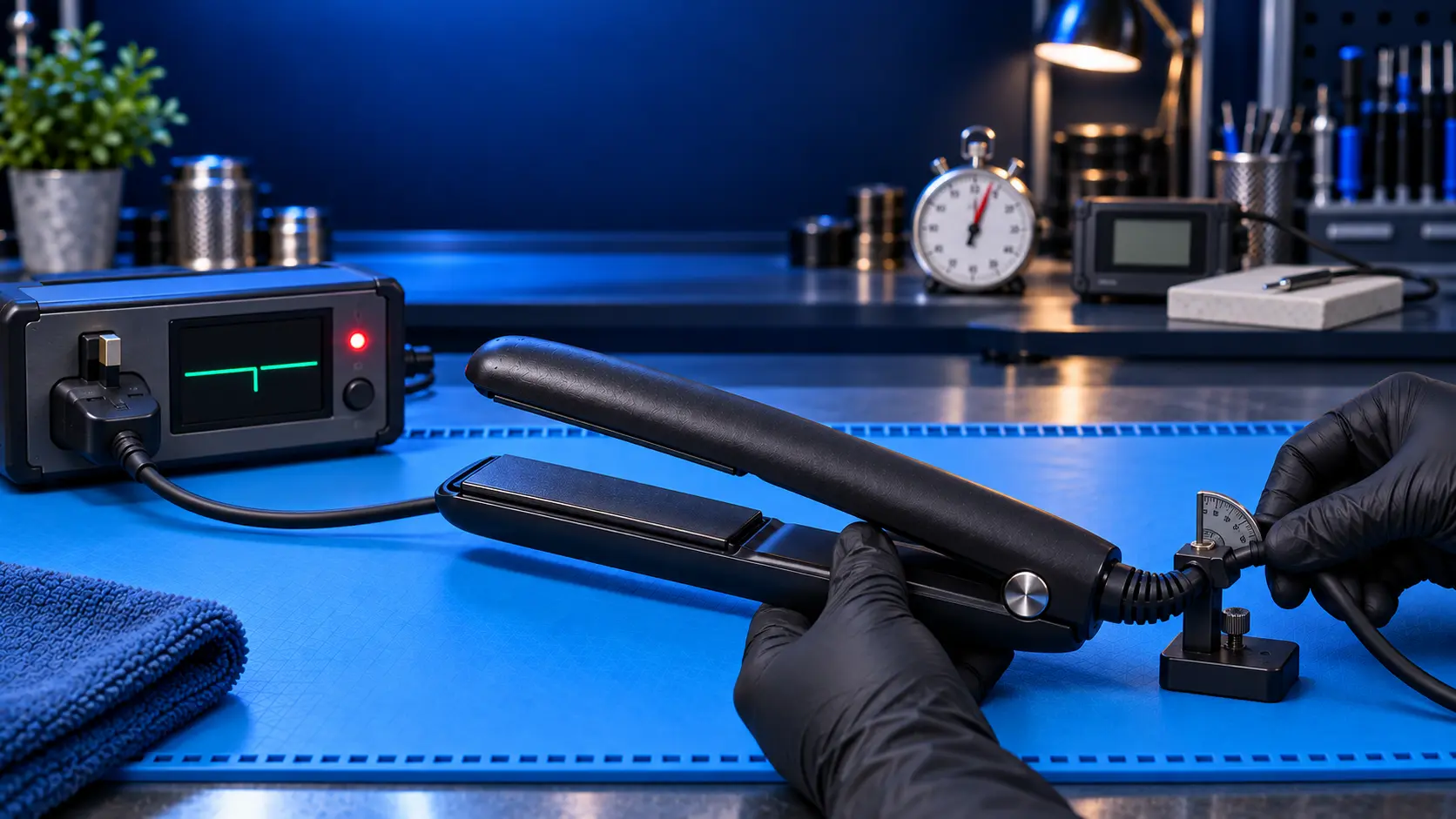
Yes. I test the cable circuit along its length rather than waiting for the fault to show itself, and I run repaired irons repeatedly from cold to catch anything intermittent before they go back. An intermittent fault that hides is a known part of the job, not an excuse.
My straightners only work if the cable is bent a certain way. Is that dangerous?
It's a fault that needs sorting rather than an emergency, but don't keep using it that way, and stop altogether if the plug or handle feels warm.
How long does a repair take?
The current turnaround is shown when you book. If a part needs ordering, I'll tell you as soon as I've diagnosed it and give you a realistic date.
Start by working out which group you're in, because it costs nothing and it tells you almost everything. Movement makes it cut out, or time does. Then try a different socket once, to rule out the socket rather than the iron. Two minutes, no tools, and you'll know what you're dealing with.
Then send it in and I'll put it right. £39 all in — parts, labour, return postage, a PAT safety test and a twelve-month warranty — with a full refund less £4.99 return postage if I can't fix it. Every repair is done by me personally, on my own bench, start to finish. Of all the faults these irons get, this is the one most worth not putting off: it never improves on its own, and it's the cheapest one to deal with while it's still only annoying.
The Repair Works is an independent UK repair service, run by me, Paul — 25 years of hands-on repair experience, working by post for customers across the whole country. Not affiliated with or endorsed by Cloud Nine.