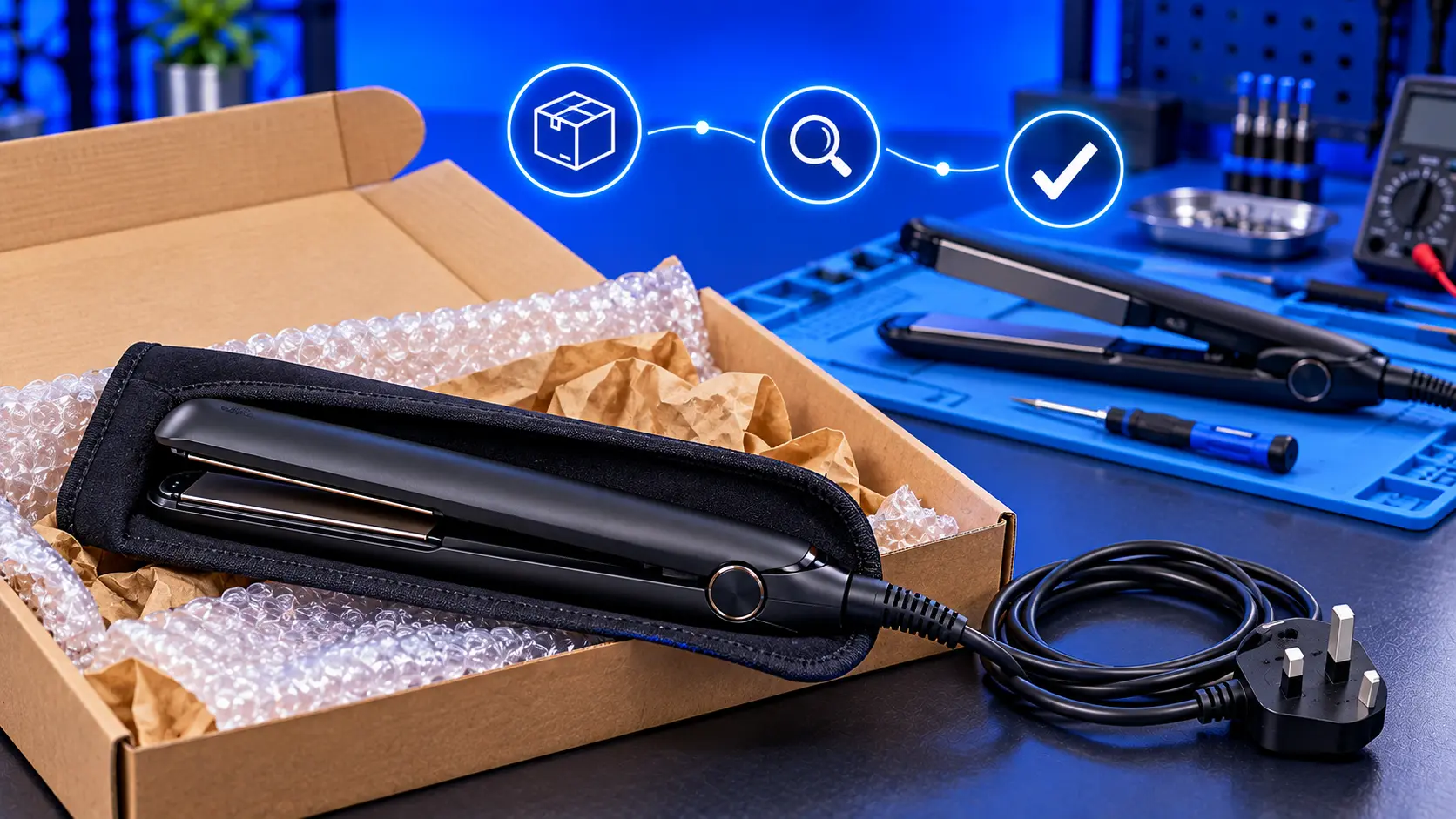
If you're trying to work out whether your GHDs can be repaired, what a repair will cost, or which spare parts they take, the first thing you need is your model. The trouble is that GHD has made a lot of very similar-looking straighteners over the years, and most people have no idea which one they own. The good news: it takes about ten seconds to find out once you know where to look.
I've been repairing electronics for over 25 years, so I can also tell you why the model matters — because it genuinely changes what's possible and what it costs.
Where to find your model number
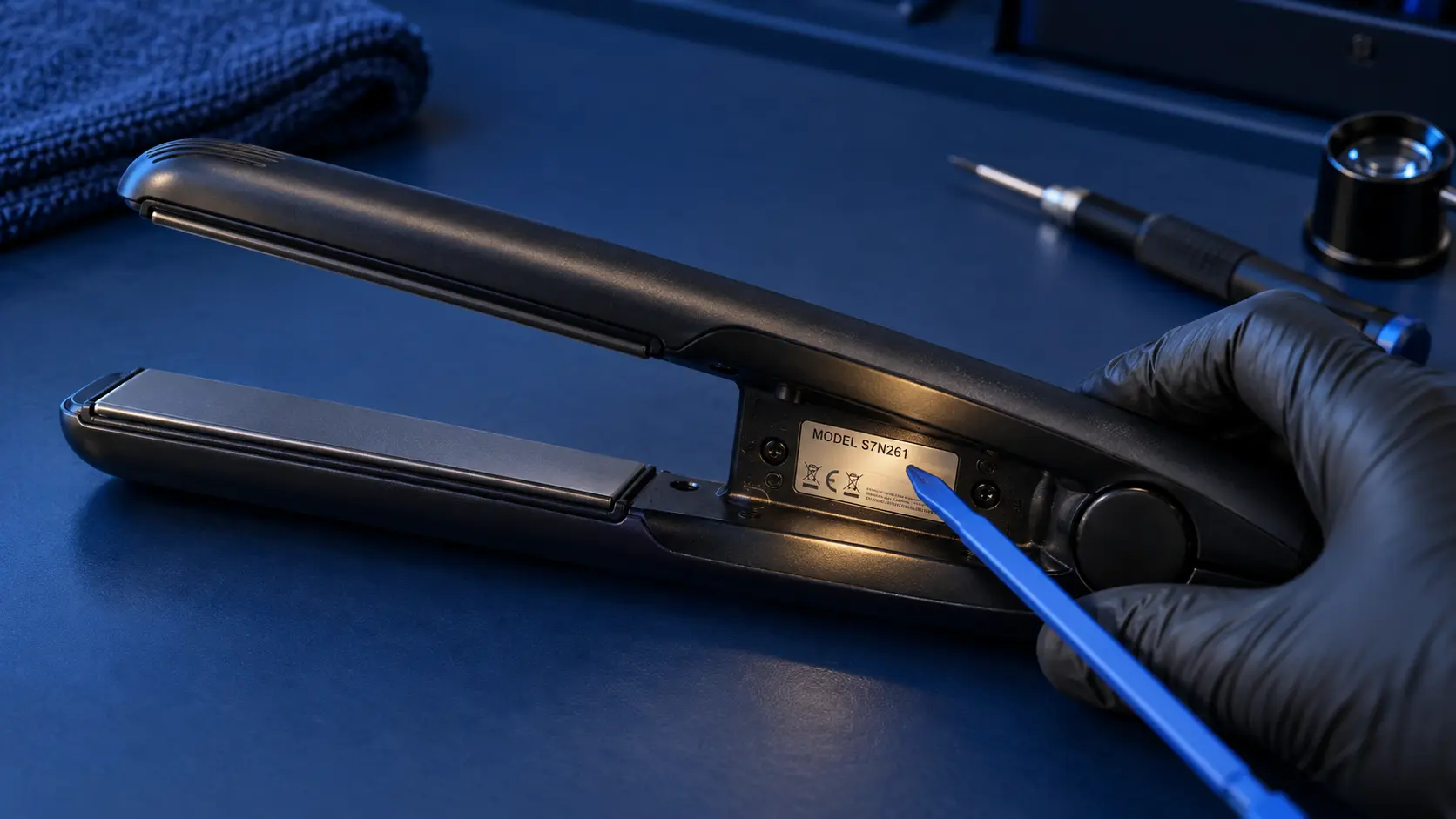
Your GHD model number is printed on a small label, and there are a couple of places to check:
On the straighteners themselves — look on the inside of the arm, near the hinge, or on the barrel. There's usually a small printed label or engraving with a model code on it.
On the plug or cable — some models carry the details on a label near the plug.
On the original box or receipt, if you still have them.
The code you're looking for is something like S7N261, S8T262, or a name like Mk4, Mk5, Gold, Max, Platinum+ or Eclipse. That's your model — and it tells you almost everything you need to know.
The quickest test of all: the on/off switch
Here's a shortcut that tells you the single most important thing in seconds — whether your straighteners can be repaired at all. Look at how they turn on and off:
A sliding on/off switch → an older model, such as the Mk4, Mk5 or 3.1b. These are repairable.
A round on/off button → a later model. Most are repairable, including the Gold, Max, Mini and Platinum+, but the Eclipse (Mk6) and the original Platinum (S8T261) are sealed, cable replacement only. The model number tells them apart.
So before you even find the printed code, that one look at the switch tells you whether you're in "yes, this can be fixed" territory or the small handful of models that can't. I've explained the unrepairable models in more detail here.
What the common models are
To help you place yours, here are the models you're most likely to have:
Mk4 and Mk5 (including SS wide-plate and MS mini versions) — the classic sliding-switch GHDs. Repairable, standard pricing.
Gold (S7N261), Max (S7N421) and Mini (S7N151) — the newer "gold-family" straighteners. Repairable, priced at the higher tier.
Platinum+ (S8T262) — repairable, higher tier. Note: this is not the same as the original Platinum (S8T261), though both have a round button.
Eclipse (Mk6) and Platinum (S8T261) — sealed units. Not repairable internally; cable replacement only.
3.1b — an older classic. Still repairable.
If your code doesn't exactly match one of these, don't worry — there are sub-versions (like the 4.2b or SC5 Contour), and the switch test above still tells you the most important thing.
Why the model matters so much
Knowing your model isn't just tidiness — it genuinely changes three things:
Whether it can be repaired at all. As above, the Eclipse (Mk6) and the original Platinum (S8T261) are sealed, cable replacement only. Every other mainstream model can be repaired.
What the repair costs. My repairs are a flat £29 all-in for standard models, and £39 all-in for the Gold, Max and Platinum+. Knowing your model means you get the right price up front, with no surprises.
Which parts and faults apply. Some faults are model-specific — for example, the R8/R11 resistor weakness I mentioned in my guide to GHDs that won't heat affects Mk4 and Mk5 models in particular. Knowing the model means the repair is done right first time.
Still not sure? I'll work it out for you
If you've looked and you still can't tell which model you've got, don't let that stop you. You can simply book a repair at the standard price, and I'll confirm the model and the exact price when it arrives, before doing any work.
Either way, there's no guesswork left on your side — a quick look at the switch and the label tells you almost everything, and I'll handle the rest.